

Audio By Carbonatix
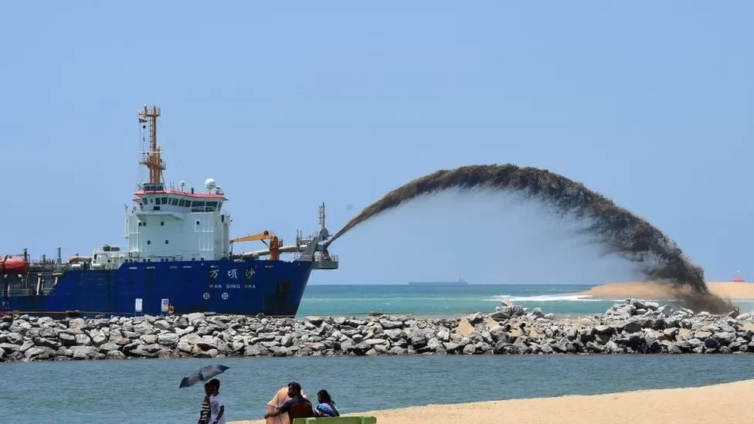
Around six billion tonnes of sand is dredged from the world's oceans every year, endangering marine life and coastal communities, the UN says.
Sand is the most exploited natural resource in the world after water and is used to produce concrete and glass.
The UN Environment Programme (UNEP) said some vessels were acting as vacuum cleaners, dredging both sand and micro-organisms that fish feed on.
This means that life may never recover in some areas.
The new data coincides with the launch of a new analysis tool called Marine Sand Watch that monitors dredging activities using marine tracking and artificial intelligence.
"The scale of environmental impacts of shallow sea mining activities and dredging is alarming," said Pascal Peduzzi, who heads UNEP's analytics centre GRID-Geneva.
The new platform estimates that out of some 50bn tonnes of sand and gravel used by humanity each year, an average of six billion tonnes come from the world's oceans and seas.
This is the equivalent of "more than one million dump trucks every day", Mr Peduzzi said.
The marine environment must be given time to recover, he said, adding that "it's not sustainable".
Large vessels were "basically sterilising the bottom of the sea by extracting sand and crunching all the microorganisms that are feeding fish", Mr Peduzzi said.
Sometimes the sand is dredged to the bedrock, meaning marine life may never recover, he added.
The UNEP recommended that sand dredging should also be banned from beaches to protect coastal resilience and economies.
Sand is essential for constructing buildings, roads, hydroelectric damns and solar panels. It can also play an important environmental role, protecting communities from rising sea levels.
The South China Sea, the North Sea and the US east coast are among the areas where the most dredging has occurred, the report states.
Latest Stories
-
He entered at eight. He is now 16: Ghana’s children growing up in prayer camps
2 hours -
‘Development must not always begin from Accra’ — Anwelle Foundation launched in Jirapa
2 hours -
PKO trio eye victories at Odwira Festival
5 hours -
346 Ghana Navy recruits pass out after 26 weeks of intensive training
5 hours -
Newsfile to discuss EOCO-MP arrest, drug trafficking, speech arrests and $235m water debt
5 hours -
JoyNews gets results as listeners raise GH¢40,000 to help 17-year-old student with cerebral palsy attend SHS
6 hours -
Vice President calls for stronger local pharmaceutical production to reduce medicine imports
6 hours -
The brewing tension at KNUST; Beware the Ides of October….
7 hours -
Health Ministry moves to integrate traditional medicine into mainstream healthcare
7 hours -
550 pupils in Kintampo South get educational lifeline as ‘Seeds of Hope’ reaches farming communities
7 hours -
Opoku Mensah urges Christian Council, House of Chiefs to speak up on democratic freedoms
8 hours -
Teacher unions’ strike: Minority demands immediate payment of teacher arrears, 20% deprived area allowance
8 hours -
The Accra-Kumasi Expressway: Building it right
8 hours -
Beyond gold exports: Building value and economic resilience from Ghana’s gold
8 hours -
2027 AFCONQ: Ghana under pressure as Gambia beat Somalia 2-1
8 hours