

Audio By Carbonatix
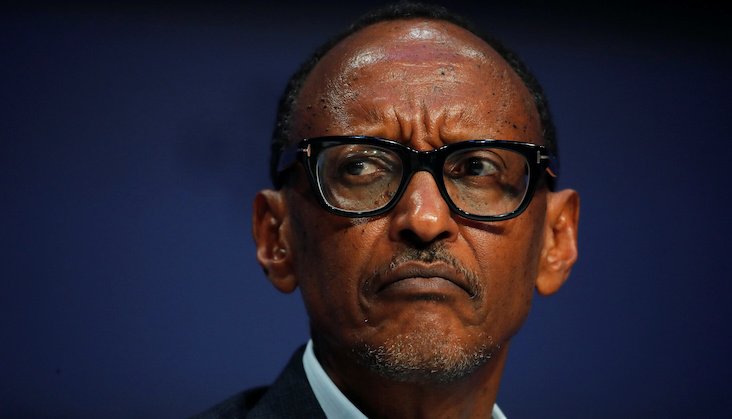
Rwanda's President Paul Kagame has confirmed that he will run for a fourth term next year, which could extend his presidency to nearly three decades.
"I am happy with the confidence that Rwandans have in me," President Kagame told French-language magazine Jeune Afrique on Tuesday.
He has faced criticism from rights groups, which have accused him of cracking down on the opposition.
But the president said he was not bothered by the opinion of outsiders.
Mr Kagame won the last presidential election in 2017 with nearly 99% of the vote. Rights group Human Rights Watch (HRW) said the vote took place in a context where free speech was very limited.
In the magazine interview, the president said that he was happy to carry on as long as Rwandans wanted him to stay and serve them.
He had previously hinted that he could run for re-election, but this is the first time that he has categorically stated he will be a candidate in next year's poll scheduled for August.
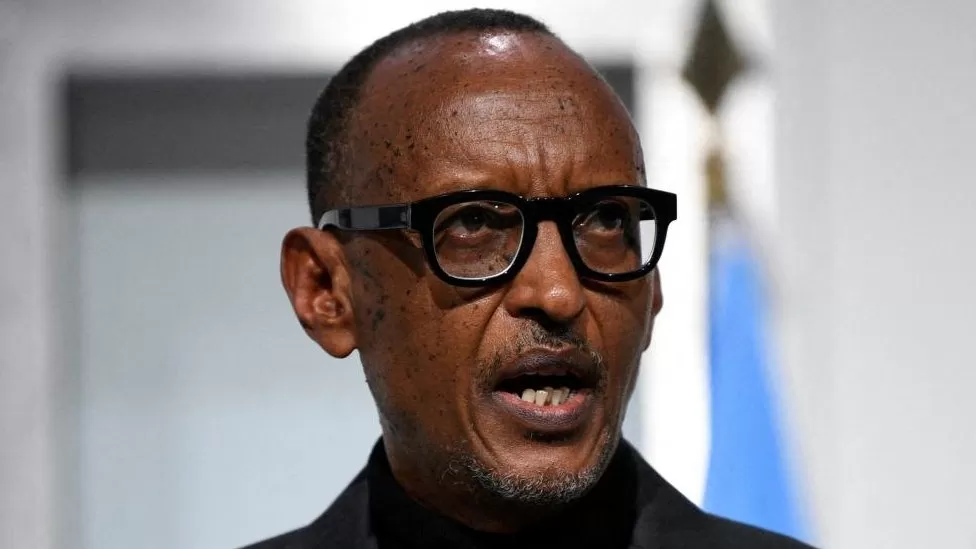
The 65-year old has been the dominant force in Rwanda since his then-rebel group, the Rwanda Patriotic Front (RPF), came to power at the end of the genocide.
But he only became president in 2000 following the resignation of Pasteur Bizimungu.
In 2003, Rwanda adopted a new constitution giving the president a seven-year tenure renewable once.
But this was amended in a controversial referendum in 2015.
The changes, which were approved with 98% of the vote, allowed the president to run for a third seven-year term and then serve two further five-year terms starting in 2024.
Asked about what the West would think about his decision to run again, Mr Kagame told Jeune Afrique that "what these countries think is not our problem".
"Personally, I no longer know what corresponds to Western values. What is democracy? The West dictating to others what they should do? But if they violate their own principles, how do we listen to them?" President Kagame said.
"Seeking to transplant democracy to someone else is already a violation of democracy in itself. People are supposed to be independent and should be allowed to organise themselves as they wish," he added.
Last year, HRW's Central Africa director, Lewis Mudge, told the BBC that "Rwanda is a country where it's very dangerous to oppose the government, let alone to be a political opponent".
Several prominent opposition figures have been attacked, and some killed, while in exile.
President Kagame has in the past fiercely defended Rwanda's record on human rights, saying his country respects political freedoms.
Latest Stories
-
Promotion pay row: Gov’t gives teachers September to complete salary adjustments
5 minutes -
Financial irregularities plummet by 62.9% as state tightens fiscal controls
5 minutes -
DVLA to expand mobile services to underserved communities in Ghana’s Eastern Corridor of the Northern Region
21 minutes -
GUTA urges GPHA to act swiftly to end Tema Port congestion to avert rising business costs
21 minutes -
Port congestion could undermine 24-hour economy policy – GUTA
22 minutes -
NSA opens three-day window to resolve national service biodata mismatches
32 minutes -
Abu Jinapor highlights increased gold exports after Domestic Gold Purchase Programme
36 minutes -
NPP UK branch calls for independent audit into gold purchasing operations and parliamentary probe
1 hour -
Zanetor Agyeman-Rawlings pledges decisive action on climate change, galamsey and environmental degradation
1 hour -
Bawumia was brainchild behind Domestic Gold Purchase Programme – Samuel Jinapor
1 hour -
Fuel prices set to go up from September 1, Petrol to sell at GHC 16.69 and Diesel, GHC 17.90 – COMAC
1 hour -
Our World Our People withdrawn due to curriculum duplication, not politics – Adutwum’s spokesperson
1 hour -
GANRAP is essentially a rebranding of Domestic Gold Purchase Programme – Abu Jinapor
1 hour -
I am tired of being in opposition, my goal is to win in 2028 – Boakye Agyarko
2 hours -
Ghana’s road maintenance funding gap deepens as only 37% of needs met – World Bank
2 hours