

Audio By Carbonatix
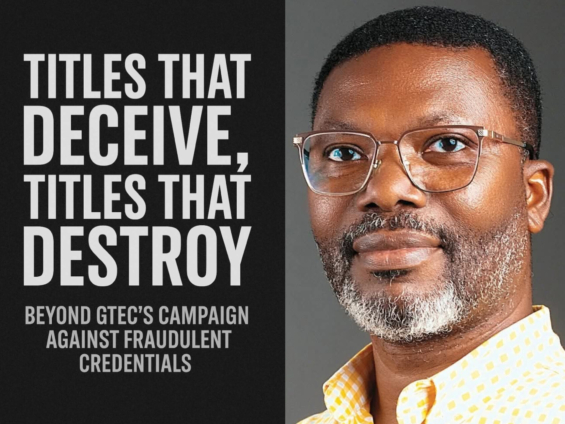
Over the past few years, the Ghana Tertiary Education Commission (GTEC) has embarked on an aggressive campaign to expose and sanction individuals holding fake academic credentials.
This intervention has been widely applauded within the academia.
For scholars who have endured years of rigorous study and research to earn titles such as Doctor or Professor, GTEC’s vigilance affirms the sanctity of hard-won academic achievement.
Such actions are essential for preserving the credibility of Ghana’s tertiary education system in an era where academic titles risk being cheapened by fraudulent appropriation.
Yet, the significance of fake titles varies across social domains.
In academia, a fraudulent professorship or doctorate undermines scholarly integrity.
However, outside academic institutions, the practical utility of such titles is limited.
Indeed, recent cases of individuals presenting counterfeit PhDs or professorial ranks have collapsed swiftly under scrutiny, with titles stripped after simple verification checks.
Intriguingly, many of these individuals have retained their jobs or public roles even after their exposure.
The reason is straightforward: outside the academia, academic titles are rarely the basis for legitimacy.
In politics, religious ministry, and entrepreneurial ventures, charisma, resources, or networks often matter more than degrees.
For this reason, the public spectacle of GTEC’s corrective actions, though symbolically important, does not necessarily translate into functional disruption for those exposed.
There is, however, a category of titles whose misuse extends beyond symbolic harm, carrying implications that can escalate into matters of life and death.
This is the medical doctorate.
Unlike academic titles, whose falsification primarily undermines institutional credibility, fraudulent medical credentials directly threaten public health.
The widespread appropriation of the title “Doctor” by unlicensed practitioners, including herbalists, traditional healers, spiritualists, and chemical drug sellers, represents an urgent national challenge.
These individuals do not merely adopt the title casually.
They systematically deploy it across media platforms, in advertisements, and in personal branding to bolster their perceived authority.
The harm is twofold.
First, these false claims deceive vulnerable populations who lack the means to distinguish between accredited medical doctors and impostors.
In Ghana, where health literacy remains uneven and access to quality healthcare is often limited, many citizens turn to informal practitioners as their first point of care.
When such practitioners illegitimately assume medical authority, the results are tragic: misdiagnosis, exacerbation of otherwise manageable conditions, transmission of preventable diseases, and tragically avoidable deaths.
Second, the proliferation of fake medical doctors corrodes public trust in legitimate healthcare providers.
When impostors masquerade as professionals, the credibility of the entire medical system suffers, further deepening reliance on unregulated and unsafe alternatives.
This situation raises a critical regulatory dilemma.
Who is responsible for authenticating and policing the use of medical titles?
While GTEC’s mandate covers tertiary academic institutions, the scope of its interventions is less clear in relation to professional practice outside academia.
The Ghana Medical Association (GMA) and allied health regulatory bodies may seem more appropriate actors, yet evidence suggests that enforcement remains fragmented.
Unlike academic impostors, who can be publicly unmasked through simple checks, fake medical doctors often operate unchecked, particularly in media spaces where they wield enormous influence over audiences.
The danger is compounded by the cultural context in which these figures operate.
Traditional and alternative healing practices command deep trust among large segments of the Ghanaian population.
While many of these practices are valuable, the conflation of cultural healing with counterfeit medical authority creates fertile ground for deception.
This is not simply a matter of academic fraud but of public safety, ethics, and social justice.
Consequently, while GTEC’s current crusade against fake academic titles is laudable, it risks addressing only the surface of a much deeper problem.
Academic impostors may tarnish institutional reputations, but fake medical doctors imperil lives.
Regulatory action should therefore be broadened and coordinated.
The GMA, Ministry of Health, Food and Drugs Authority, and GTEC must work together to establish clear frameworks for verifying, monitoring, and sanctioning the use of medical titles across both physical and digital platforms.
Without such collaboration, enforcement will remain piecemeal and largely ineffective.
So, Ghana’s fight against fraudulent credentials must be understood in two dimensions: the symbolic and the substantive.
Fake professorial and doctoral titles threaten academic integrity and deserve sanction.
Yet fake medical titles pose a far greater danger, undermining both the health system and the safety of citizens.
To focus exclusively on the academic sphere is to neglect the urgent need to protect vulnerable populations from impostors who exploit trust for profit.
The whip must indeed be cracked, but with equal, if not greatest force against those whose fraudulent claims endanger human lives.

Latest Stories
-
GCB extends Customer Service Week into month-long customer engagement
46 seconds -
Africa risks widening inequality if it fails to build AI expertise – Kweku Awotwi
2 minutes -
Women’s Voices Matter Movement petitions Gender Ministry over women’s rights and development
2 minutes -
Huel ad banned for suggesting its products could replace all meals
14 minutes -
Global InfoAnalytics poll puts John Boadu, Justin Kodua and Titus Glover ahead in NPP executive race
2 hours -
Ghana to establish skills development university with $50m from German support package
2 hours -
Baffour Awuah under EOCO investigation over alleged financial loss and money laundering – Deputy AG
2 hours -
How healthy is Ghana’s health sector?
2 hours -
HACSA Tech4Girls graduates 80 young women with digital and technology skills
2 hours -
Arrest of Manhyia South MP should involve Parliament, not police station – Kpebu
3 hours -
Two Nigerians sentenced to 189 months in US prison over $2.4m cyber fraud
3 hours -
Cristiano Ronaldo leaves Portugal’s training camp after rift with Head Coach
3 hours -
Ghana Energy Awards opens nominations for landmark 10th anniversary edition
3 hours -
Aayalolo contra-flow: Are we treating the symptom instead of the disease?
3 hours -
GTEC orders Colleges of Education to begin 2026/2027 admissions despite fees approval delay
3 hours