

Audio By Carbonatix
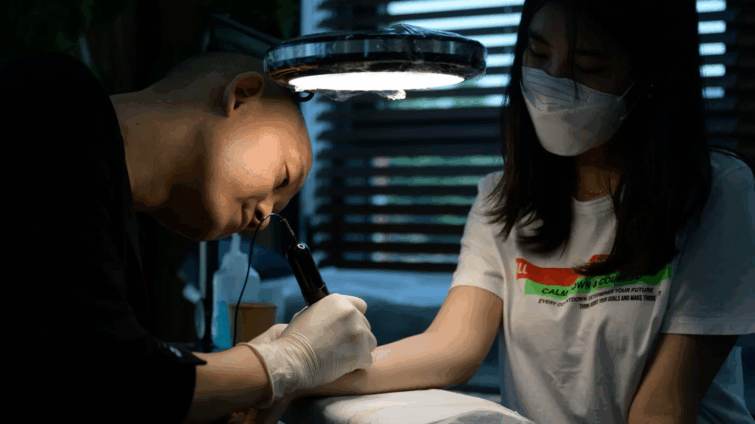
South Korea has legalised tattoo artistry by non-medical professionals for the first time in more than 30 years, following a campaign by members of the profession to work without fear of prosecution or harassment.
Though tattoos are commonplace in the East Asian nation, offering them has been limited to medical professionals following a 1992 Supreme Court ruling.
But, after the passing of the Tattooist Act by the General Assembly on Thursday, non-medical professionals - who compose most of the industry - will be able to obtain a licence.
Lim Bo-ran, president of the Korea Tattoo Federation, cried at the law's passing, saying, "I can't speak because it feels like a dream. I am truly grateful."
Between 1992 and now, anyone offering tattoos without medical credentials faced up to five years in prison or a fine of up to 50 million Korean won ($35,000; £28,000).
There are no official statistics on how many tattooists have been prosecuted, but South Korea's Tattoo Union says it gives legal support to at least 50 each year, and believes there are many more that result in fines.
As of 2021, there were an estimated 350,000 tattoo artists in the country, according to the Ministry of Health and Welfare - most of whom specialised in semi-permanent make-up for lips, eyebrows or hairlines.
But relatively few of these have medical qualifications. Instead, most come from art or beauty backgrounds like elsewhere in the world.
By technically engaging in an illegal practice, tattoo artists in South Korea have been subjected to threats or reported by disgruntled clients.
A female tattoo artist who goes by the pseudonym Narr previously told the BBC that she had been sexually harassed by a man after tattooing him, but did not report the incident to the authorities for fear of being prosecuted.
Another, who goes by Banul, was reported to the police by a client who wanted five million Korean won ($3,500; £2,800) after claiming without evidence that it had smudged.
But in recent years, South Korean courts have acquitted several tattoo artists, signalling a shift in attitudes.
Park Ju-min, chairman of the National Assembly's health and welfare committee and the law's main legislative proponent, noted that many politicians in the house had eyebrow or lip tattoos.
He said the passing of the law will allow "citizens to get tattoos safely, and those engaged in the tattoo industry will be recognised as legal professionals".
However, the change of law has faced opposition from South Korea's medical community.
Ahead of its passing, the Korean Medical Association said tattooing "not only damages the skin but can also pose other health risks, including interference with cancer diagnosis".
It stated that "tattooing is fundamentally a medical procedure, and its growing popularity does not reduce the associated risks".
There are also some in the industry who feel that, despite their popularity among young people and growing prominence in influencer culture, the change of law will not reverse the stigma towards tattoos. Recent opinion polls suggest a majority of South Koreans still view them negatively.
Though the tattooing prohibition will no longer be a permanent feature of South Korean society, removing it completely may be a slow and painful process.
The new law will only take effect in two years, with tattoo artists having to pass a national exam, complete safety and hygiene training, and keep detailed records.
Tattoo removals, done using a laser, will still be limited to medical professionals.
Latest Stories
-
Government plans mandatory drug tests for public service jobs — Muntaka
5 minutes -
Media urged to intensify awareness campaigns on breast cancer
10 minutes -
Interior Minister urges public to share drug intelligence
16 minutes -
Afadzato South DCE commissions water projects, teachers’ bungalow
21 minutes -
Council of State urges sustained dialogue, negotiations as teachers resume work
26 minutes -
We are committed to leaving a legacy in Mandari – Bole-Bamboi MP
29 minutes -
Greater Accra teachers resume work after strike suspension
37 minutes -
Education Minister assures teachers of salary adjustments by October 16
43 minutes -
Abass Osabutey declares bid for NDC Deputy National Organiser position
44 minutes -
Education Minister inaugurates NDU Governing Council, announces $25m seed funding
53 minutes -
THE LAW 101: La Beach Demolitions – The State’s own documents, the courts’ orders – and the bulldozers
56 minutes -
DVLA contributes GH¢17.7m to Consolidated Fund in 2025
59 minutes -
Why disaster risk reduction must connect early warnings, preparedness and financial protection to household-level resilience
1 hour -
Fentuo Tahiru narrates how 2018 Commonwealth Games visa scandal became an international embarrassment
1 hour -
The AI Gold Rush: Who strikes gold and who gets left behind?
1 hour