

Audio By Carbonatix
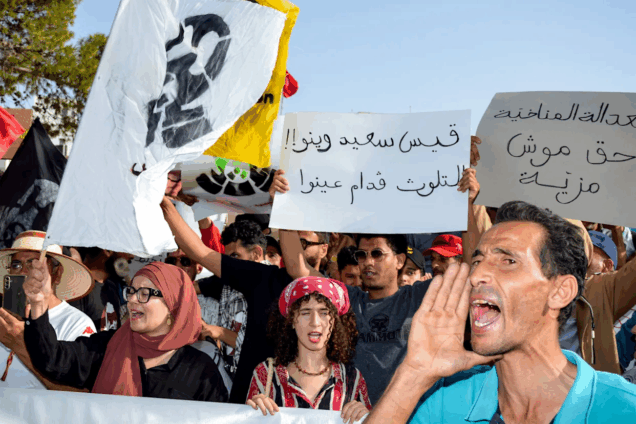
Thousands took to the streets of the Tunisian coastal city of Gabes in a huge march on Wednesday, in an escalation of protests that began last week over pollution from the state Chemical Group’s (CGT) phosphate complex.
The large-scale protests heighten pressure on President Kais Saied's government, which fears the unrest may spread to other regions of the country.
The government, already pressured by a deep financial crisis, needs to balance public health demands with the production of phosphate, Tunisia's most valuable natural resource.
The protesters chanted slogans such as "we want to live" and “Gabes is crying out for help”.
The protesters marched towards Chatt Essalam, a coastal suburb to the north of the city, where the chemical group is located. There, witnesses said that police fired tear gas to disperse them as they approached the headquarters.
In the capital, Tunis, crowds also gathered in support of Gabes, highlighting growing national concern over the environmental crisis and the call for urgent government action.
Residents of Gabes say they are suffering from increased respiratory illnesses, osteoporosis and an increased incidence of cancer due to the toxic gases emitted by the factory's units.
The latest wave of protests was triggered earlier this month after dozens of schoolchildren suffered breathing difficulties caused by toxic fumes from a plant that converts phosphates into phosphoric acid and fertilizers.
CGT did not reply to Reuters' attempts to seek comment on the situation in Gabes.
Khaireddine Diba, one of the protesters, said: “Today, our voice will be loud and resounding until this crime stops immediately."
Saied said this month that Gabes was suffering an "environmental assassination" due to what he called criminal policy choices by a previous government.
He called on ministries to maintain the units to stop leaks as a first step.
However, the protesters reject temporary solutions and demand the permanent closure and relocation of the units.
Tons of industrial waste are discharged into the sea at Chatt Essalam daily.
Environmental groups warn that marine life has been severely affected, with local fishermen reporting a dramatic decline in fish stocks over the past decade, hitting a vital source of income for many in the region.
Latest Stories
-
PKO trio eye victories at Odwira Festival
2 hours -
346 Ghana Navy recruits pass out after 26 weeks of intensive training
2 hours -
Newsfile to discuss EOCO-MP arrest, drug trafficking, speech arrests and $235m water debt
3 hours -
JoyNews gets results as listeners raise GH¢40,000 to help 17-year-old student with cerebral palsy attend SHS
3 hours -
Vice President calls for stronger local pharmaceutical production to reduce medicine imports
3 hours -
The brewing tension at KNUST; Beware the Ides of October….
4 hours -
Health Ministry moves to integrate traditional medicine into mainstream healthcare
4 hours -
550 pupils in Kintampo South get educational lifeline as ‘Seeds of Hope’ reaches farming communities
5 hours -
Opoku Mensah urges Christian Council, House of Chiefs to speak up on democratic freedoms
5 hours -
Teacher unions’ strike: Minority demands immediate payment of teacher arrears, 20% deprived area allowance
5 hours -
The Accra-Kumasi Expressway: Building it right
5 hours -
Beyond gold exports: Building value and economic resilience from Ghana’s gold
5 hours -
2027 AFCONQ: Ghana under pressure as Gambia beat Somalia 2-1
5 hours -
Eastern NPP Women’s Organiser calls on AG, Police to secure bail for Salomey Baffoe
5 hours -
Poverty, illiteracy driving acceptance of vote-buying among women – Damongo Queen Mother
6 hours