

Audio By Carbonatix
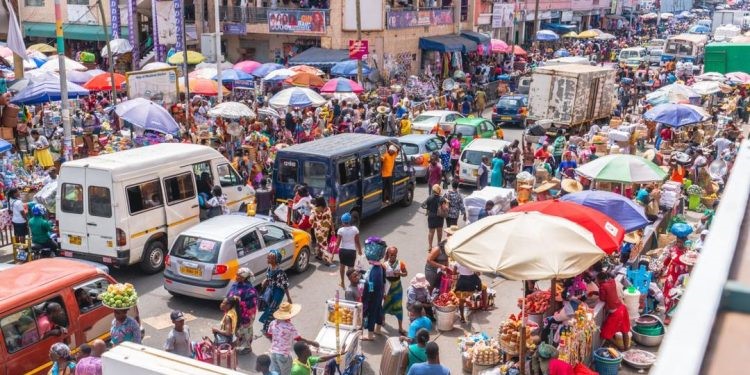
The Ghana Statistical Service (GSS) has underscored the immense value of informal cross-border trade (ICBT) to Ghana’s economic development, describing it as a crucial engine for growth, regional integration, and livelihood support.
According to the GSS, data gathered from the recently launched ICBT survey is invaluable for capturing the full scope of cross-border economic activities, allowing policymakers to design more equitable and evidence-based economic strategies.
In the data, the total value of informal trade in the fourth quarter of 2024 is estimated at GH₵ 7.4 billion.
The survey also reveled that, Ghana posted notable trade surpluses with Burkina Faso (GH¢576 million) and Côte d’Ivoire (GH¢378 million) in the Fourth Quarter of 2024, to underscore the strength of informal trade links with its northern and western neighbours.
Read also: Ghana records trade surplus with Burkina Faso and Côte d’Ivoire – GSS
GSS noted that informal trade is not merely a marginal activity but a vital component of Ghana’s economic fabric, especially in border and rural communities where formal trade channels remain limited.
The GSS outlined several key benefits that Ghana stands to derive from the effective utilisation of ICBT data:
- Improved trade statistics: The data enhances the accuracy of Ghana’s external trade records, allowing for more reliable economic planning and policy formulation.
- Better Balance of Payments data: With more precise estimates of informal exports and imports, Ghana can achieve a truer reflection of its trade balance and overall economic performance.
- Enhanced food security: Informal trade helps maintain a steady and affordable food supply, particularly in areas where formal trade networks are weak or disrupted.
- Stronger income generation policies: ICBT supports thousands of traders, farmers, and transporters in border communities, offering a foundation for targeted income and employment policies.
- Promotion of regional integration: By understanding the dynamics of informal trade, Ghana can better align its policies with the African Continental Free Trade Area (AfCFTA), identifying and addressing the practical barriers to trade while ensuring that informal traders are included in regional economic integration.
The GSS emphasised that recognising and integrating informal trade into Ghana’s policy framework would lead to more inclusive economic planning, fairer distribution of resources, and stronger collaboration across borders.
By leveraging ICBT data, the Service stated, Ghana can ensure that no segment of its trading population is overlooked, turning informal trade into a strategic pillar for sustainable growth, social stability, and continental partnership.
Latest Stories
-
Communications Minister announces 2,800-site telecom expansion during Volta visit
15 seconds -
Impunity fuelling sexual abuse in Ghana – ARK Foundation boss
1 minute -
Kojo Asante calls for task force to review protocols for dealing with sexual abuse in schools
2 minutes -
NUGS condemns alleged sexual abuse by Obuasi SHTS headmaster, calls for prosecution
5 minutes -
President Mahama urges investors to employ trained local residents as 1,238-acre industrial park takes off
8 minutes -
Media doing its job, but politicians fuelling insults on social media – NMAG president
10 minutes -
Child protection must be the state’s responsibility, not NGOs’ burden – ARK Foundation Boss
16 minutes -
CODEO calls for Emelia Agbenyo’s resignation over partisan ties
18 minutes -
Stop Obuasi SHTS head from contesting Juaben chairmanship amid sexual abuse allegations – Kojo Asante to NDC
23 minutes -
Obuasi SHTS scandal: Kojo Asante calls for taskforce to review protocols for handling sexual abuse in schools
25 minutes -
Richard Owusu of Debibi United named NASCO September player of the month
27 minutes -
Day 1: Republic Bank–JoyNews Habitat Fair underway in Ho as firms showcase housing solutions
28 minutes -
Children aged 5, 8 and 11 killed in US school shooting before suspect shot by bystander
29 minutes -
FC Samartex coach Nana Agyemang scoops NASCO coach of the month award for September
29 minutes -
Ghana Association of University Administrators suspends nationwide strike
39 minutes