

Audio By Carbonatix
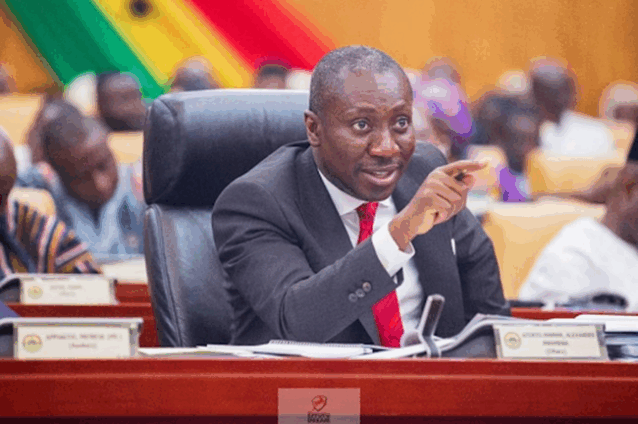
Minority Leader Alexander Afenyo-Markin says he draws deep inspiration from the example of former Speaker Alban Bagbin as he leads a weakened Minority in the current Parliament.
Speaking on JoyNews’ PM Express on October 27, the Effutu MP dismissed suggestions that the minority’s reduced numbers leave him overwhelmed.
“Not at all. I’m not in any way worried about the numbers. Like I indicated in my opening remarks in Parliament, it’s about substance,” he said.
He insisted that while the Majority may hold numerical strength, real democratic progress depends on the depth of argument and conviction.
“Before the final destination, you need to demonstrate your weight. For me, that is what enriches democracy,” he stated.
Afenyo-Markin said the NPP’s situation mirrors what the NDC once faced when it lost power in 2001.
“The state we find ourselves as a party, though novel in a sense in terms of the numbers, has happened before to the NDC. I draw a lot of inspiration from the Bagbin era and NDC opposition,” he said.
Recalling that period, he noted how Bagbin was brought “from obscurity” to lead a demoralised Minority.
“Kufuor enjoyed huge goodwill. In 2001, nobody wanted to hear NDC. In fact, it was difficult for them to even appear on radio programmes. But they put themselves together in the midst of confusion,” Afenyo-Markin said.
He praised the NDC’s turnaround between 2001 and 2008 as a model for resilience.
“By 2004, they had managed to snatch some of the very seats we are taking from them, like Ashaiman, La Dadekotopon and many others. They had momentum on their side because of the hard work, the determination of the Bagbin-led minority,” he explained.
According to him, that determination eventually brought the NDC back to power.
“By 2008, they surprised the nation. NPP perhaps thought all was well; we were going to have a walk in the park. Then Professor Mills, who had been written off, made a strong showing, pushed the election into round two, and then by round three, we were down,” he recounted.
For Afenyo-Markin, the lesson is clear: political strength is not static.
“It tells me a story. I’ve been reading the Hansard, watching videos, and learning how they strategised. They were collective. They were determined. And as a politician, you should not be shy of your weakness,” he said.
Reflecting on the NPP’s current struggles, he admitted that the government faced serious challenges.
“We had an opportunity. We were faced with some huge challenges. We tried, but we were not too successful. Typical example, galamsey. It was a great concern,” he said.
He pointed to global and domestic crises that hurt the party politically.
“The global crisis hit us with COVID, and then eventually we had to stabilise the economy. And in stabilising the economy, certain hard decisions had to be taken. We lost the middle class, our own base, the businessmen, because there were some haircuts,” Afenyo-Markin admitted.
He said these economic shocks alienated some of the NPP’s most loyal supporters.
“Pensioners, educated people who ordinarily will vote NPP, got disappointed to the extent that a former Chief Justice who was appointed by our own administration, who ordinarily would have her love for our party, was on the streets fighting for her pension. It’s understandable,” he said.
Still, he insists the NPP’s record remains strong in many areas.
“All these things more or less took away the shine of the Free SHS we had introduced, which had benefited many Ghanaian families. Ours is to create a platform to build the human resource capacity of the Ghanaian people. We did that successfully,” he said.
He added that the government’s industrialisation policies also left a lasting impact.
“We brought in the 1D1F, a major boost for the private sector. That 1D1F attracted a lot of companies who felt that if in Ghana you can set up your industry, have tax-free on your raw material and machinery, then they found Ghana as a great destination for business,” he said.
However, he conceded that the inability to meet public expectations cost the NPP dearly. “Eventually, all these gains, because of our inability to meet the higher expectations of the Ghanaian people, we lost out,” he concluded.
Latest Stories
-
John Boadu pledges unity, reconciliation as he takes over as NPP National Chairman
38 seconds -
‘Whatever the personal cost, I will not abandon my duty’ – Baffour Awuah assures Salomey Bafoh
2 minutes -
Government to increase funding for Houses of Chiefs to speed up dispute resolution
4 minutes -
Govt’ to introduce digital property rate system to boost MMDAs’ revenue – Mahama Ayariga
6 minutes -
Traditional Medicine Practice Council closes three unlicensed spa and massage centres in Ashanti Region
8 minutes -
Let’s accept the reality and move along – Mike Oquaye on NPP’s decision to make flagbearer party leader
10 minutes -
Early presidential primary helped cool tensions in NPP – Prof. Mike Oquaye
28 minutes -
NDC congratulates new NPP executives, urges national interest above party interests
31 minutes -
NPP implementing 2024 election review recommendations in stages – Prof Mike Oquaye
32 minutes -
Ghana Rugby Union announces managerial changes
32 minutes -
US removes all bombers from RAF Fairford base
33 minutes -
France closes up to 500 schools Monday over student protests
34 minutes -
Girl, 12, fatally shot in US during ‘dispute over parking space’
34 minutes -
NPP is a party for all classes – Prof. Mike Oquaye
35 minutes -
Chief Justice urges Judiciary to strengthen foundations of justice
35 minutes