

Audio By Carbonatix
The Ghana Chamber of Mines has welcomed the government’s decision to implement a sliding scale royalty regime in Ghana’s mining sector, but called for further discussions on the specific percentages and other key elements of the regime.
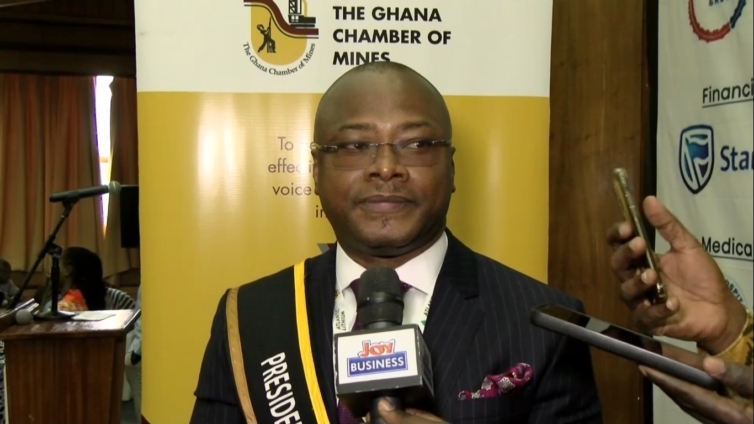
Speaking to journalists at the Africa Extractives Media Fellowship, Michael Edem Akafia, President of the Chamber of Mines, said that while the Chamber supports the introduction of a sliding scale regime, it has reservations about the proposed percentages and the underlying premise for the new regime.
He stated that the Chamber holds a divergent view on the percentages, noting that a rise in global gold market prices does not automatically translate into profit for mining companies.
He said the Chamber is proposing a base rate of 4% and a top-end rate of 8%.
He explained that this proposal was developed following detailed research into other mining jurisdictions, and the Chamber believes its recommendation fairly reflects trends across the continent.
“We are not against a sliding scale, but we believe the range should be between 4% and 8%. In the paper we presented to the Minister, we compared mature mining jurisdictions. In Africa, the only outlier is Mali, which recently introduced 10.5% at the higher end of its scale under a military regime—so we know they don’t listen to industry concerns.
“In virtually every jurisdiction you examine, especially for gold, no country reaches 12%. We therefore believe 4–8% is the most reasonable range. Another proposal we made was the dedication of one percent of profits to community development,” he said.
Michael Edem Akafia also dispelled the widely held perception that a rise in gold prices automatically translates into profit for mining companies.
He explained that while higher prices do enhance revenue generation for mining firms, this does not necessarily translate into profit due to a number of factors.
He noted that during periods of increased revenue, companies often channel funds into other operations to improve efficiency.
He stated that the additional revenue is typically directed toward activities such as in-pit exploration, the purchase of new equipment, the adoption of advanced technology, and other initiatives to ensure the sustainability of the company.
He therefore called for nuanced, non-sentimental discussions around the royalty regime to ensure that companies can fulfill their regulatory obligations without operating at a loss.
Latest Stories
-
Africa World Airlines unveils first Embraer E190 as part of 10-aircraft fleet expansion
44 minutes -
Civilian hospitalised after alleged machete attack by prison officers, inmates
1 hour -
Toobu rejects calls to recall Parliament over 3.9-tonne cocaine shipment
2 hours -
Residents in 5 Northern Regions warned of approaching rainstorm
2 hours -
Constituency Games still a work in progress – Sports Minister
2 hours -
Team Ghana set for historic Karting Africa Showrun in Angola
2 hours -
52-year-old South African arrested with suspected heroin after arriving from Accra
2 hours -
Shatta Wale challenges UPSA students to build entrepreneurial mindsets
3 hours -
Finance Minister advises African governments to strengthen regional tax cooperation
4 hours -
NPP accuses NDC of master-minding demolition of Ho regional office fence
4 hours -
Ghana plans stronger regional power trade with Nigeria
4 hours -
GRA Commissioner-General calls for stronger tax cooperation to boost regional revenue mobilisation
4 hours -
NACOC needs more personnel to tackle drug trafficking – Toobu
4 hours -
Railway workers resist KMA eviction order, demand consultation
5 hours -
Legacy Leadership Africa Institute to host boardroom women’s leadership programme
5 hours