

Audio By Carbonatix
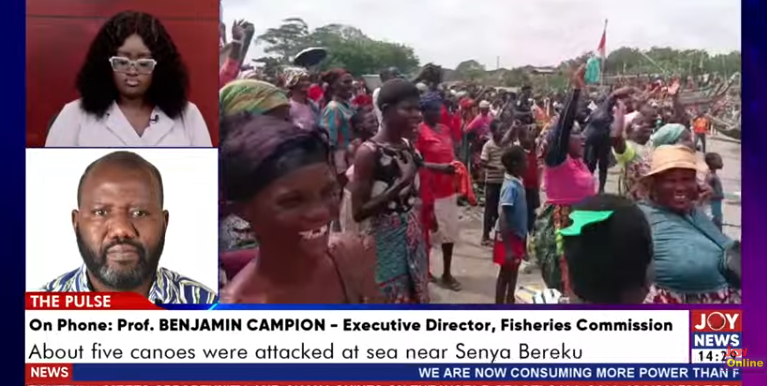
Executive Director of the Fisheries Commission, Prof. Benjamin Campion, has highlighted the need for insurance cover for fishermen as part of urgent measures to tackle rising piracy and robbery attacks at sea.
Speaking on JoyNews' The Pulse on February 26, Prof. Campion said authorities are shifting focus beyond security patrols to also cushion fisherfolk against financial losses.
“We’ve received reports from the fishermen themselves, and one of the major efforts we’ve been undertaking in recent times is not only to look at security at sea but also to provide some form of insurance for them,” he stated.
His comments follow attacks on some fishermen at sea near Senya Beraku, where gun-wielding men robbed the Ghanaian crew of their outboard motors, generators and other valuables.
According to him, several fishermen have reported cases where sea robbers vandalised their canoes, seized fishing equipment and made away with their catch.
“Sometimes they vandalise the canoes, take items they are interested in and take their fish away. Some form of insurance will help and give them some level of protection,” he explained.
Prof. Campion disclosed that discussions are ongoing with an insurance agency to develop tailored packages for small-scale fishers.
Unlike artisanal canoe operators, industrial trawl and tuna vessels typically have insurance cover and, in some cases, onboard security.
He, however, admitted that providing individual security for the over 14,000 registered canoes across the country remains a major challenge.
“It will be very difficult providing them individual policing at sea for each canoe,” he said.
As part of alternative interventions, he said that authorities are collaborating with the Ghana Navy to organise training programmes aimed at equipping fishermen with basic security awareness and survival skills.
“Our canoes have flags and inscriptions and they know each other. If they see a suspicious vessel, they should move away or work together. There is strength in numbers,” he advised.
He further revealed that naval patrols will be intensified within recognised fishing grounds, particularly within the 12-nautical-mile Inshore Exclusion Zone reserved for artisanal fishers.
However, he cautioned that some fishermen venture beyond the designated zone, exposing themselves to greater danger.
“When they move beyond the 12 nautical miles, we also have to look at how to protect them. That is why we are focusing on training and survival skills at sea,” he said.
Latest Stories
-
Power restoration fault suspected in Kumasi Central Market fire
4 hours -
The 7-foot giant of Ngleshie Amanfro: Seven-foot Ghanaian Ephraim Saawa dreams of joining the national basketball team
5 hours -
Government promises support for Kumasi Central Market fire victims
5 hours -
Vibes The Movie: Big Ghun’s Ghanaian film earns five nominations at 2026 REFFA
5 hours -
MamaCare CEO warns unresolved conflicts among health workers could undermine maternal and neonatal care
6 hours -
Health professionals urged to translate medical knowledge into practice to save mothers
6 hours -
Conflicts among care providers linked to maternal, neonatal deaths – Expert
7 hours -
GIS marks 10th TIME conference, champions improved teaching practices
7 hours -
BRICS Or Balance? What Ghana’s bid really means
8 hours -
GPRTU wants full TRAFFITECH-GH implementation to start in 2027
8 hours -
How 10-mile walks for basic education birthed a 50-year legal career for Justice Korbieh
8 hours -
Mahama announces plans to import electric wheelchairs for PWDs
8 hours -
KGL U17 Colts 2026: Western beat Prempeh Elite Academy to set up final final with Greater Accra Region
9 hours -
Late Solanke strike salvages 10-man Spurs draw at Man United
9 hours -
Gender Ministry to monitor welfare of Nana Akua Addo’s children amid domestic violence case
9 hours