

Audio By Carbonatix
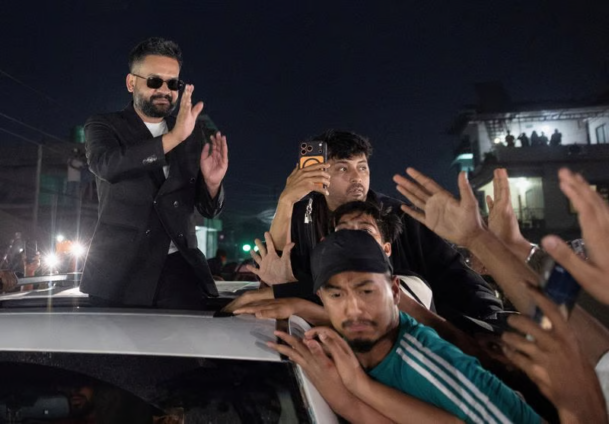
A three-year-old party won Nepal's general elections by a landslide, authorities said, positioning its candidate, Balendra Shah, to become the next prime minister, with a mandate to restore political stability.
The March 5 election was the Himalayan nation's first vote since demonstrations against corruption last September, led by Gen Z protesters that killed 77 people and toppled the government.
"If everything goes well, we can expect that it can give a stable government for five years," said constitutional expert Purna Man Shakya, referring to splits over dividing up the spoils of office that doomed prior majority governments.
Shah’s Rastriya Swatantra Party (RSP) won 182 seats in the 275-member parliament, the Election Commission said on Thursday, the largest majority of any party in more than six decades.
That holds out hope for stability in a nation that has seen 32 changes of government in the last 35 years, battering investors' confidence while crippling economic and jobs growth.
"We are encouraged by the victory," said newly-elected lawmaker Sisir Khanal, a senior leader of the winning RSP. "The mandate has made us very responsible."
The election relegated the oldest party, the Nepali Congress, to distant second place with just 38 seats, while the Communist Party of Nepal (Unified Marxist-Leninist) of former Prime Minister K.P. Sharma Oli won only 25.
Former Chief Justice Sushila Karki succeeded Oli as the interim prime minister tasked with holding the election.
The election has been dominated by Shah, the former mayor of Kathmandu, the capital, whose rap music critical of the establishment has gained him near-rockstar-like fame on social media.
He is the first politician expected to become prime minister who hails from the southern plains, known as Madhesh, where smaller regional groups failed to win a single seat.
His RSP canvassed for a programme to fight graft, create jobs , and more than double the $42 billion economy in five years.
But its firebrand leader, Ravi Lamichhane, a former television host, faces charges of misusing the funds of small savings companies. He denies the accusations and has been released on bail.
Last year's youth-led uprising in the nation of 30 million nestled between China and India followed a social media ban that drew thousands into the streets, triggering clashes and deaths that forced Oli's resignation.
Latest Stories
-
We need development pathway, not selection exercise – Sports Minister urges football stakeholders
8 minutes -
Government prioritises foundational learning to improve education outcomes
14 minutes -
Ghana, Côte d’Ivoire deepen maritime security cooperation through joint boundary inspection
20 minutes -
Three-hour rainfall exposes poor drainage system in Kadjebi
26 minutes -
Give young people skills and the systems to create jobs
46 minutes -
Food inflation never responded – Dr Yamson says Ghana must stop throwing money at short-term fixes
60 minutes -
Oil set for second weekly rise as unsettled US-Iran war crimps supply
1 hour -
US teen drops lawsuit against Meta, Google and Snap ahead of trial
1 hour -
Meghan could return to acting once back in UK
2 hours -
Bali jails Swiss tourist for insulting sacred Day of Silence
2 hours -
At least 50 killed, mostly children, as overloaded boat capsizes in Nigeria
2 hours -
Cameroon president returns home after 10-week absence
2 hours -
Mineworkers demand release of $34.5 million in trapped savings
2 hours -
Stability must last 10 years, not 4 – Dr Yamson challenges gov’t to make boom-bust economy last
2 hours -
Tunisia opposition protests against president amid economic discontent
3 hours