

Audio By Carbonatix
South Korean police have raided the headquarters of the transport ministry as questions mount over its handling of the country's deadliest aviation disaster.
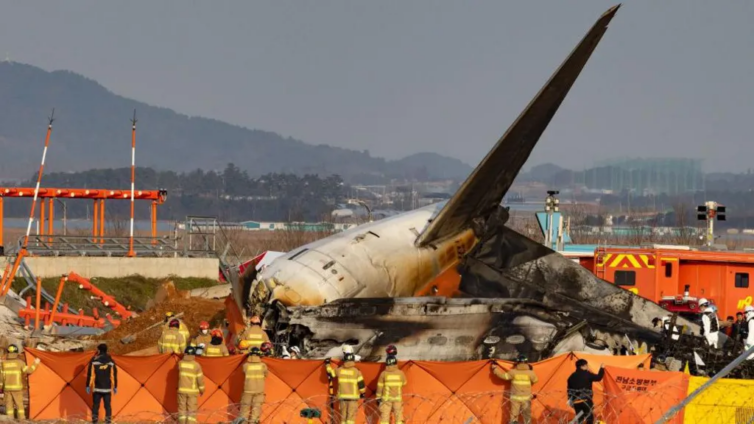
Jeju Air Flight 2216 hit a concrete structure after overshooting the runway at Muan International Airport on 29 December 2024, killing all but two of 181 people on board.
Initial investigations found that the Boeing 737-800 had encountered a bird strike and that the concrete mound exacerbated the number of casualties.
The incident triggered multiple probes, with the latest one ordered by South Korea's President Lee Jae Myung on Thursday, after investigators recently discovered more body parts and victims' belongings.
Police searched the transport ministry's office in the central city of Sejong on Friday, looking for fresh leads on the cause of the crash and whether officials handled it properly, news agency Yonhap reported.
The raid was linked to the main government investigation into the crash. The results are due to be announced by the middle of this year.
But other, parallel investigations have also been launched by various agencies and the South Korean parliament.
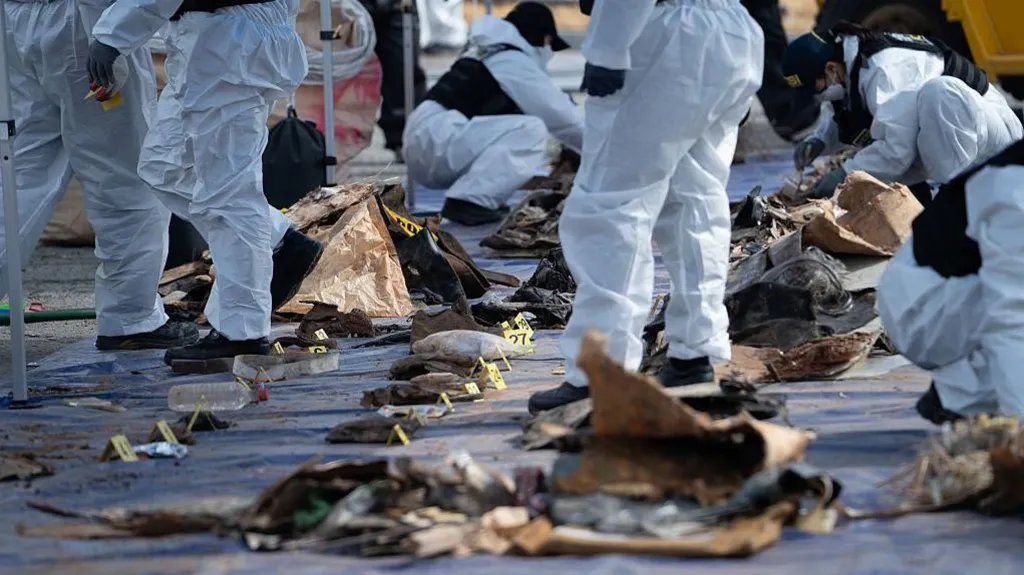
In recent months, investigators discovered body parts and victims' belongings that had been put in sacks and stored alongside sacks of rubble collected from the accident site.
The victims' families had been requesting a re-examination of the rubble removed from the site for months.
The latest discovery triggered public anger and prompted Lee to order an inquiry as to why the remains and belongings had not been detected earlier.
Lee also ordered disciplinary action against those responsible for delays in the recovery of human remains.
The Ministry of Land, Infrastructure and Transport has apologised but the victims' families have refused to accept it.
"We are appalled by the transport ministry's late and inadequate apology, which the families say is like killing the victims a second time," a representative for the families said.
Earlier this week, a separate inquiry by the audit board found that the concrete mound was built to cut costs.
Muan International Airport was built on sloping terrain. Instead of flattening the ground to install an antenna system for navigation - which would have cost more - authorities built the system into a concrete structure that is elevated above the runway.
The Board of Audit said structures that house the antenna system, known as localisers, should be designed to break easily upon impact.
Simulations have shown that all 181 on board the Jeju Air plane could have survived had the plane not hit the concrete mound, causing it to explode into a fireball.
After a flock of migratory ducks hit the plane's engine, the pilots were able to land the plane on its belly and slide it down the runway - until it hit the concrete structure.
One month after the crash, aviation authorities removed similar concrete structures for navigation in seven airports.


Latest Stories
-
Gauff’s flaw forgotten on winning US Open return
8 minutes -
Birds stop play but Medvedev flies into third round
20 minutes -
LA Clippers fined $30m by NBA over Leonard scandal
31 minutes -
Uber to cut over 3,000 jobs in major global restructuring
40 minutes -
Tiger Woods gets five-year driving ban after reckless driving plea
49 minutes -
South African airline behind daring stadium stunt cancels next flyby
58 minutes -
PURC urges ECG to address outages, metering delays
1 hour -
Police engage traders over alleged harassment, extortion on Aflao-Accra highway
1 hour -
Uber shuts operations in Nigeria and Uganda with immediate effect
2 hours -
Netherlands moves billions in gold to London in ‘crisis preparedness’ move
2 hours -
Legal vacation does not halt urgent court cases – Chief Justice
2 hours -
Keta residents react with mixed feelings to fresh fuel price hike
2 hours -
Managing Director on GH¢150,000 bail over five dud cheques
2 hours -
BOSTenergies reports strong 2025 performance, pays first-ever dividend to government
3 hours -
Carlos Queiroz reappointed as Black Stars head coach
3 hours