

Audio By Carbonatix
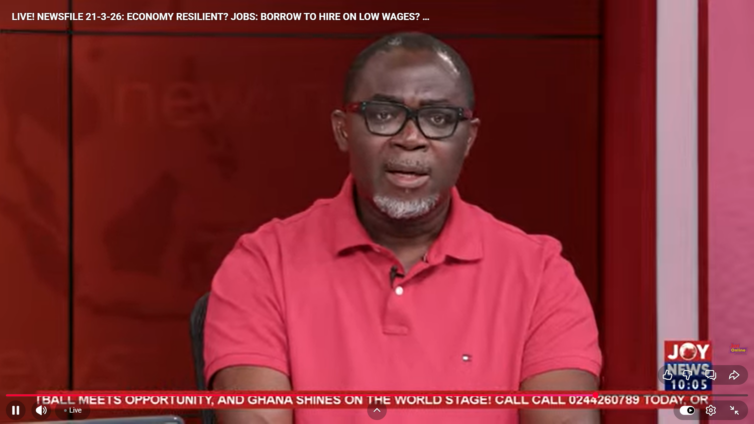
The Deputy Secretary-General of the Trades Union Congress Ghana, Kwabena Nyarko Otoo, has criticised claims that government borrowing is driven primarily by the need to pay public sector salaries, describing the narrative as unfair and damaging to workers.
Speaking on Newsfile on Saturday, March 21, Dr. Otoo argued that the framing of government expenditure has been deliberately skewed in a way that casts public sector employees in a negative light.
Dr Otoo rejected the suggestion that the government borrows chiefly to pay wages, insisting that salaries are a statutory obligation that must be met.
“This idea that government is borrowing to pay salaries is quite unfair to labour,” he said. “The narrative could equally be that after paying salaries and statutory transfers, government had to borrow to service its debts.”
He questioned why the issue is often presented in a manner that appears to blame public sector workers for fiscal challenges, rather than focusing on broader structural pressures such as debt servicing.
The labour leader also recounted recent wage negotiations between organised labour and government, highlighting what he described as significant restraint on the part of workers despite difficult economic conditions.
He noted that in 2025, when inflation stood at nearly 24 per cent, labour unions accepted a 10 per cent wage increase following direct appeals from President John Mahama.
“Government presented the economic situation to us, and the President himself pleaded that conditions were not favourable,” Dr Otoo explained. “We accepted 10 per cent, even though inflation was much higher, and our members were not happy.”
According to him, the decision drew criticism from workers who felt the increase did not reflect the rising cost of living.
Dr. Otoo said organised labour made additional concessions in 2026, agreeing to a 9 per cent wage increase after government cited competing fiscal priorities.
He explained that officials, including the Finance Ministry, appealed to unions to moderate their demands in order to create fiscal space for the recruitment of newly trained teachers and nurses.
“They told us they needed to bring more young people into employment, particularly those graduating from training colleges,” he said. “On that basis, we accepted 9 per cent.”
Despite these concessions, Dr. Otoo expressed concern over what he described as a growing narrative that public sector wages are consuming the bulk of government resources.
He indicated that organised labour disputes some of the statistics being used to support this claim, arguing that they do not accurately reflect the full picture of public finances.
“Now we are being told that nearly everything is going into compensation,” he said. “We strongly refute some of these figures.”
Dr Otoo maintained that public sector workers are being unfairly blamed for economic difficulties, despite their willingness to compromise during periods of hardship.
He warned that such narratives risk undermining morale and misinforming the public about the true drivers of Ghana’s fiscal challenges.
“Our woes cannot simply be reduced to public sector wages,” he said, calling for a more balanced and transparent discussion on government spending priorities.
Latest Stories
-
MP status does not place anyone beyond law – EOCO on Manhyia MP’s attempted arrest
18 seconds -
Chief Justice must examine arrests of suspects on court premises – Afenyo-Markin
3 minutes -
Black Stars arrive in Bouake ahead of Cote d’Ivoire clash
7 minutes -
We’ve identified two persons who allegedly helped Manhyia South MP escape arrest – EOCO
12 minutes -
Manhyia South MP declined two invitations in February, attempted arrest was lawful – EOCO
24 minutes -
Bosomtwe Assembly ultilises PWDs fund to empower over 30 PWDs with start-up kits
28 minutes -
Nkrumah’s ideas must be given practical meaning – P.L.O. Lumumba
37 minutes -
Disproportionate arrests over criticism may create ‘undeserving martyrs’ – Mahama
39 minutes -
“This is an abuse of power” – Minority slams EOCO over attempted arrest of Manhyia South MP
40 minutes -
Time to turn Volta Region’s economic potential into action – EXIM Bank CEO
41 minutes -
Bring your appointees to order – Afenyo-Markin urges Mahama to act against alleged EOCO abuses
54 minutes -
Mahama tasks MFWA, GJA to lead national dialogue on hate speech, harmful digital content
55 minutes -
Manhyia South MP recounts alleged attempt to forcibly take him to EOCO
1 hour -
‘I had to drive off to safety’ – Nana Agyei Baffour Awuah on why he fled after High Court clash
1 hour -
Nkrumah was a lonely man because of Pan-African vision – PLO Lumumba
1 hour