

Audio By Carbonatix
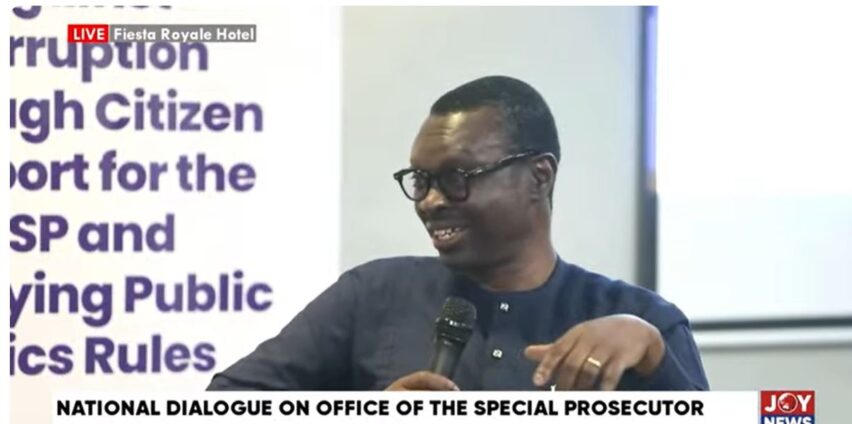
Chairperson of the African Union Advisory Board Against Corruption, Edem Senanu, has defended the performance of the Office of the Special Prosecutor (OSP), stating that the institution has made notable progress despite operational constraints and public criticism.
Speaking during a national dialogue on the Office of the Special Prosecutor on Tuesday, March 31, Senanu noted that building a resilient anti-corruption institution takes time, particularly in an environment marked by limited resources and political pressure.
“The OSP has performed above average. It is very difficult to build an institution under attack and without adequate resources, yet still expect it to deliver instant results,” he stated.
The anti-corruption campaigner stressed that the OSP’s effectiveness should not be measured solely by prosecutions, but also by its deterrent impact on public officials.
“There’s so much that institutions achieve just by existing. The presence of the OSP alone has influenced the conduct of politicians,” he noted.
He pointed out that the OSP has handled about 67 cases, with seven completed, alongside some financial recoveries—contrary to claims that the office has achieved little.
Senanu expressed concern over what he described as a misleading public narrative, often amplified by political actors across media platforms.
"It is not accurate to say the OSP has achieved nothing. Cases have been completed and monies recovered, but the communication around these achievements has been weak,” he said.
To address this, he called for the establishment of clear performance indicators to better measure and communicate the OSP’s impact.
According to him, institutional success should also be assessed through: Established operational systems, defined procedures and strengthened investigative capacity. “These are foundational to long-term effectiveness,” he added.
Senanu also highlighted the importance of strengthening the broader justice system, including the creation of specialised anti-corruption courts to handle complex cases explaining that “without the right judicial support systems, even strong investigations may not lead to convictions.”
He therefore urged stakeholders to support the OSP rather than undermine it, noting that the institution is on a positive trajectory.
“The data is encouraging. What we need now is better communication and stronger institutional backing to enable the OSP to fully deliver on its mandate.”
Latest Stories
-
Mahama commends Trade Minister for championing Ghana’s industrial growth
8 minutes -
Public cautioned against transactions over Borteyman land as Supreme Court rules in favour of Sino Africa
10 minutes -
Ghana Air Force mourns with Nigeria over 25 citizens killed aircraft accident
12 minutes -
Minority demands permanent scrapping of GSA’s $300 PVoC charge on imported vehicles
17 minutes -
White vs traditional marriage: Aesthetics above culture?
55 minutes -
Tumu Municipal Hospital receives new delivery bed to boost maternity care
1 hour -
Telecel Ghana unveils Project X with Black Sherif partnership
1 hour -
Rev. Kwadwo Bempah defies restriction on preaching on buses; warns it won’t succeed
1 hour -
French Embassy to partner Kobby Kyei Media for bloggers’ training
1 hour -
Nestlé and NBA announce multi-year international marketing partnership
2 hours -
Mahama sends condolences to Nigeria over plane crash that killed 25
2 hours -
Our lifestyles may be killing us but our spatial planning is too
2 hours -
12 arrested as police seize firearms, suspected drugs in Tamale
2 hours -
Chamber of Mines challenges Reuters report on proposed mining law
2 hours -
LA 2028: Black Queens take first leg advantage with 3-0 win over Mauritius
2 hours