

Audio By Carbonatix
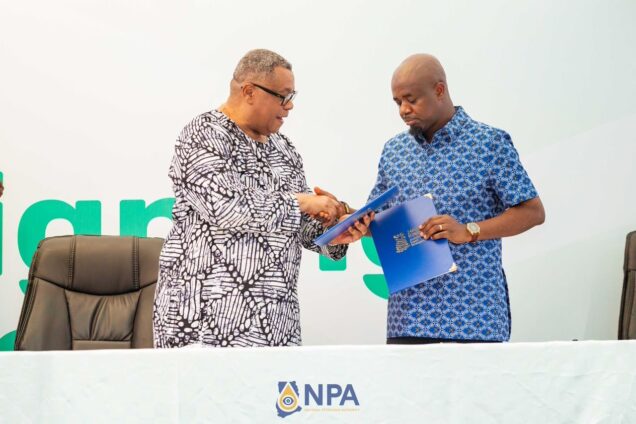
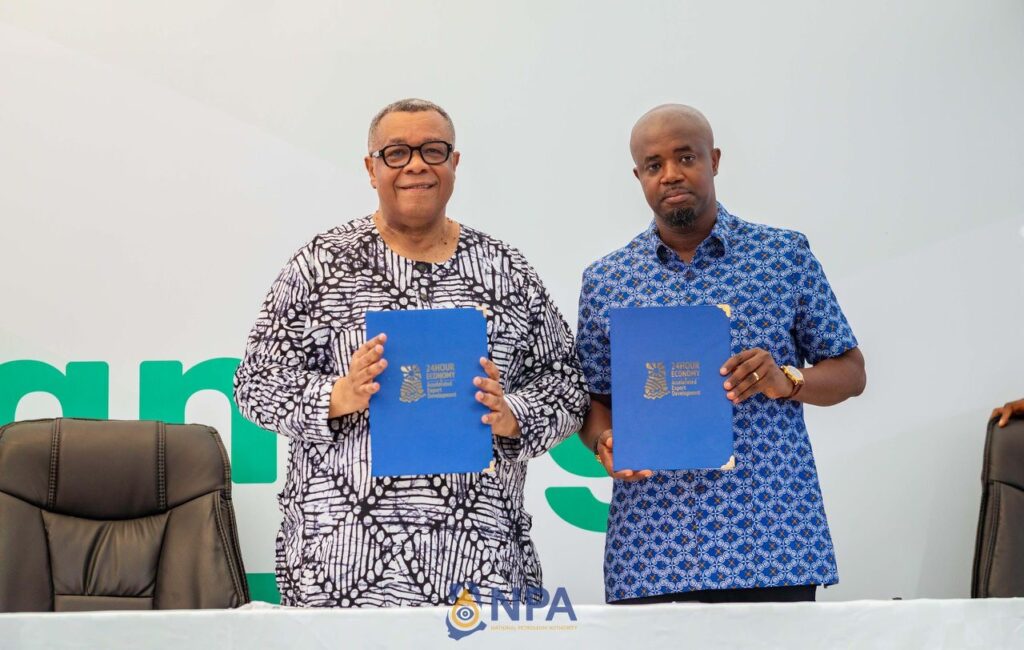
The 24-Hour Economy Authority and the National Petroleum Authority (NPA) have signed a Memorandum of Understanding (MoU) to support the expansion of 24-hour operations across Ghana’s downstream petroleum sector.
The agreement, signed in Accra on March 31, forms part of efforts to advance the country’s broader economic transformation agenda through reliable, round-the-clock fuel supply.
Under the terms of the MoU, the NPA will develop and enforce operational readiness standards for 24-hour service delivery across fuel stations, refineries, bulk storage depots, and bulk road vehicle operations.
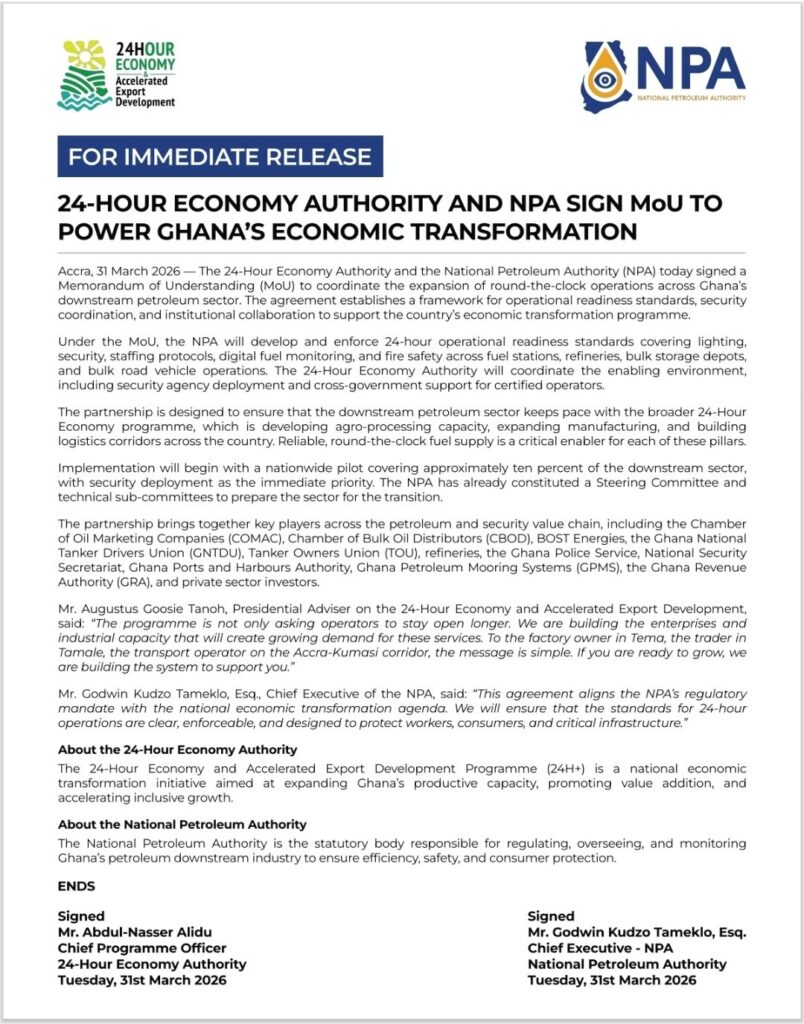
These standards will cover critical areas such as lighting, security, staffing protocols, digital fuel monitoring, and fire safety.
The 24-Hour Economy Authority, on the other hand, will coordinate the enabling environment, including the deployment of security agencies and cross-government support for certified operators.
The partnership is expected to align the downstream petroleum sector with the wider 24-Hour Economy programme, which seeks to expand agro-processing, boost manufacturing, and strengthen logistics corridors nationwide.
A reliable and continuous fuel supply is seen as a key enabler for these sectors, ensuring sustained productivity and economic activity across the country.
Implementation of the initiative will begin with a nationwide pilot covering about 10 percent of the downstream sector, with security deployment identified as an immediate priority.
The NPA has already set up a Steering Committee and technical sub-committees to oversee preparations for the transition.
The initiative will involve collaboration with key stakeholders, including industry players, security agencies, and regulators across the petroleum value chain.
Presidential Adviser on the 24-Hour Economy and Accelerated Export Development, Augustus Goosie Tanoh, described the programme as a strategic effort to build industrial capacity and stimulate demand.
Meanwhile, NPA Chief Executive, Godwin Kudzo Tameklo, said the agreement aligns the Authority’s regulatory mandate with the national transformation agenda, assuring that clear and enforceable standards will be implemented to protect workers, consumers, and critical infrastructure.
Latest Stories
-
T-bills auction: Government fails to achieve target; yield on 91-day-bill remains unchanged
9 minutes -
It’s Ghana’s shame to denigrate Nkrumah when the whole world honours him as African of the Century – Asiedu Nketiah
17 minutes -
No other nationalist can compare to Nkrumah – Asiedu Nketiah
24 minutes -
Collateral Registry: Foreign banks accounted for GH¢19.9bn of secured credit in quarter 2, 2026
24 minutes -
This government should expect scrutiny – Asiedu Nketiah
50 minutes -
Two-year-old girl dies in domestic fire at Cantonments
2 hours -
Asiedu Nketiah urges better working conditions for journalists
2 hours -
JoyNews’ Precious Semevoh wins climate change reporting award at Bono GJA Awards
2 hours -
Kumasi Central Market phase 2 to begin in October after years of abandonment
2 hours -
Sentuo offers fuel supply reassurance as NPA sees steady output through December
3 hours -
Ghanaian smock showcased at Lesotho Tourism Summit
3 hours -
Four pupils to one desk: The painful plight of schools in New Juaben North
4 hours -
Ipswich launch investigation into racist abuse of Abdul Fatawu
4 hours -
Arrest of Techiman nurse is purely political persecution – ‘Ghana Jollof’
4 hours -
Isak nets winner as Liverpool edge Bournemouth
5 hours