

Audio By Carbonatix
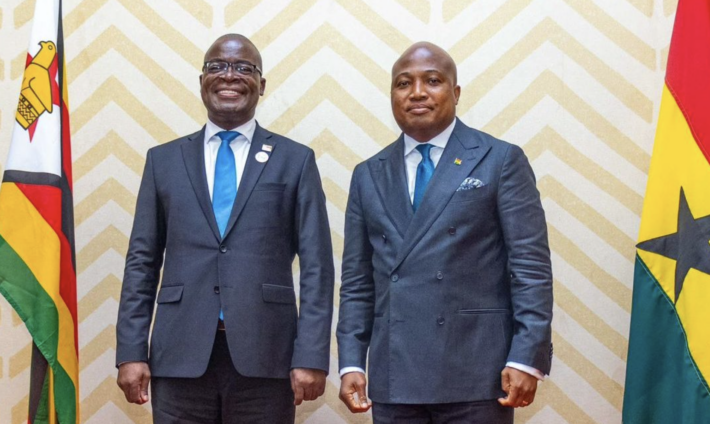
The Foreign Ministers of Ghana and Zimbabwe have jointly called for the strengthening of trade and investment ties between their countries.
The renewed call reflects a deliberate effort by both countries to reposition their longstanding bilateral relations towards delivering tangible economic benefits.
It signals a shift from largely symbolic and historical ties to a more pragmatic, results-oriented partnership focused on expanding trade, attracting investment and creating jobs for their citizens.
The call was made at the ministerial session of the inaugural Permanent Joint Commission for Cooperation (PJCC) in Accra, where both sides emphasised the need to prioritise economic collaboration as the foundation of their partnership.
The PJCC, which has taken nearly three years to convene, follows the signing of a General Framework Agreement in 2023 and culminated in multiple Memoranda of Understanding covering over 20 priority areas, including trade, agriculture, mining, energy, health, tourism, and education.
Technical Meetings laid the groundwork for the Ministerial Session, where agreements reached were reviewed and adopted, setting the stage for a new phase of strategic cooperation between Ghana and Zimbabwe.
Mr Samuel Okudzeto Ablakwa, Ghana’s Minister of Foreign Affairs, said while the two countries shared deep historical bonds rooted in Africa’s liberation struggle and Pan-African solidarity, there was an urgent need to translate those ties into concrete outcomes.
“Our meeting here today represents far more than a diplomatic engagement. It marks an important milestone in elevating Ghana-Zimbabwe relations to a strategic partnership capable of delivering tangible results to our peoples,” he said.
He noted that trade levels between Ghana and Zimbabwe remained below potential and called for deliberate measures to expand commercial exchanges, promote joint ventures and enhance private sector participation.
Mr Ablakwa stressed that trade and investment must become the central pillars of cooperation under the PJCC framework, supported by policies that remove barriers and improve connectivity between West and Southern Africa.
He identified key sectors for collaboration, including agriculture, mining, education and innovation, where both countries possess significant resources and expertise.
Ghana’s Foreign Affairs Minister called for increased cooperation in mineral beneficiation and value addition, noting that Ghana and Zimbabwe were endowed with minerals such as gold, manganese, diamonds and lithium.
The Minister stressed that partnerships in these areas should focus on technology transfer, environmentally responsible practices and job creation.
On human capital development, both sides acknowledged the strong historical ties in education, with Ghanaian teachers having contributed to Zimbabwe’s high literacy rate.
Mr Ablakwa said these people-to-people connections provided a solid foundation for expanding cooperation in research, academic exchange and skills development.
“We must encourage exchange programmes between our universities and promote collaboration in research and innovation to empower our youth and strengthen our knowledge economies,” he said.
Professor Amon Murwira, Zimbabwe’s Minister for Foreign Affairs and International Trade, echoed the call, stressing that diplomacy must be anchored on improving the material conditions of citizens.
“Diplomacy must produce prosperity. If it does not result in food, water, shelter and dignity for our people, then it is not meaningful,” he said.
He underscored the importance of trade as a key driver of development, noting that meaningful relations between countries must be built on the exchange of goods and services that directly impact people’s lives.
Professor Murwira proposed practical measures to boost bilateral trade, including the establishment of trade warehouses in both countries and improved transport linkages to facilitate direct movement of goods between Accra and Harare.
He said Zimbabwe was ready to expand exports of agricultural products such as sugar, beef and maize seed, while Ghana could increase exports of cocoa-based products, textiles, shea butter and traditional black soap.
He highlighted the strategic positions of both countries within Africa’s economic landscape, with Ghana hosting the Secretariat of the African Continental Free Trade Area (AfCFTA) and Zimbabwe serving as a gateway to the Southern African Development Community (SADC).
The Foreign Ministers said leveraging these advantages could significantly enhance intra-African trade, strengthen regional value chains and promote industrialisation.
The ministers also underscored the importance of private sector involvement, calling for stronger business-to-business partnerships to unlock new economic opportunities.
They tasked officials to ensure that deliberations under the PJCC translate into actionable programmes with clear timelines and measurable outcomes.
The meeting precedes the first-ever state visit to Ghana by a Zimbabwean President, scheduled for April 1 to 3, 2026, which is expected to further consolidate bilateral relations and formalise new areas of cooperation.
Both ministers expressed optimism that the outcomes of the PJCC would serve as a foundation for agreements to be endorsed during the visit.
They reaffirmed their commitment to advancing African integration and collective development, stressing that stronger cooperation among African countries was essential in addressing global challenges.
Latest Stories
-
Over 38,000 commercial, 150,000 residential customers unbilled – Ghana Water MD
11 minutes -
Several injured as Sprinter bus collides with ‘trotro’ at Odorkor
11 minutes -
Ghana records progress on reparatory justice agenda – Ablakwa
28 minutes -
Mahama commissions Christian Tetteh Yohuno Ward Complex at Police Hospital
43 minutes -
Vice President calls for wider access to Ghana’s political party histories
43 minutes -
Republic Bank JoyNews Habitat Fair to connect prospective homeowners with exhibitors in Ho from October 16 to 18
53 minutes -
Obaasima Summit: ‘AI is not a spiritual attack’ — Rev. Dr. Ofori-Boateng urges young women to embrace technology
1 hour -
GHS to distribute 80,000 pairs of locally-made protective footwear to health workers
1 hour -
GoldBod boosts local jobs as 90% of gold undergoes refining in Ghana – Sammy Gyamfi
1 hour -
The search for the politically unblemished: Are we asking the impossible of public appointees?
1 hour -
Ghana seeks climate finance access for debt-restructuring countries
1 hour -
Afenyo-Markin urges stronger media scrutiny of public institutions
1 hour -
GoldBod recovers GH¢38.7m in legacy PMMC debts, targets remaining arrears
1 hour -
62 out of every 100 commercial meters inspected missing from Ghana Water database – MD
1 hour -
GoldBod gets BoG authorisation to sell forex, Sammy Gyamfi tells PAC
1 hour