

Audio By Carbonatix
US authorities have arrested an Iranian woman for trafficking arms to Sudan on behalf of her country, prosecutors have said.
Shamim Mafi, 44, who has an American green card, was arrested at Los Angeles airport on Saturday and is accused of "brokering the sale of drones, bombs, bomb fuses, and millions of rounds of ammunition manufactured by Iran and sold to Sudan", First Assistant US Attorney Bill Essayli said on X.
The alleged sales were to Sudan's defence ministry, including a €60m ($70m; £52m) drone contract, court documents show.
She is accused of breaching US sanctions against Iran, which prohibit US persons from transacting or dealing in Iranian goods or services without authorisation.
Mafi, who has not yet commented on the allegations, is expected to appear in court later on Monday. If convicted, she could face a jail sentence of up to 20 years.
An FBI criminal complaint filed in court, a copy of which was obtained by the BBC, says Mafi coordinated a "Sudanese delegation's travel to Iran, received over €6m in payments, and issued payment receipts" for the drone deal.
She submitted "a letter of intent" to Iran's Islamic Revolutionary Guard Corps (IRGC) to broker the sale of 55,000 bomb fuses to Sudan's defence ministry, it adds.
According to Essayli, Mafi is "an Iranian national who became a lawful permanent resident of the United States in 2016".
Court documents describe her "repeated use of informal exchange entities across multiple transactions" in the arms deals as a "deliberate effort... to evade US sanctions".
She is said to have been ready to board a flight from California to Turkey when she was arrested.
Essayli's post included images of a woman presumed to be Mafi surrounded by security agents at an airport, a drone on tarmac and bundles of cash.
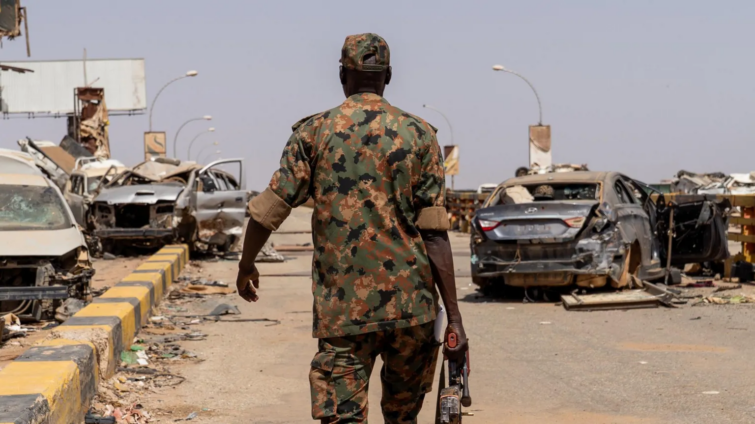
Sudan has been engulfed in a devastating civil war between the army and the paramilitary Rapid Support Forces for the past three years.
The war has resulted in the world's worst humanitarian crisis, according to the UN, with tens of thousands of people killed, and millions displaced.
Foreign powers have been accused of backing both sides and providing ammunition, further fuelling the conflict.
Rights group Amnesty International previously said it had found evidence of weapons manufactured in Serbia, Russia, China, Turkey and Yemen being used in Sudan.
The United Arab Emirates has denied extensive evidence that it provides military support to the RSF.
Iran has also been accused of supporting Sudan's army with weapons in the past, which were denied by Sudan.
The Sudanese army has increasingly been deploying sophisticated Turkish drones, although Iranian weapons are believed to have played a critical role in the 2024 offensive against the RSF.
Justin Lynch, the head of Conflict Insights Group, a private organisation that tracks data for conflict analysis and research, said the allegations against Mafi highlighted the "murky world" of arms brokering - an "unregulated space where corruption and thievery reign".
"If you're fighting a war as a non-Western country, you can't go to a supermarket and buy 55,000 bomb fuses," he told the BBC.
"If these allegations are proved true, this indictment would be a great indication of that murky world and would show that Sudan was desperate to acquire weapons from any source."
"For Iran, it would show how important its defence industry is to its foreign policy," he added.
Sudan's relationship with Iran has fluctuated over the years.
Close ties developed during the 1990s following the Islamists' rise to power in Khartoum, which included security cooperation.
In the mid-2000s Sudan came to rely on Gulf Arab monarchies such as Saudi Arabia and the UAE to prop up its economy, hit hard by US sanctions and the secession of South Sudan, which removed much of Khartoum's oil production.
That led to a rupture in Sudan's relationship with Tehran, given tensions between Iran and the Gulf.
But the military-backed government in Khartoum restored ties with Iran after civil war broke out in 2023, seeking to bolster weapons supplies.
Since the beginning of the US-Israeli war on Iran, the Sudanese army has proceeded with caution – condemning Iranian attacks on Gulf states but not severing ties with Tehran.
Its balancing act has been further complicated by the recent US designation of the Sudanese Muslim Brotherhood as a terrorist group, claiming that it had been trained and supported by Iran's IRGC.
Lynch said Sudan's conflict was a logistical battle where the armed forces and RSF are competing "sometimes with the same arms dealers - to procure the same weapons".
According to him, they both have to "rely on quasi or unofficial connections to countries that procure arms".
Latest Stories
-
NPP’s new executives will not alter our 2028 preparations – Tanko-Computer
12 minutes -
Tema East MP urges men to take active role in breast cancer awareness
17 minutes -
Hawa Koomson vows to bring experience and maturity to NPP women’s wing
21 minutes -
Opare Addo cautions NDC against adopting NPP’s aggressive politics
22 minutes -
NPP has 35 months to prepare for 2028 after early reorganisation – Political strategist
28 minutes -
All six passengers presumed dead after plane went missing off US coast
39 minutes -
Teachers’ promotion arrears to be paid by Oct. 30 – Education Minister
47 minutes -
Stop talking too much on stage – Kafui Dey warns MCs
53 minutes -
Government has Ho, Volta Region at Heart — Warlord of Asogli
60 minutes -
Mahama reaffirms commitment to Volta development at Asogli Te Za
1 hour -
REGSEC orders immediate demolition of fire-ravaged building at Koforidua Jackson Park
1 hour -
Ambassador Boateng congratulates new NPP leadership, urges reconciliation, rebuilding
1 hour -
50 vetted to contest Effutu NDC executive positions
1 hour -
GACL enhances security screening at Accra International Airport
2 hours -
COCOBOD raises GH¢3.39bn at 11% in first Commercial Paper tranche
2 hours