

Audio By Carbonatix
When we watch our favourite athletes take to the field, score that winning goal, or lift a trophy, we celebrate their strength, talent, and moments of glory.
But behind the cheers and applause lies a quieter story, one filled with personal struggles, emotional pain, and silent battles that often go unnoticed.
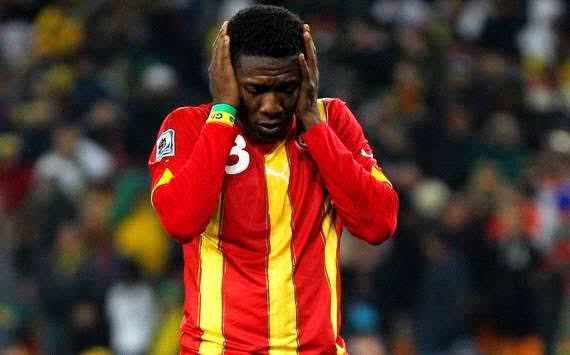
Take a moment to remember that unforgettable night in 2010 at Soccer City Stadium in Johannesburg. Ghana was on the brink of history, with the world watching.
Asamoah Gyan, our hero, had the chance to send Ghana into the semi-finals of the World Cup, an achievement that had never been achieved by any country since the World Cup was instituted in 1930.
Africa held its breath.
He stepped up, took the shot, and their hearts sunk. The ball hit the crossbar, and the dream slipped away. The stadium fell into stunned silence.
For Gyan, that moment was more than a missed opportunity; it was a heavy weight of disappointment, grief, and public scrutiny that followed him long after.
That night, millions cheered for Ghana’s Black Stars, but many didn’t see the tears Gyan fought back or the emotional toll of that failure. It’s a reminder that even in victory or near-glory, athletes carry personal stories of heartbreak and resilience.
"I was gone," Asamoah Gyan recalls with a photographic memory recently in an interview with England and Manchester United legend, Rio Ferdinand.
"My head, my everything, was gone. I was emotional. It was crazy,” he adds.
"That was one of the worst moments of my career… I was scared," he stated.
Even in that darkness, he found a sliver of redemption. “I said to myself it was just a mistake… go and prove to people you can score.” He returned for the shootout. He scored. But the scars? They do not disappear as easily as the scoreboard resets.
The sark side of fame
The heartbreaking reality faced by many Ghanaian footballers who once shone with incredible promise but ultimately fell short of expectations. It’s a story tinged with hope, disappointment, and the fragility of dreams.
Despite moments of brilliance and undeniable talent, factors beyond their control, such as injuries, discipline issues, bad luck, or lack of opportunity, stunted their careers, leaving fans to wonder what might have been.
Figures like Nii Odartey Lamptey, once heralded as Pele’s successor, Awudu Isaka, whose potential was cut short by injuries, Baba Adamu, whose promising journey was marred by setbacks, and Peter Ofori Quaye, a record-breaking goalscorer whose career waned, embody this bittersweet unpredictability.
Their stories serve as a poignant reminder that early promise in football is no guarantee of lasting success, and the path to greatness is often fraught with unforeseen challenges.
The silent battles
From the outside, sport looks glamorous. Travel. Fame. Applause. But behind the curtain, many athletes are fighting battles that never make headlines.
A missed chance can trigger insults across radio, television, and social media.
A dip in form can invite ridicule.
A single mistake can define a career. The pressure is relentless. And when the lights go off, the athlete is left alone with their thoughts.
Anxiety creeps in. Confidence erodes.
Depression quietly settles.
When Manchester United lost the Champions League final in Rome in 2009, Michael Carrick blamed himself for the defeat after he gave the ball away in the build-up to Barca's opening goal.
"I beat myself up over that goal," Carrick told The Times as quoted by BBC.
"I kept asking myself: 'Why did I do that?' And then it [the depression] snowballed from there. It was a tough year after that. It lingered for a long time.
"I had won the Champions League the year before, but that was totally irrelevant.
"It felt like I was depressed. I was really down. I imagine that is what depression is.
"I describe it as depression because it wasn't a one-off thing. I felt bad or terrible after some games, but then you get over it in the next couple of days, but that one I just couldn't shrug off. It was a strange feeling."
He played 481 times for Man United, but no one, including his team-mates, was aware of the extent of his mental health problems.
"I kept it to myself most of the time. Even my family didn't know the full extent of it," he told the Times in 2018.
"[Depression] is not something that's really spoken about in football.
Retirement brings its own storm. The jersey is gone. The routine disappears. The identity fades.
For many, it feels like losing a part of themselves.
Without proper guidance, financial planning, or emotional support, the transition can be brutal.
A global reality, not just Ghana’s story
This is not only a Ghanaian problem. It is a human one.
Across the world, elite athletes have stepped back not because they lacked talent but because the mind needed healing.
America's gymnast, Simone Biles, widely regarded as the greatest gymnast ever, paused her Olympic journey to protect her mental health. Naomi Osaka walked away from Grand Slam pressure to confront anxiety and depression. Michael Phelps, the most decorated Olympian in history, revealed battles with deep depression and suicidal thoughts.
Former Barcelona goalkeeper Robert Enke committed suicide by jumping in front of a train in November 2009. His tragic death remains one of the darkest reminders of what unchecked mental health struggles can lead to.
Adriano, once called “The Emperor” saw his career unravel after personal loss. There were former Spurs left back Danny Rose, and more recently, Richarlison, who admitted he battled depression after the World Cup.
These are not weak individuals. They are strong people who reached their limits.
Retirement can be equally tough. The sudden loss of identity, financial uncertainties, and lack of guidance can leave athletes feeling adrift like they’ve lost a part of themselves. Injuries and chronic health issues only compound these feelings, turning physical pain into emotional suffering.
Many of these struggles are invisible, and without proper support, athletes often feel isolated, overwhelmed, and unprepared for life after sports.
A new approach
The good news is that change is happening. Ghana is beginning to recognize that developing championship athletes isn’t just about physical training; it’s about nurturing resilient, well-rounded individuals. Initiatives like the partnership between the Church of Pentecost and the Ministry of Sports aim to incorporate moral, emotional, and psychological support into athlete development.
What if we looked beyond medals and records? What if we invested in mental health programs, mentorship, and career planning that help athletes transition smoothly into life after sports? Imagine a future where young athletes grow up not just dreaming of victory but also equipped to handle setbacks, failures, and the ups and downs of life.
A call to action
Ghana’s sports journey must evolve. We need to celebrate our heroes not just for their athletic achievements but also for their strength as individuals. We must create a system where athletes feel safe to share their struggles, seek help, and find purpose beyond the game.
Because at the end of the day, behind every goal scored, trophy lifted, and record broken, there’s a person, someone who laughs, cries, fears, and hopes just like everyone else.
Let’s honour our athletes, let’s support them in moments of triumph and in their darkest hours. That’s how we truly build champions on and off the pitch.
Latest Stories
-
GAEC must retain nuclear scientists for Ghana’s nuclear ambitions – Minister
21 minutes -
Man reportedly mistaken for game and shot by hunter dead in forest
23 minutes -
19-year-old mason jailed 15 years for defiling seven-year-old pupil
27 minutes -
Ghana’s banking sector assets rise 20.47% to GH¢500.2bn – BoG Governor
32 minutes -
22 injured as Sprinter bus overturns at Sege after tyre burst
33 minutes -
UN housing expert urges Ghana to strengthen Rent Control Department amid housing affordability concerns
41 minutes -
Delta-BCI partnership reaches 166,000 people with breast cancer education
51 minutes -
Power restoration fault suspected in Kumasi Central Market fire
6 hours -
The 7-foot giant of Ngleshie Amanfro: Seven-foot Ghanaian Ephraim Saawa dreams of joining the national basketball team
7 hours -
Government promises support for Kumasi Central Market fire victims
7 hours -
Vibes The Movie: Big Ghun’s Ghanaian film earns five nominations at 2026 REFFA
7 hours -
‘I’m a fulfilled man’—Justice Korbieh on missing out on Supreme Court despite two nominations
7 hours -
MamaCare CEO warns unresolved conflicts among health workers could undermine maternal and neonatal care
8 hours -
Health professionals urged to translate medical knowledge into practice to save mothers
8 hours -
Retired judge Justice Francis Korbieh charges 1,568 new lawyers to uphold integrity
9 hours