

Audio By Carbonatix
Youth unemployment remains Ghana’s most pressing economic challenge despite recent signs of macroeconomic stabilisation, economist and CEO of Dalex Finance, Joe Jackson, has said.
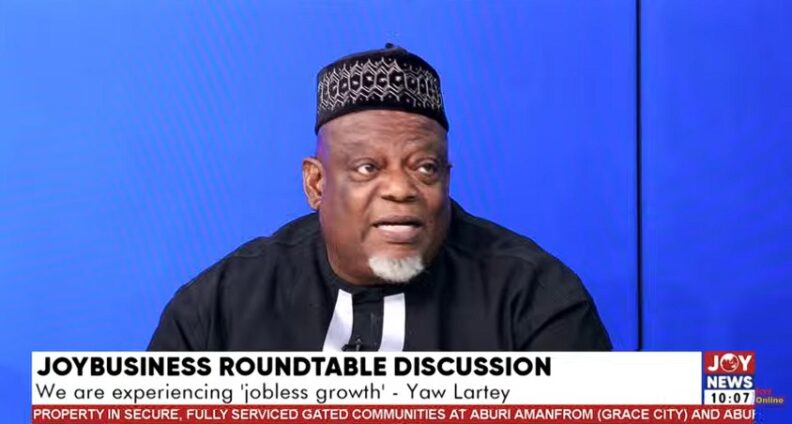
Speaking at the JoyBusiness Roundtable on April 30, Mr Jackson acknowledged that the country has made notable progress in stabilising key economic indicators — a development he said is now broadly accepted across policy and business circles.
However, he cautioned that stabilisation alone is not enough, stressing that it must lead to real improvements in livelihoods.
“Stabilisation is not an end in itself. It must translate into better livelihoods,” he stated.
His remarks come at a time when government officials have been highlighting falling inflation, easing lending rates, and a more stable currency as evidence of economic recovery. But concerns persist about whether these gains are being felt by ordinary Ghanaians, particularly the youth.
Mr Jackson explained that it is normal for economies to take time to move from stabilisation to full transformation. Nonetheless, he argued that there must be clear and deliberate policies to drive that transition.
He urged policymakers and stakeholders to shift the national conversation towards identifying concrete actions that signal a move beyond stabilisation.
Central to his concerns is job creation, which he described as the weakest link in Ghana’s current recovery phase.
“We’re still not creating enough jobs for the young people of this country,” he emphasised, warning that without significant employment growth, the broader economic gains risk losing relevance for many households.
While giving credit to the government for restoring a measure of stability, Mr Jackson maintained that the bigger question now is what comes next.
“The real question is what is being done on transformation, because stabilisation was never the end game,” he added.
His comments reflect a growing consensus among economists and business leaders that Ghana’s recovery will ultimately be judged not just by macroeconomic indicators, but by its ability to generate jobs, boost incomes, and improve living standards.
Latest Stories
-
Michail Antonio helps young Ghanaians chase Premier League dreams
2 hours -
Zambian opposition leader charged with treason
2 hours -
Iceland votes against restarting EU membership talks
2 hours -
WhatsApp chat used to launder cash for crime and extremism
2 hours -
US judge blocks Pentagon’s Anthropic blacklisting
2 hours -
Tinubu files case in US court to block release of alleged drug trafficking record – Lawyer
3 hours -
‘Powder Guy’ denies $32,000 visa fraud charges
3 hours -
Two suspects arrested over lynching at Daboya
3 hours -
Mobile phones contributing to Christians’ spiritual decline – Bishop Patu
3 hours -
Government to develop 150-acre air cargo hub at Tamale Airport – Goosie Tanoh
3 hours -
Stronger GRA digital systems needed at ports – IEAG
3 hours -
24-Hour Economy Secretariat brokers $270m poultry project to cut chicken imports
4 hours -
Ghana attaches particular importance to sustainable African-owned financing of peace – Mahama
4 hours -
Ho to establish first public college of education – MCE announces
4 hours -
“We are one house – let’s settle this at home” – Atomaase Royal family calls for unity, rallies behind Twafohene
4 hours