

Audio By Carbonatix
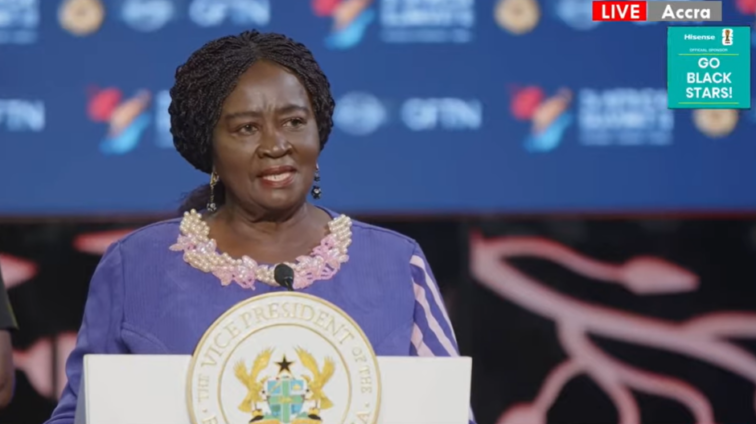
Vice President Professor Naana Jane Opoku-Agyemang has outlined four key areas Africa must address to achieve full digital integration and unlock the benefits of cross-border trade.
Speaking at the 3i Africa Summit 2026 in Accra, she identified payments, identity, regulation and infrastructure as critical pillars that must work together to support a continent-wide digital economy.
She said that while progress has been made in some areas, Africa must now move beyond isolated gains.
"Africa has already demonstrated a capacity to live from legacy systems; mobile money, digital identity, and financial technology have shown what is possible."
“The task is to move from pockets of progress to continental scale,” she added.
On payments, the Vice President raised concerns about the cost and inefficiencies in intra-African transactions.
She said that many payments between African countries are still processed through systems outside the continent.
“In many cases, intra-African transactions are routed through financial systems outside the continent and denominated in third currencies,” she said.
“This adds costs and delays and undermines the very idea of a single African market.”
She said ongoing efforts, including platforms like the Pan-African Payment and Settlement System, are helping to address these challenges, but more work is needed to ensure seamless and affordable transactions across borders.
"The objective is for a Ghanaian enterprise to be able to invoice a Guinean client and receive payments in CDs directly, efficiently, and at a reasonable cost," she said.
On identity, she underscored the importance of trust in building a digital economy. “No digital economy can function without trust, and trust begins with identity,” she said.
She pointed out that many Africans still lack verifiable digital identities, which limits their ability to access services and participate in cross-border trade.
“Interoperable identity systems are therefore essential to unlock participation at scale,” she added.
On regulation, the Vice President said countries do not need identical laws, but must ensure their systems can work together.
“Integration does not require identical laws across all countries, but it does require compatibility,” she explained.
She warned that fragmented regulatory systems increase the cost of doing business and discourage innovation.
She called for stronger coordination through shared standards, regulatory sandboxes and practical collaboration between countries.
"The digital trade protocol provides a basis for alignment, but this work must be carried forward with discipline. Regulatory sandboxes, shared standards, and practical coordination between jurisdictions will make integration real."
On infrastructure, she highlighted persistent gaps in connectivity and digital capacity across the continent.
“Too many Africans remain offline due to costs, coverage gaps, and skills gaps,” she said.
She also noted that Africa holds only a small share of global data centre capacity, which has implications for control over data and digital services.
“If our data is stored and processed elsewhere, then even when we participate, we lack control,” she cautioned.
"Investment in broadband, cloud infrastructure, and digital systems must therefore accompany regulatory and policy alignment," she added.
She said Africa must act decisively to take advantage of its demographic and technological potential.
“Without disregarding the challenges before us, we must seize the opportunities. Africa is the youngest continent in terms of population, and technology adoption is accelerating. The next phase of global digital growth must be shaped in emerging markets,” she said.
Latest Stories
-
Ghana explores centre of excellence for hearing, communication and cochlear implant care
41 minutes -
Schizophrenia-related disorders lead mental health cases recorded in Ghana
1 hour -
Dutch authorities enlist Ghana in hunt for fugitive drug lord Bolle Jos
1 hour -
Ghana housing finance conference adopts communiqué to improve affordable housing access
6 hours -
Special Initiatives Minister urges Wa Technical Institute to enrol more girls as EU-backed solar training lab opens
6 hours -
In the matter of my first year at the Bar
6 hours -
ActionAid Ghana calls for an end to child marriage, greater investment in girls’ rights
7 hours -
Newsfile to tackle World Cup visa scandal, beach demolitions, education strikes, BRICS bid
7 hours -
UK-Ghana Trade & Investment Summit: Trade Resource Centre to help businesses maximise UK-Ghana trade opportunities
7 hours -
Embassy of Denmark celebrates World Maritime Day
7 hours -
Linking LEAP to productive inclusion could cut extreme poverty by 2030 – UNICEF
8 hours -
Trade Ministry backs use of creative arts to rehabilitate prison inmates
9 hours -
Negotiations with government to continue despite strike suspension – GNAT
9 hours -
‘Ghana cannot afford to waste public resources; every cedi has a job’ – Ato Forson
9 hours -
Ghana expects economic boost as World Assemblies of God Congress brings 10,000 delegates to Accra
9 hours