

Audio By Carbonatix
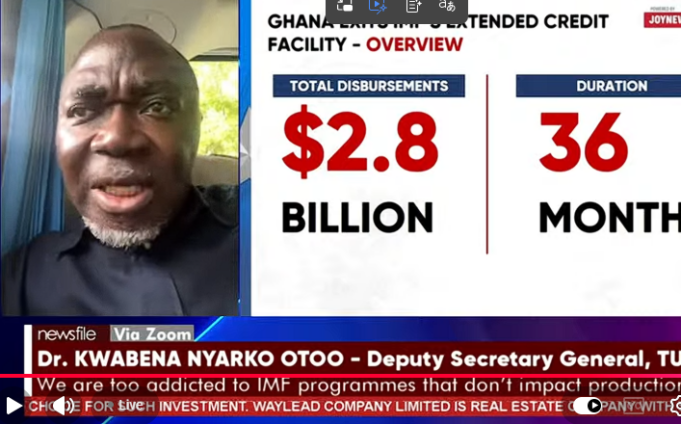
The Deputy Secretary-General of the Trades Union Congress Ghana, Dr Kwabena Nyarko Otoo, has criticised Ghana’s continued dependence on International Monetary Fund (IMF) programmes, warning that the country remains trapped in policies that fail to support production and long-term economic transformation.
Speaking on Newsfile on Saturday, May 16, Dr. Kwabena Nyarko Otoo argued that Ghana’s continued reliance on IMF programmes, coupled with plans for private sector participation in the Electricity Company of Ghana (ECG), reflects a policy direction that has failed to address the country’s longstanding structural economic challenges.
“We are too addicted to IMF programmes that do not ensure production in our part of the world,” he stated.
According to him, Ghana continues to operate an import-driven economy despite periods of macroeconomic stability, leaving many young people unemployed years after completing school.
“We continue to be an import-driven economy and even when there is macroeconomic stability, there is social instability. Our young people complete school and five or six years down the line, they still do not have jobs,” he said.
Dr Otoo maintained that government’s renewed push for private sector participation in ECG is simply an attempt to complete a privatisation agenda.
“Government is simply trying to complete the privatisation process which they could not do with a regular programme. I can assure you the unions are fully prepared and will do everything possible to ensure ECG is not privatised,” he stressed.
He argued that ECG is already showing signs of improvement and does not require privatisation.
“At the end of 2024, ECG was collecting about GH¢900 million. Today, ECG is collecting GH¢2.1 billion. Clearly, ECG is making progress,” he noted.
Describing the privatisation push as ideological, Dr Otoo said there was no justification for handing over the state power distributor to private entities.
“The only reason somebody wants to privatise ECG is ideology. There is nothing wrong with ECG continuing the progress it is making,” he added.
He also downplayed celebrations surrounding Ghana’s economic recovery under the IMF programme, insisting that rising gold prices rather than IMF policies had largely supported the economy.
“Take gold prices out of the equation and let economists tell us where this economy would have been,” he argued.
Dr Otoo called for a complete shift in Ghana’s economic policy framework, with greater emphasis on protection, industrialisation and decent job creation.
“What we need is a whole change in policy framework so that we can begin to talk about protection, creating decent employment and ensuring that macroeconomic stability translates into social stability for the people of Ghana,” he said.
Latest Stories
-
I remain fully committed to judicial independence – Mahama
2 minutes -
NDC opens nominations for 2026 constituency executive elections on September 15
3 minutes -
GROW2 project exceeds targets for women farmers in Northern Ghana
18 minutes -
Twenty-five dead after fire on cargo ship in eastern China
20 minutes -
The Battle For The Soul of the Ghanaian BAR: Is it a freedom of association or regulatory anarchy?
21 minutes -
Mahama urges new Supreme Court Justices to draw on diverse experience
27 minutes -
Mahama urges judges to uphold impartiality in all cases including politically sensitive ones
32 minutes -
Mass exodus hits Category C and D schools as heads scout for students at Kumasi centre
40 minutes -
Photos: Jama, chants and school pride as NSMQ 2026 grand finale heats up
42 minutes -
Supreme Court oath is ‘consequential, not ceremonial’ – Mahama tells new justices
45 minutes -
ATLF2026: Tourism industry players honoured at event in Limpopo, South Africa
47 minutes -
Obuasi SecTech closure leaves newly placed students in limbo as Adansi group demands reopening
47 minutes -
Livestream: NSMQ 2026 Grand Finale, PRESEC, AUGUSCO and Accra Academy battle for national glory
52 minutes -
Best Assurance donates GH¢100,000 to GETFund to support education
55 minutes -
Uphold Constitution, administer justice without fear or favour – Mahama to new Justices
1 hour