

Audio By Carbonatix
Thousands of Kenyan commuters have been stranded, and businesses have been paralysed as public transport operators went on a nationwide strike to protest against recent increases in the cost of fuel.
Key roads in the capital, Nairobi, remained largely empty, forcing some commuters to walk to work, with other parts of the country also affected by the transport crisis. Businesses in parts of Nairobi remained shut, and schools asked students to stay at home.
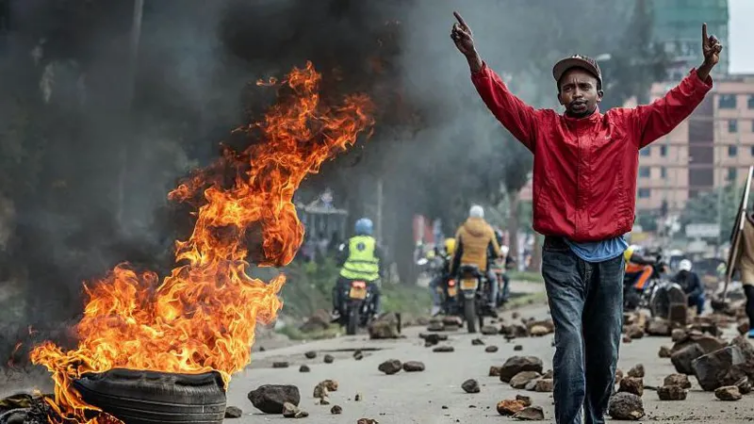
Local TV on Monday showed protesters barricading roads and lighting fires.
The strike comes days after the authorities raised petroleum prices to record levels, with costs increasing by more than 20%.
Kenya, like many other African countries, relies heavily on fuel imports from the Gulf, a supply route disrupted by the US-Israel conflict with Iran that began on 28 February. Even though a ceasefire has been declared, fuel prices have remained high as the Strait of Hormuz, where a fifth of the world's oil passes through, is still blocked.
In parts of Nairobi and elsewhere across the country, police clashed with protesters, using tear gas to disperse them. This came amid reports of demonstrators stopping and harassing some motorists.
Ahead of the strike, the police assured Kenyans that security measures would be in place and warned against any disruptive conduct.
The association representing transport operators had earlier urged all vehicle users, including private motorists, public transport buses (locally known as matatus) and truckers, to stay off the roads as part of a coordinated shutdown.
"This action is not only for transport operators, but for every Kenyan citizen," the Transport Sector Alliance (TSA) said in a statement.
The alliance has accused the government of not doing enough to shield Kenyans from the rising fuel prices, amid a broader high cost-of-living crisis.
It has called for the reversal of the price increases announced last week, and for fuel prices to be reduced by about 35%.
The Energy and Petroleum Regulatory Authority (Epra) on Thursday raised prices to a high of 242 shillings ($1.8; £1.4) a litre for diesel and petrol to $1.65.
Treasury Minister John Mbadi told local NTV station on Monday that the increase in fuel prices was "unfortunate" and acknowledged that it was hurting the economy.
He however said the strike was "completely uncalled for" and the government would only make decisions that are "informed and not emotional".
"Why are we trying to solve a global problem using domestic means?" he asked.
The high cost of fuel is being blamed for increases in the price of food and other basic goods and services, with public service vehicles already raising commuter fares.
Last month, the government cut VAT on fuel from 16% to 8% until July but there have been calls for it to do more.
Latest Stories
-
Poverty, illiteracy driving acceptance of vote-buying among women – Damongo Queen Mother
12 minutes -
Photos: Democracy Is Not For Sale forum in Savannah region
18 minutes -
GNFS launches 2026/27 National Anti-Bushfire campaign in Atebubu, records 62.8% reduction in bushfire cases
36 minutes -
I’ll vote for a female president; women are less likely to steal from the state – Okyeame Kwame
37 minutes -
More public education needed to stop vote-buying – Savannah Region MP
46 minutes -
Absa Bank commissions new head office, commits to strengthening operations in Ghana
49 minutes -
Republic Bank-JoyNews Habitat Fair clinic: Day 1 ends on positive note as patrons explore housing solutions at Junction Mall
53 minutes -
Vanderpuye: NDC welfare system needed to support former officials, cadres
57 minutes -
Chamber of Mines extends support to Akropong, Mampong Special Schools
60 minutes -
Tumu chiefs, MP back clearance of road corridor for Ghana-Burkina road corridor
1 hour -
‘Democracy Is Not For Sale’: Monetisation of elections could lead to wrong people entering Parliament – UDS lecturer
1 hour -
COCOBOD increases cocoa producer price to GH¢42,400 for 2026/27 season
1 hour -
Atebubu College of Education receives GETFund boost after years of infrastructure neglect
1 hour -
64 arrested over alleged unlawful possession of firearms at Achimota lounge
2 hours -
Savannah Regional Minister calls for clear rules to distinguish generosity from vote-buying
2 hours