

Audio By Carbonatix
A flawless defensive campaign has carried Tunisia to 2026, but history poses a familiar question: can control finally translate into progression?
They qualified for the 2026 World Cup without conceding a single goal, a feat of remarkable defensive mastery.
Yet for all their organization and consistency, Tunisia remains haunted by one stubborn truth: they have never escaped the group stage in six previous World Cup appearances. Can Sabri Lamouchi finally unlock the breakthrough?
Tunisia did not concede a single goal on its way to the 2026 World Cup, a statistic that reads less like form and more like design. Across their history, few teams have been as structurally reliable and as predictably contained.
And yet, the contradiction remains intact: six appearances, no passage beyond the group stage. Consistency has defined them. So has its ceiling. Under Sabri Lamouchi, Tunisia arrives with the same foundations but, perhaps, finally, a different margin for error.
Tunisia has long occupied a distinctive place in African football. They do not overwhelm opponents; they outlast them. While others chase moments, Tunisia manages matches, reducing games to a series of controlled exchanges where risk is rationed and space is negotiated rather than conceded.
It is a model that travels well but has historically struggled under the sharper demands of tournament football.
This time feels different, not because Tunisia has changed dramatically, but because they have refined what they already are.
The Road to 2026: Control without concession
Tunisia’s qualification campaign was not just effective; it was controlled to an unusual degree. They progressed unbeaten and without conceding, built on a defensive unit that treats positioning as a first principle rather than a last resort.
Opponents were not simply denied chances; they were guided away from danger, funnelled into areas where the threat dissipated.
Lamouchi’s appointment in early 2026 brought clarity after a period of drift. His approach is pragmatic but not passive: Tunisia defends with structure, presses in chosen moments, and attacks through rehearsed patterns rather than impulse.
The objective is not dominance but certainty.
*The Squad: Function over fame
This is a team constructed around roles rather than reputations, players defined less by what they produce individually than by what they enable collectively.
Captain Ellyes Skhiri anchors the side, dictating tempo through positioning and anticipation. Hannibal Mejbri injects verticality and unpredictability, while Anis Ben Slimane and Rani Khedira provide the balance that allows others to take calculated risks.
In defence, Montassar Talbi and Dylan Bronn prioritize control over confrontation, with Aymen Dahmen, whose calm decision-making often prevents shots from materializing. It is a back line that defends space as much as it defends the ball.
The attack remains the variable. Elias Achouri, Sebastian Tounekti, and Elias Saad offer pace and technical quality, but Tunisia’s forward play is still built on moments rather than momentum.
Their challenge is not creating chances in volume, but recognizing and maximizing the few they allow themselves.
*Hannibal and the missing spark
For all the defensive perfection, Tunisia still lacks a consistent cutting edge. Ellyes Skhiri provides control, and Wahbi Khazri brings experience, but the player who offers a different dimension is Hannibal Mejbri.
Young, technically gifted, and fearless on the ball, Hannibal is the one who can break lines, change tempo, and inject imagination into a side that sometimes feels too controlled.
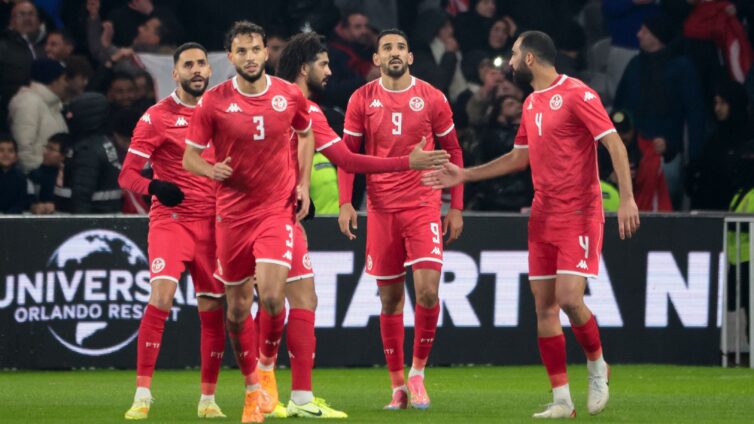
His goal in the final qualifier against Namibia was small in isolation, but symbolically important a hint that Tunisia might one day combine their famous discipline with genuine attacking threat.
*Tactical Identity: Structure as dtrategy
Tunisia typically operates in a 4-3-3 or 4-2-3-1, but their real system is spatial.
Distances are disciplined, lines are compact, and pressing is used selectively less to win the ball immediately than to shape where the next phase will occur.
They are particularly effective at redirecting attacks wide, where possession becomes less dangerous and more predictable. Matches against Tunisia often take on a familiar rhythm: circulation without penetration, pressure without payoff.
Set-pieces, then, become more than a supplement; they are a strategy. In a team that limits randomness, dead-ball situations provide one of the few controlled opportunities to tilt a game.
The risk, as ever, is that control without incision can turn into control without consequence.
*More than football
The national team carries weight beyond results.
Since the 2011 Jasmine Revolution, it has served as a point of cohesion in a shifting national landscape, an expression of discipline, resilience, and collective identity.
In that sense, Tunisia’s style is not incidental; it reflects something deeper. Order, patience, and structure are not just tactical choices but cultural ones.
A place in the knockout stage would not simply mark progress; it would validate a way of competing that is often overshadowed in a sport drawn to spectacle.
*Group F: Margins and matchups
Tunisia enters a demanding group alongside Sweden, Japan, and the Netherlands, three teams that will test different aspects of their system.
Sweden will challenge them physically and structurally. Japan will test its spacing and decision-making under movement.
The Netherlands will ask whether Tunisia can maintain control against a side built to manipulate it.
For Tunisia, progression will likely be decided in small moments: a set-piece, a defensive lapse avoided, a transition taken at the right time. Their margin is thin but clearly defined.
The defining question
Tunisia has mastered the art of qualification. They have once again proven that they belong at the World Cup.
Now comes the harder part: proving that perfection in qualifying can translate into something more dangerous once the tournament begins.
If Tunisia is to reach the knockout stage for the first time, it will not come from abandoning their identity but from stretching it, finding goals without losing control, and taking risks without losing shape. That is a narrow path, and one they have failed to walk before.
They have answered whether they can defend.
In 2026, they must finally answer the question of whether they can attack. What makes this moment different is not the scale of expectation but the precision of their preparation.
Tunisia is not chasing variance; they are trying to outgrow it.
And that is the real test in front of them, not whether they can compete, but whether a team built to eliminate chaos can produce just enough of it to change their history.
Latest Stories
-
He entered at eight. He is now 16: Ghana’s children growing up in prayer camps
2 minutes -
‘Development must not always begin from Accra’ — Anwelle Foundation launched in Jirapa
4 minutes -
PKO trio eye victories at Odwira Festival
3 hours -
346 Ghana Navy recruits pass out after 26 weeks of intensive training
3 hours -
Newsfile to discuss EOCO-MP arrest, drug trafficking, speech arrests and $235m water debt
3 hours -
JoyNews gets results as listeners raise GH¢40,000 to help 17-year-old student with cerebral palsy attend SHS
4 hours -
Vice President calls for stronger local pharmaceutical production to reduce medicine imports
4 hours -
The brewing tension at KNUST; Beware the Ides of October….
4 hours -
Health Ministry moves to integrate traditional medicine into mainstream healthcare
5 hours -
550 pupils in Kintampo South get educational lifeline as ‘Seeds of Hope’ reaches farming communities
5 hours -
Opoku Mensah urges Christian Council, House of Chiefs to speak up on democratic freedoms
5 hours -
Teacher unions’ strike: Minority demands immediate payment of teacher arrears, 20% deprived area allowance
5 hours -
The Accra-Kumasi Expressway: Building it right
6 hours -
Beyond gold exports: Building value and economic resilience from Ghana’s gold
6 hours -
2027 AFCONQ: Ghana under pressure as Gambia beat Somalia 2-1
6 hours