

Audio By Carbonatix
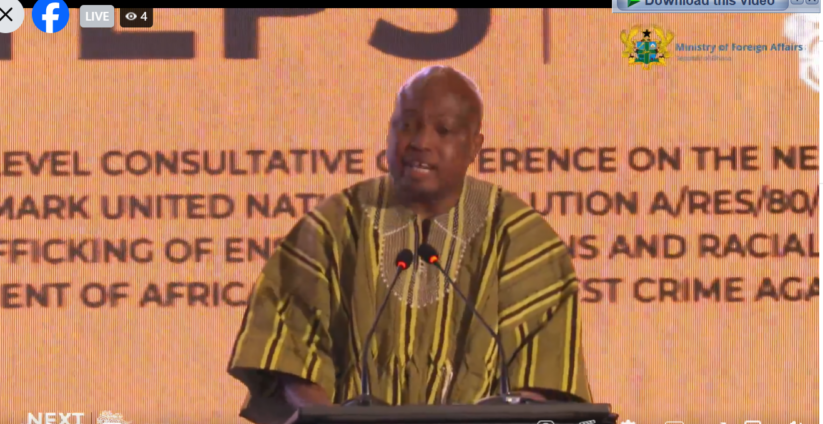
Foreign Affairs Minister Samuel Okudzeto Ablakwa says people who once dismissed Ghana’s United Nations resolution on the trans-Atlantic slave trade as merely an academic exercise is now being proven wrong, as reparatory justice gains global traction through apologies, acknowledgements and policy shifts.
Addressing heads of state, foreign ministers, scholars and members of the African diaspora, Mr Ablakwa said the issue of reparatory justice has moved beyond academic debate into firm global policy engagement.
He said that those who once dismissed the UN resolution must now be “revising their notes.”
He noted that the UN resolution, which declared the trans-Atlantic slave trade and enslavement of Africans as the gravest crime against humanity, has helped elevate the issue onto the international agenda.
According to him, developments since the adoption of the resolution show that skeptics who dismissed it as an “academic exercise” are now having to reconsider their position.
“The reports for these conversations demonstrate that reparatory justice is no longer a peripheral issue.
It is now firmly established as a legitimate global concern that demands serious engagement and thoughtful solutions,” he said.
Mr. Ablakwa pointed to a series of recent apologies and acknowledgements from global institutions as evidence of growing momentum.
“We have all heard the apology from Pope Leo XIV, the head of the Catholic fraternity, apologising for the role of the Catholic Church and the papal bulls that offered theological doctrinal justification for slavery,” he stated.
He added that Ghana, together with its global coalition led by President John Dramani Mahama, has accepted these apologies as part of wider reconciliation efforts.
“We have warmly accepted the apology,” he said.
Mr Ablakwa also referenced a similar apology from the leadership of the Church of Scotland over its historical role in slavery.
He further highlighted remarks by French President Emmanuel Macron, who has called for France to confront its colonial past and is expected to address the Accra conference.
“He has also led France to take steps to confront its colonial past, including moves to repeal the Code Noir—that deeply dehumanising set of laws which treated Africans as commodities,” he noted.
He also said Code Noir does not exist anymore.
Mr Ablakwa concluded that these developments confirm that reparatory justice can no longer be treated as an academic exercise, but as a serious global agenda shaping international discourse and policy.
Latest Stories
-
British couple on honeymoon killed in helicopter crash on Greek island
4 minutes -
Man, 20, drowns while helping travellers cross Ghana-Togo border river
13 minutes -
Top 10 online bill payment platforms in Nigeria
18 minutes -
Fire destroys more than 27 wooden structures at Spintex Coastal junction
21 minutes -
GoldBod: Day of reckoning will come – Afenyo-Markin
24 minutes -
In Photos: Defence Ministry welcomes Kenneth Gilbert Adjei as new Defence Minister
34 minutes -
CSA fines EY Ghana GH¢360,000 for providing cybersecurity services without a licence
42 minutes -
Bonsu Baah scores and assists in Al Qadsiah big win in Saudi King’s Cup
42 minutes -
The Galamsey war and GWL’s fictitious and inaccurate rebuttal
55 minutes -
Afenyo-Markin demands answers over alleged GH¢22bn GoldBod loss
56 minutes -
GoldBod ‘Losses’: We’re not ignorant, we know our job – Afenyo-Markin
59 minutes -
GoldBod cannot hide behind agency role to escape accountability – Afenyo-Markin
1 hour -
‘You don’t get to keep the fees and disown the costs’ – Afenyo-Markin challenges GoldBod
1 hour -
GNPC turns 40, targets oil production recovery and $3.5bn fresh investment
1 hour -
Minority will speak boldly on GoldBod losses despite attacks – Afenyo-Markin vows
1 hour