

Audio By Carbonatix
For years, Ghana stood out in West Africa for the wrong reason. It had no national food reserve system, even as neighbouring countries had already established theirs.
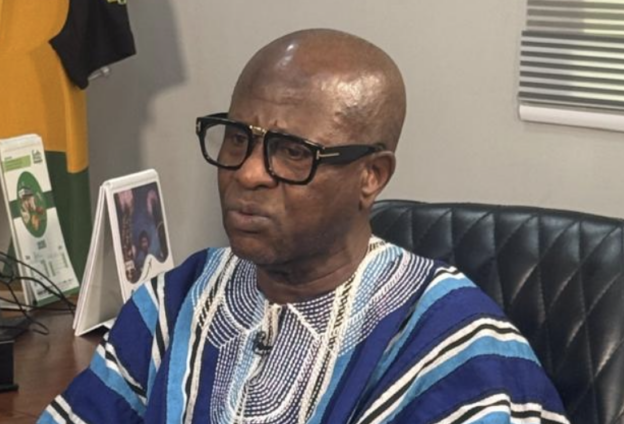
That revelation came from the CEO of the National Food Buffer Stock Company, George Abradu-Otoo, who described government’s recent efforts to build food reserves as a major policy shift despite severe funding constraints.
Speaking on JoyNews’ PM Express Business Edition on Thursday, Mr Abradu-Otoo said the company has so far received only ₵300 million for grain purchases, far below what is required to undertake a meaningful intervention.
“Last year, Minister of Finance Dr Ato Forson announced that they were giving us further ₵200 million to continue the good work that we were doing, so in other words, so far we had only ₵300 million,” he said.
According to him, the amount is insufficient for the scale of work expected from the Buffer Stock Company.
“If we need to do proper meaningful mopping up of excess grains, we need no less than ₵1.5 billion, so you can imagine what ₵300 million has done,” he stated.
Despite the shortfall, Mr Abradu-Otoo insisted the allocation represents an important first step toward establishing a national food reserve system.
“But it’s a good beginning because it hasn’t been done before. That’s where I draw my comfort from,” he said.
He noted that successive governments had never seriously pursued maintaining strategic food reserves, making the current initiative significant.
“It’s a good beginning for the government to even think in the first place that we need to have a national food reserve,” he added.
Mr Abradu-Otoo said Ghana’s absence from the list of countries with food reserves was particularly striking given developments elsewhere in the sub-region.
“Because if you take the West African sub-region, Ghana is the only country that did not have a food reserve, can you believe that?” he said.
He pointed to neighbouring countries that had already established such systems.
The Buffer Stock CEO’s comments come as government seeks to strengthen food security and stabilise prices by purchasing excess grains from farmers and storing them for future use.
However, his remarks suggest that achieving that objective on a meaningful scale will require substantially higher investments than those committed so far.
For now, Mr Abradu-Otoo believes the most important breakthrough is that Ghana has finally begun taking steps toward building a strategic food reserve, a policy many of its West African neighbours embraced years ago.
Latest Stories
-
Prince Harry and Meghan moving back to UK
13 minutes -
Ghana’s output expansion largely driven by labour, capital rather than innovation – Opoku-Afari
15 minutes -
Ghana is ready for nuclear power adoption – Gov’t affirms
20 minutes -
GJA@77: Media-government partnership vital to Ghana’s democracy – Shamima Muslim
32 minutes -
LUV FM High School Debate: Opoku Ware and St. Hubert Seminary book quarterfinal spots
38 minutes -
Stronger research, industry linkages needed to build a competitive digital economy – Deloitte Technology Senior Manager
40 minutes -
Economy experience high but unbalanced growth from mid-2000 to 2022 debt crisis – Former 1st Deputy Governor
56 minutes -
Tell Your Story: Political, business and industry leaders to share journey with young Ghanaians
1 hour -
‘Gold cannot save you at 2am’ – Obuobia Darko challenges mining giants to invest in healthcare
1 hour -
Wontumi’s incarceration will not stop his chairmanship bid – Palgrave
1 hour -
Eurobond borrowings over 2007-2021 used for budget financing; Ghana borrowed US$15.59bn – Opoku-Afari
1 hour -
Newborn baby found in dustbin at Kasoa Main Station toilet
2 hours -
Ghanaian skincare brand KAEME wins DHL ESG Excellence Exporter of the Year award
2 hours -
Ho Communique: Democracy Not for Sale
3 hours -
National Health Insurance Levy Uncapped: The Game Changer
3 hours