

Audio By Carbonatix
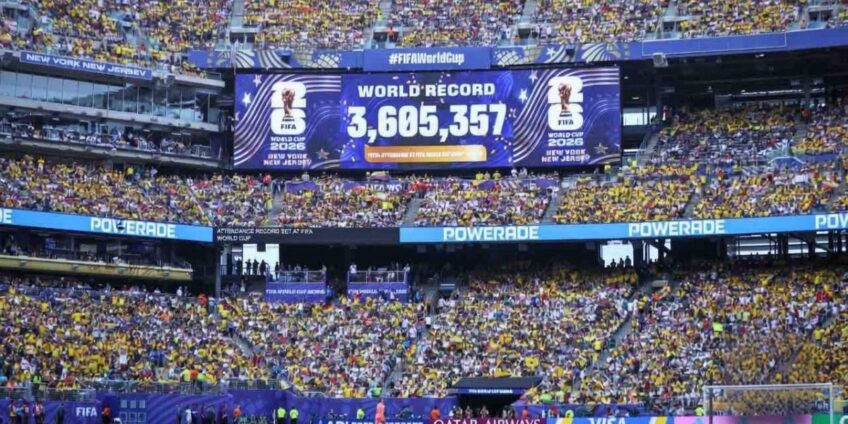
The 2026 Men's World Cup has officially surpassed the standing all-time attendance record. During Thursday's action at New York-New Jersey Stadium, the tournament moved past the mark of 3,587,538 fans, which had stood since the 1994 tournament in the United States. FIFA confirmed the threshold was crossed during the match between Ecuador and Germany. By the conclusion of the subsequent Côte d'Ivoire-Curaçao fixture at Philadelphia Stadium, the total reached 3,605,357. This number continues to climb as the tournament progresses toward its conclusion on July 19.
A Moment of Recognition on the Pitch
The historic shift occurred during the 65th minute of the match at New York-New Jersey Stadium. FIFA representatives, joined by German legend and 2014 World Cup champion Sami Khedira, honoured a specific fan identified as number 3,587,539 on the field. This recognition took place during a hydration break, marking the official transition into record-breaking territory. FIFA stated, "The 2026 FIFA World Cup™ has officially set a world record as the highest-attended event, with 3.6 million attendees and counting."
Drivers of Unprecedented Attendance
Several structural changes to the 2026 format have accelerated the path to this record. This year marks the first expansion to 48 teams, an increase of 12 nations compared to the 2022 tournament in Qatar. Consequently, the schedule features 104 matches, representing 40 more games than the previous cycle. Additionally, the reliance on large-scale NFL venues across the United States has boosted capacity significantly. While many stadiums in Qatar maxed out near 45,000, U.S. venues frequently accommodate between 60,000 and 80,000 spectators. MetLife Stadium, a primary host, holds 82,500 for sporting events, contributing to a tournament-wide stadium occupancy rate of 99.7 percent.
Perspectives from Leadership and Players
FIFA President Gianni Infantino has expressed strong satisfaction with the event's reach and atmosphere. Highlighting the demographic diversity within the stands, Infantino remarked, “Stadiums are full, cities are full, the ambience is great. We have many families, many children, many women in the stadium, and this is really beautiful.” He further characterised the tournament as the “most successful event in history.”
The expanded format has also provided a global platform for smaller nations to create lasting memories. Cape Verde goalkeeper Vozinha, who gained widespread attention after a standout performance against Spain, reflected on the emotional weight of the tournament. “It’s the best moment in my life, the best experience I’ve had in what I love,” he noted. “And there are no words that I can describe this moment.”
African Football on the Global Stage
The 2026 tournament has provided a historic stage for African nations to prove their mettle against footballing giants. Ghana’s Black Stars have captured the imagination of fans across the continent, entering their pivotal group-stage stretch with newfound momentum and tactical resilience. Having secured a hard-fought draw against tournament heavyweights England, the Black Stars carry the hopes of a passionate fan base into their upcoming clash against Croatia. This fixture, held at Philadelphia Stadium, represents more than just a match; it serves as a litmus test for Africa's competitive standing on the world's most prestigious stage.
Sustaining the Tournament Momentum
Thursday also established a new daily attendance record, with 384,206 fans recorded across the day’s slate of matches. The tournament shows no sign of slowing, with major fixtures still scheduled, including the high-stakes Croatia-Ghana match in Philadelphia and a highly anticipated Round of 16 game on the Fourth of July. As the event heads toward its final, the total attendance figures will continue to rise well beyond the current 3.6 million milestone. While the expanded format and increased capacity have undeniably fueled these record-breaking numbers, the true test of the tournament’s legacy will be how these logistical successes translate into long-term growth for the sport in host regions and the competitive integrity of the matches moving forward.
Latest Stories
-
Vieira named new Senegal head coach
1 hour -
Global borrowing costs hit fresh highs on oil, AI and inflation
1 hour -
American Airlines to bring back TV screens on US flights
2 hours -
Carney’s final chance to convince Trump as US-Canada trade deadline looms
2 hours -
BOSTenergies meets fuel tanker drivers over their concerns at the Kumasi depot
2 hours -
X1 Energy Drink-backed DOL Super Cup ends with Ebusua Dwarfs crowned champions
2 hours -
Disney and ABC sue Trump’s media regulator to stop early licence renewal
2 hours -
Luv FM High School Debate: Prempeh dethroned as CHRISSEC and KUHIS ignite quarter-final path
2 hours -
British couple on honeymoon killed in helicopter crash on Greek island
2 hours -
George Opare Addo to lead National Youth Forum in Accra
2 hours -
ECG invested GH¢710,965 in infrastructure replacement across Greater Accra – PURC
2 hours -
Cyber Security Authority, EY resolve satisfactorily matters relating to licence fees
3 hours -
Beyond the ribbon: Why the sport of dog showing matters for every pet owner
3 hours -
Illegal mining drives Ghanaian children from classrooms into hazardous labour
3 hours -
NACOC committed to strengthening border security – DG
3 hours