

Audio By Carbonatix
Ghana does not lack information about flooding, but the country’s biggest challenge is turning existing knowledge into effective action, a Public Health Researcher, Judith William, has said.
Judith William of Ensign Global University said researchers already have enough evidence on flood-prone communities, vulnerable populations and the health risks associated with flooding, but weak implementation continues to undermine preparedness efforts.
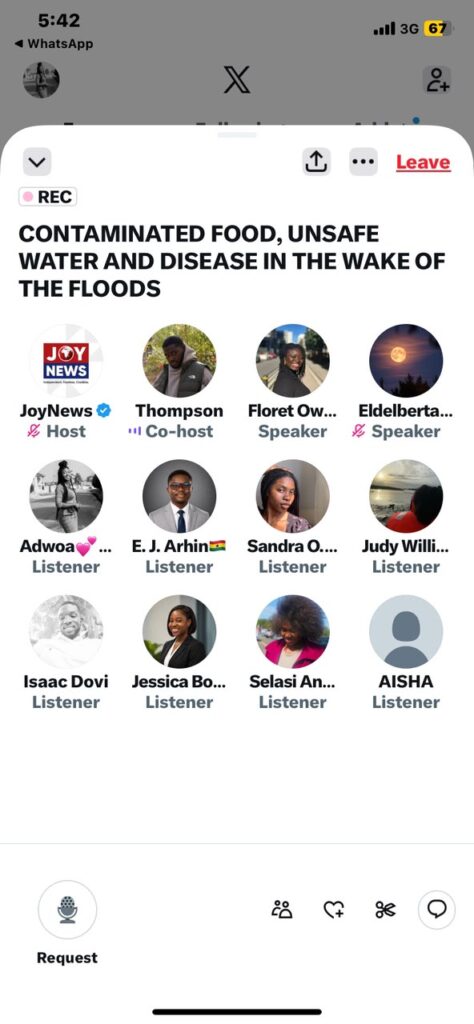
Speaking during the seventh edition of the Loud and Green XSpaces conversation hosted by JoyNews, she challenged the view that inadequate data is the main reason flooding continues to trigger public health emergencies.
“We know which neighbourhoods flood. We know which populations lose access to essential services every single time,” she said.
“We know what to do. What we need is the systems and the will to act.”
According to Ms William, years of research have produced recommendations on improving flood preparedness, disease prevention and emergency response, but many of these proposals have not been translated into practical interventions.
She said continued research alone would not solve Ghana’s flood challenges without commitment from institutions responsible for implementing solutions.
“We can research and research and provide all the solutions we need, but if there is no willingness to implement the recommendations, then the research becomes pointless,” she stated.
The Public Health Researcher also urged the public to rely on credible sources, including the Ghana Health Service, scientific publications and verified media platforms, for accurate information on flood-related health risks.
The discussion, which focused on “Contaminated Food, Safe Water and Disease in the Wake of Floods,” highlighted the need for stronger coordination between researchers, policymakers and communities.
Participants stressed that reducing the health impact of flooding requires more than collecting data, but sustained political commitment, investment in prevention and the effective application of evidence already available.
She maintained that Ghana’s ability to manage future flood emergencies will depend largely on whether existing knowledge is matched with decisive action.
Latest Stories
-
Civilian hospitalised after alleged machete attack by prison officers
15 minutes -
Toobu rejects calls to recall Parliament over 3.9-tonne cocaine shipment
57 minutes -
Residents in 5 Northern Regions warned of approaching rainstorm
59 minutes -
Constituency Games still a work in progress – Sports Minister
1 hour -
Team Ghana set for historic Karting Africa Showrun in Angola
1 hour -
52-year-old South African arrested with suspected heroin after arriving from Accra
2 hours -
Shatta Wale challenges UPSA students to build entrepreneurial mindsets
2 hours -
Finance Minister advises African governments to strengthen regional tax cooperation
4 hours -
NPP accuses NDC of master-minding demolition of Ho regional office fence
4 hours -
Ghana plans stronger regional power trade with Nigeria
4 hours -
GRA Commissioner-General calls for stronger tax cooperation to boost regional revenue mobilisation
4 hours -
NACOC needs more personnel to tackle drug trafficking – Toobu
4 hours -
Railway workers resist KMA eviction order, demand consultation
4 hours -
Legacy Leadership Africa Institute to host boardroom women’s leadership programme
4 hours -
Ghana needs a law to sustain constitutional reforms – CDD-Ghana
7 hours