

Audio By Carbonatix
The World Health Organization (WHO) has warned that Africa risks losing decades of progress in tackling major health challenges unless governments increase domestic financing to strengthen health systems.
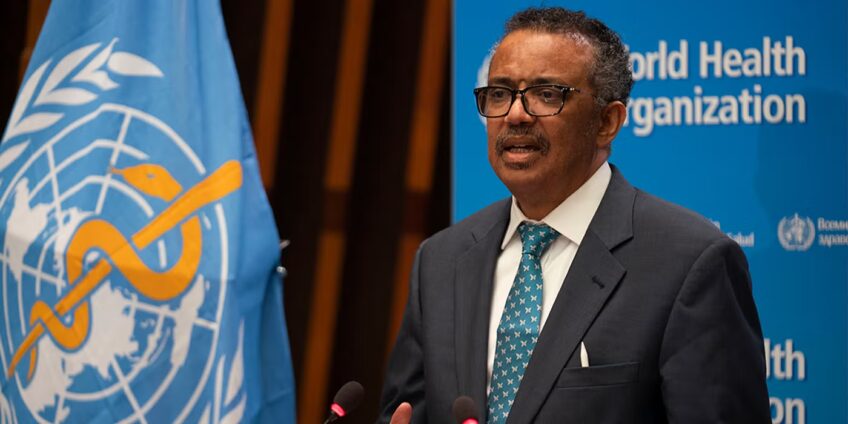
WHO Director-General Dr. Tedros Adhanom Ghebreyesus issued the warning at the African Union’s first Extraordinary Summit dedicated to health, held in Accra, where he urged African leaders to make health sovereignty a key political priority.
According to Dr. Tedros, while the continent has recorded significant gains in the fight against diseases such as HIV, tuberculosis and malaria, declining external support threatens to reverse those achievements.
“Africa has made extraordinary progress against HIV, with new infections down 40% since 2010. But Africa still carries the heaviest burden, and as external funding declines, we risk losing ground,” he said.
He noted that the challenge extends beyond HIV, affecting maternal health, tuberculosis, malaria, neglected tropical diseases and the growing burden of non-communicable diseases.
“These are not separate crises. They are one crisis, and systems are not yet strong enough to protect every person on this continent,” Dr. Tedros said.
The WHO Director-General also highlighted the impact of conflicts on public health, citing the Ebola outbreak in Bunia, Ituri Province, where insecurity has slowed contact tracing efforts and limited health workers’ access to affected communities.
He stressed that addressing Africa’s health challenges requires tackling underlying social and economic factors, including poverty, poor education, unsafe water and gender inequality.
“Beating disease alone is not enough. We must also tackle what drives it: conflict, poverty, poor education, unsafe water and gender inequality,” he added.
Dr. Tedros called on African governments to prioritise domestic resources for healthcare, invest in primary healthcare systems, promote local manufacturing of medical products and use scientific innovations to improve health outcomes.
“Only Africa’s leaders can deliver the political will and domestic investment this moment requires,” he said.
He assured African leaders of WHO’s continued partnership through technical support and guidance, but urged governments to take ownership of the continent’s health future.
The Accra summit is expected to produce a roadmap aimed at improving health financing, strengthening healthcare systems and reducing Africa’s dependence on external support.
Latest Stories
-
He entered at eight. He is now 16: Ghana’s children growing up in prayer camps
22 minutes -
‘Development must not always begin from Accra’ — Anwelle Foundation launched in Jirapa
24 minutes -
PKO trio eye victories at Odwira Festival
3 hours -
346 Ghana Navy recruits pass out after 26 weeks of intensive training
3 hours -
Newsfile to discuss EOCO-MP arrest, drug trafficking, speech arrests and $235m water debt
4 hours -
JoyNews gets results as listeners raise GH¢40,000 to help 17-year-old student with cerebral palsy attend SHS
4 hours -
Vice President calls for stronger local pharmaceutical production to reduce medicine imports
4 hours -
The brewing tension at KNUST; Beware the Ides of October….
5 hours -
Health Ministry moves to integrate traditional medicine into mainstream healthcare
5 hours -
550 pupils in Kintampo South get educational lifeline as ‘Seeds of Hope’ reaches farming communities
5 hours -
Opoku Mensah urges Christian Council, House of Chiefs to speak up on democratic freedoms
6 hours -
Teacher unions’ strike: Minority demands immediate payment of teacher arrears, 20% deprived area allowance
6 hours -
The Accra-Kumasi Expressway: Building it right
6 hours -
Beyond gold exports: Building value and economic resilience from Ghana’s gold
6 hours -
2027 AFCONQ: Ghana under pressure as Gambia beat Somalia 2-1
6 hours