

Audio By Carbonatix
Minister for Finance, Dr Cassiel Ato Forson, says the unchecked liabilities of state-owned enterprises (SOEs) added the equivalent of about 3% of Ghana's Gross Domestic Product (GDP) to the country's public debt every year over the last decade, describing the situation as a major driver of the nation's debt crisis.
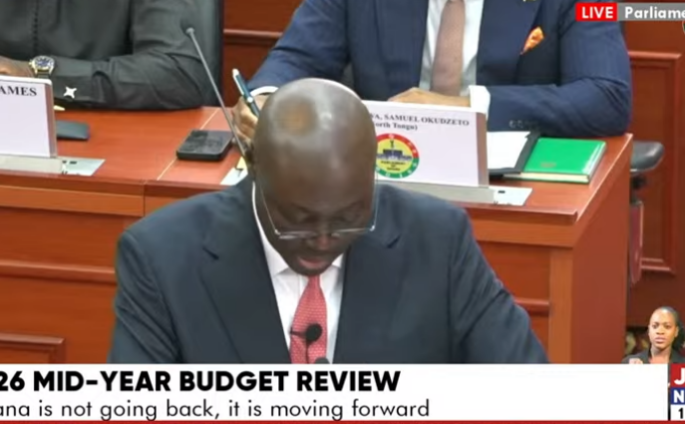
Presenting the 2026 Mid-Year Budget Review in Parliament on Thursday, July 23, Dr Forson announced that, for the first time, state-owned enterprises have been brought under the government's commitment authorisation regime to prevent them from spending beyond their means.
"For the first time, state-owned enterprises are now bound by the commitment authorisation, restraining them from spending beyond their means.
Over the last 10 years, liabilities of state-owned enterprises have added the equivalent of about 3% of GDP to Ghana's public debt every single year," he said.
According to the Finance Minister, the persistent failure of SOEs to meet their contractual obligations forced successive governments to assume and settle those debts, placing an enormous burden on the public purse.
"This occurred because state-owned enterprises failed to honour their contractual obligation, compelling government to assume and settle those liabilities. This contributed to the sharp rise in Ghana's public debt."
Dr Forson said the growing debt burden deprived the country of resources that could have been invested in critical infrastructure and public services.
"The resources that would have financed critical infrastructure were used to pay those SOEs' debt. This is part of the reason why Ghana's debt grew unsustainably without the bridges, roads or hospitals," he stated.
He argued that enforcing fiscal discipline only within ministries and government departments would be ineffective if state-owned enterprises continued to accumulate liabilities that eventually fell on taxpayers.
"What is the point of ensuring that ministries and even Parliament live within their means if state-owned enterprises are permitted to run up liabilities that taxpayers are ultimately forced to pay?" he questioned.
The Finance Minister maintained that Ghana's debt challenge was driven not only by fiscal deficits but also by the unchecked accumulation of liabilities by state-owned enterprises.
"It is therefore important to recognise that Ghana's debt challenge was driven not only by fiscal deficits, but also by the unchecked accumulation of liabilities by state-owned enterprises.
This is precisely why the commitment authorisation regime would have been meaningless and ultimately ineffective had state-owned enterprises been excluded from its coverage."
Dr Forson said bringing SOEs under the commitment authorisation framework forms part of broader public financial management reforms aimed at strengthening fiscal discipline, improving debt sustainability and preventing the recurrence of off-balance-sheet liabilities that have contributed to Ghana's debt accumulation.
Latest Stories
-
KATH marks 70th anniversary with inter-directorate games
30 minutes -
Black Stars: Godwin Attram replaces Desmond Ofei as assistant coach
37 minutes -
Nkrumah never dies
1 hour -
CalBank ‘Abakade Promo’ rewards 5 customers with GH¢25,000 in first draw
1 hour -
Ecobank, Joy Business to host financial dialogue on green finance and inclusive agri-growth in Ghana
2 hours -
Nkrumah’s vision remains relevant to Ghana’s future — Mahama
2 hours -
Hitz FM announces Beach Rave for October 31
2 hours -
CPP calls for protection and revival of state-owned enterprises to honour Nkrumah
2 hours -
emPLE Life Insurance named Rising Brand of the Year at 6th CIIG Insurance Excellence Awards
2 hours -
St Peter’s old boys to build 1,000-seater dining hall and modern kitchen for 70th anniversary
2 hours -
Yango Fellowship brings together tech talent from six African countries to build locally rooted solutions
2 hours -
St Peter’s old boys kick off 70th anniversary journey with ‘Run to 70’
3 hours -
Agyemang-Badu urges GFA, Sports Ministry to disclose Carlos Queiroz’s contract terms
3 hours -
Ghana and Panama sign MoU to deepen bilateral political consultations and cooperation
3 hours -
Black Stars: Mohammed Fuseini receives late call-up for September-October games after head injury
3 hours