

Audio By Carbonatix
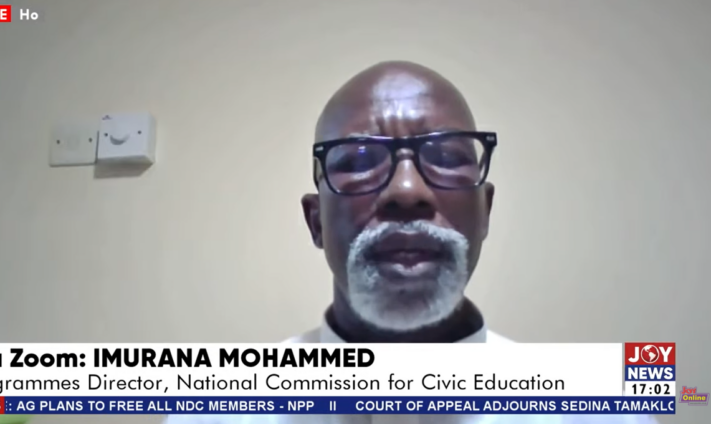
The Programmes Director of the National Commission for Civic Education (NCCE), Imurana Mohammed, has attributed the growing acceptance of vote-buying and electoral inducements in Ghana to the failure of democracy to deliver basic socio-economic needs.
Speaking at the 'Democracy Is Not For Sale' dialogue organised by the JoyNews Impact Makers Foundation, Mr Mohammed said while some Ghanaians have become disillusioned with democratic governance, the solution is not to abandon democracy but to ensure it delivers meaningful improvements in people's lives.
According to him, Ghana's Constitution recognises that a strong democracy is one that guarantees citizens access to the basic necessities of life.
"There is a very profound provision in our Constitution that says that the most secure democracy is the one that assures the basic necessities of life for its citizens," he explained via Zoom in Ho on Thursday, July 31.
He noted that growing public frustration with democracy stems from unmet expectations, as many citizens continue to struggle with inadequate access to essential services despite participating in successive elections.
"People have talked about the disenchantment of our citizens with democracy and to some extent some are calling for us to go back to the bad old days."
Rejecting any suggestion of returning to military rule, Mr Mohammed described previous periods of unconstitutional governance as "very bad old days."
"I say they are very bad old days."
He argued that democracy should be viewed as a vehicle for achieving socio-economic development rather than an end in itself.
"I think that the disenchantment stems from the fact that democracy is not an end in itself. It's a means to socio-economic development."
Mr Mohammed said when citizens continue to lack access to basic amenities such as roads, potable water and healthcare, they become more susceptible to accepting inducements during elections.
"When people feel that after several years of going to vote, access to roads is a problem, access to potable water is a problem, access to healthcare is a problem, very little things will stop them from taking handouts in order to go and vote."
He stressed that addressing vote-buying requires tackling the structural socio-economic conditions that make voters vulnerable, rather than focusing solely on enforcement.
"So primarily these are the structural issues that push people into accepting rights and then giving rights."
Latest Stories
-
Margaret-Marie Krakue
2 minutes -
Ayariga announces plans for live broadcast of MMDAs’ meetings on local radio stations
5 minutes -
Mrs Anna Tackie
7 minutes -
Ghana links Afghan heroin and Brazilian cocaine to global drug markets – Global Organised Crime Index
14 minutes -
NHIA launches nationwide inter-school quiz to deepen students’ knowledge of NHIS
21 minutes -
Political protection could be masking Ghana’s cocaine trade – Global Organised Crime Index
26 minutes -
AFCON 2027Q: ‘We have to dissolve the GFA’ – Effia MP after Black Stars lose to Gambia
28 minutes -
NPP announces voting schedule and ID requirements for October 3 national elections
30 minutes -
Lupus can mimic HIV symptoms and damage kidneys if untreated – KNUST expert
33 minutes -
Focus on Sickle Cell Foundation seeks to introduce sickle cell education through comics in Ghanaian schools
39 minutes -
NPP rewrites the campaign playbok as opposition reality shapes National Executive contest
40 minutes -
Road safety education will fail without enforcement – NRSA boss
41 minutes -
Daily Insight for CEOs: Finishing Q3 strong and entering Q4 with purpose
42 minutes -
National Ambulance Service begins ‘Operation Restore Fleet’ to restore grounded ambulances
43 minutes -
GNFS rescues 35-year-old driver trapped in overturned tipper truck in Upper East
44 minutes