

Audio By Carbonatix
The Institute of Statistical, Social and Economic Research (ISSER) has cautioned that Ghana's improving fiscal performance may be coming at the expense of long-term economic growth, arguing that the government's stabilisation efforts are being driven more by spending cuts than stronger revenue mobilisation.
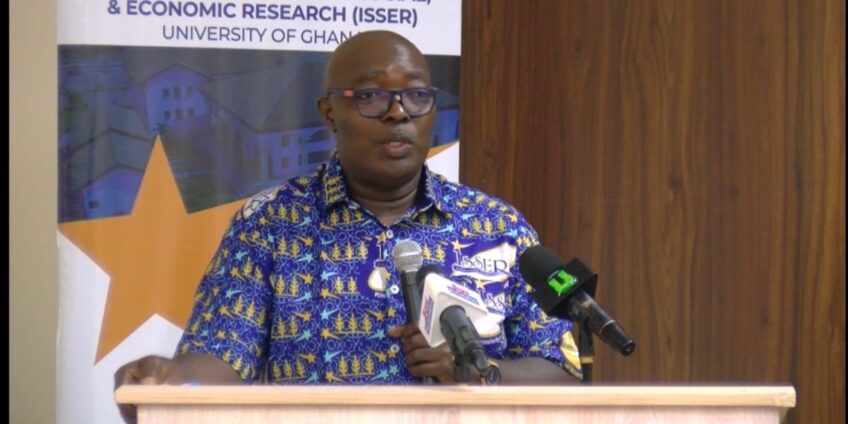
Presenting ISSER's assessment of the 2026 Mid-Year Budget Review, the Institute's Director, Professor Robert Darko Osei, said although the government had broadly met its fiscal targets, the manner in which those targets were achieved raises concerns about the sustainability of the country's economic recovery.
"The question you need to ask is: how were those targets achieved?" Prof. Osei said, urging policymakers to look beyond the headline fiscal figures.
According to ISSER, total revenue and grants fell just 1.03% short of target during the first half of 2026, suggesting that domestic revenue mobilisation remained largely on track, albeit slightly below expectations.
Government expenditure, however, painted a different picture.
ISSER's analysis showed that total spending was 20.6% below budget, indicating that Ghana's improved fiscal position was achieved largely through expenditure restraint rather than stronger revenue performance.
"Revenue targets were missed by only about one per cent. But expenditure was significantly lower than programmed," Prof. Osei noted.
The Institute observed that the sharpest reduction occurred in capital expenditure, spending on infrastructure and other productive investments that support long-term economic growth.
While the government budgeted approximately GH¢36.6 billion for capital projects during the first half of the year, it spent only about GH¢21.7 billion, leaving capital expenditure roughly 41% below target.
For ISSER, the trend poses significant risks to the country's future growth prospects.
"Capital expenditure is critical for growth and development. We planned to spend GH¢36 billion, but only spent about GH¢21 billion in the first half of the year," Prof. Osei said.
The Institute warned that prolonged underinvestment in infrastructure could weaken Ghana's productive capacity, delay job creation and constrain future economic growth, even as key macroeconomic indicators improve.
ISSER also questioned what the slowdown in capital spending means for the government's flagship Big Push infrastructure programme, which has been presented as a key pillar of Ghana's economic transformation agenda.
"The delayed capital expenditure goes against the Big Push programme that government has emphasised," Prof. Osei observed.
The concerns come against the backdrop of subdued performance in the construction sector, which expanded by just 1.3% during the first quarter of 2026 despite the government's ambitious infrastructure agenda.
According to ISSER, the modest growth suggests that many planned projects remain in their early stages and are yet to generate significant economic activity.
While acknowledging that expenditure restraint has enabled the government to outperform programme targets on the fiscal deficit and primary balance, the Institute cautioned against relying excessively on spending cuts to achieve macroeconomic stability.
"The first-half fiscal performance has largely been driven by lower-than-budgeted expenditure. Revenue mobilisation has not performed particularly strongly," Prof Osei said.
"The key question is: at what cost? Capital expenditure was the hardest hit, and that raises serious questions about the cost of stabilisation."
ISSER concluded that although Ghana is making progress towards restoring macroeconomic stability, sustaining that progress will require a better balance between fiscal consolidation and productive public investment.
Latest Stories
-
Kodua dismisses rift fears, says he and John Boadu are focused on NPP victory
46 minutes -
‘There is no competition’ – Justin Kodua confident of NPP General Secretary re-election
2 hours -
J100 Accra Doubles Champions : Kolesolva/ Ndukwa, Agarwal/Patel seal title victories
2 hours -
Sydney Wright crowned J100 Accra Champion
2 hours -
J100 Accra Boys’ Singles: Verma denies Beckles back-to-back titles to claim crown
2 hours -
Two friends fined GH¢12,000 for stealing
2 hours -
Son jailed for threatening to stab mother
3 hours -
Drive constitutional reform – GJA urges journalists
3 hours -
NPP Delagates Congress: Confusion delays voting at Ashanti Region TESCON centre
4 hours -
Fire ravages shops, houses near Koforidua Central Police Station
4 hours -
NPP Delegates conference: The wisdom of the masses will prevail – Napo
5 hours -
Flydubai co-pilot attacked captain with axe, UAE official says
5 hours -
NPP Bosome Freho Constituency Chairman reportedly arrested over ballot paper incident
5 hours -
Medical plane with 6 on board missing off Massachusetts coast
5 hours -
Bolt driver jailed 25 years for robbing beautician
5 hours