


Audio By Carbonatix
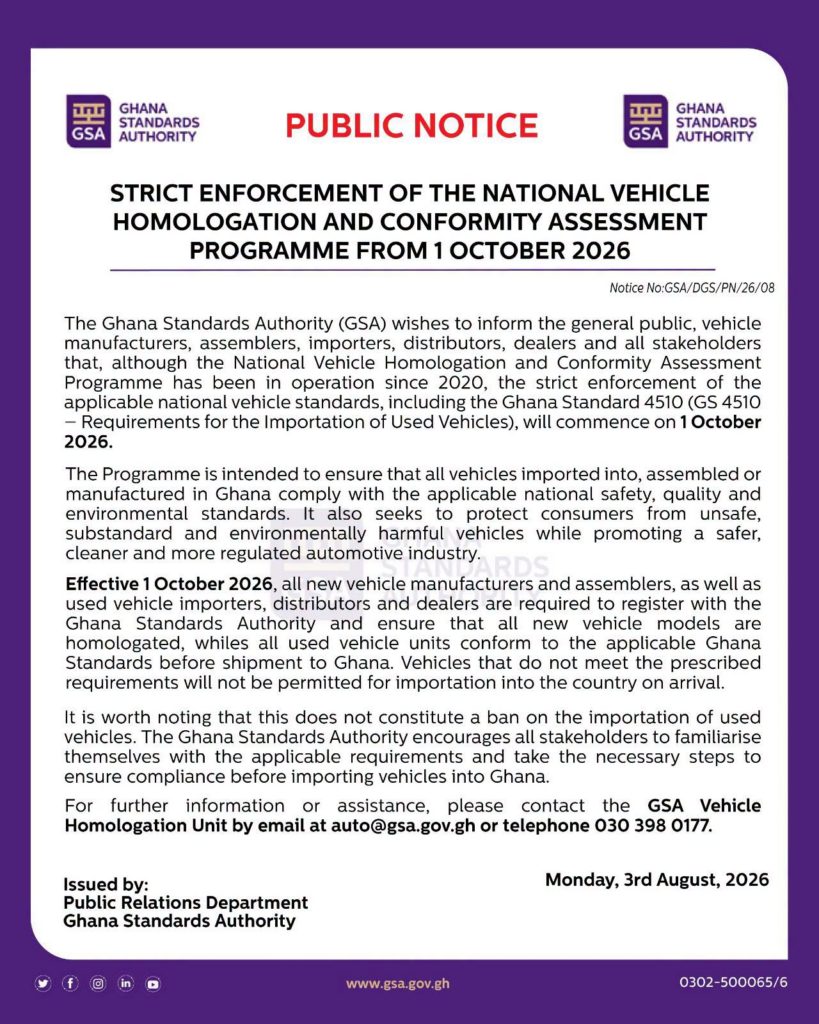
The Ghana Standards Authority (GSA) has clarified that the strict enforcement of the National Vehicle Homologation and Conformity Assessment Programme, scheduled to begin on October 1, does not amount to a ban on the importation of used vehicles into Ghana.
The Authority said the new measures are intended to ensure that vehicles entering the country meet approved national safety, quality and environmental standards before shipment, rather than prevent the importation of used cars.
In a statement issued on Monday, August 3, the GSA explained that the enforcement will require vehicle manufacturers, assemblers, importers, distributors and dealers to comply with established requirements to improve safety standards and protect consumers from unsafe and substandard vehicles.
The Authority noted that vehicles which fail to meet the required standards will not be allowed into the country.
“Effective 1 October 2026, all new vehicle manufacturers and assemblers, as well as used vehicle importers, distributors and dealers are required to register with the Ghana Standards Authority and ensure that all new vehicle models are homologated, while all used vehicle units conform to the applicable Ghana Standards before shipment to Ghana.
“Vehicles that do not meet the prescribed requirements will not be permitted for importation into the country on arrival,” part of the statement read.
The GSA said the National Vehicle Homologation and Conformity Assessment Programme has been operational since 2020, but the strict enforcement of applicable standards, including Ghana Standard GS 4510 (Requirements for the Importation of Used Vehicles), will commence on 1 October 2026.
Under the new regime, vehicle manufacturers and assemblers will be required to register with the Authority, while new vehicle models introduced onto the Ghanaian market must undergo homologation to confirm that they meet the required technical standards.
Used vehicle importers, distributors and dealers will also be required to ensure that imported vehicles comply with the applicable Ghana Standards before they are shipped to Ghana.
The enforcement of the standards will require importers and dealers to consider compliance requirements during the sourcing and purchasing stages of vehicles before shipment.
For manufacturers and assemblers, the homologation requirement means that new vehicle models will have to undergo the prescribed assessment and approval processes before they can be introduced into Ghana.
For used vehicle importers, the major change will be the obligation to confirm that vehicles meet the required standards before shipment. This is expected to reduce instances where vehicles arrive in Ghana and are rejected for failing to satisfy regulatory requirements.
The GSA said the programme is designed to protect consumers from unsafe, substandard and environmentally harmful vehicles while promoting a safer, cleaner and more regulated automotive industry.
The Authority has therefore encouraged all stakeholders to begin preparations ahead of the October 2026 deadline to avoid compliance-related disruptions.
“It is worth noting that this does not constitute a ban on the importation of used vehicles. The Ghana Standards Authority encourages all stakeholders to familiarise themselves with the applicable requirements and take the necessary steps to ensure compliance before importing vehicles into Ghana,” the statement added.
The enforcement date forms part of the GSA’s implementation of the Pre-Export Verification of Conformity (PVoC) programme for vehicle imports.
The programme is designed to ensure that used vehicles imported into Ghana comply with GS 4510, the national standard governing the importation of used vehicles, before they are shipped from the exporting country.
Through the PVoC programme, the GSA aims to prevent the entry of unsafe and substandard vehicles, improve compliance with Ghana’s safety and environmental requirements, strengthen the traceability of imported vehicles, and protect consumers and the environment.
Inspections under the programme will be conducted based on the requirements of GS 4510. Vehicles with major damage or safety concerns will not be permitted for importation.
These include vehicles that have been:
- Submerged in water or damaged by floods;
- Burnt or consumed by fire;
- Damaged in the chassis or safety cage, including broken, cracked, bent or twisted structures.
The standard also prohibits the importation of certain categories of vehicles, including originally manufactured right-hand-drive vehicles, vehicles assembled from spare parts, vehicles without speedometers displaying readings in kilometres per hour, and over-aged vehicles exceeding 10 years.
The Ghana Standards Authority has urged all stakeholders in the automotive sector to familiarise themselves with the requirements and take the necessary steps to ensure full compliance before the enforcement date.
Latest Stories
-
Mr President, Ghana was mentioned at the UN; why aren’t we talking about it?
1 hour -
Accra to convene Africa’s regulators and markets on tokenisation at AVAS 2026
1 hour -
The Paradox of Plenty — When every smartphone becomes a newsroom
2 hours -
GTA sensitises taxi drivers in ‘Know Ghana’ tourism campaign
3 hours -
Archbishop Agyinasare calls for responsible speech amid growing social media abuse
3 hours -
‘It will be inexcusable for gov’t not to honour payment of teachers’ arrears by 30th October’ – Haruna Iddrisu
3 hours -
Forbes’ World’s Best Employers 2026: No Ghanaian firm ranked among 900 companies
3 hours -
Electronic processing of teachers’ data: ‘The decision is the Controller’s’ – GES boss
3 hours -
Teachers’ Strike: Haruna Iddrisu questions paper-based processing of promoted teachers’ data
4 hours -
Savannah Region: Kunfusi bridge collapses again, leaving nearly 4,000 residents cut off
4 hours -
Teachers’ strike: GES targets Monday deadline to submit promotion data to Controller
4 hours -
Inflation to average 11.3% in 2027 – Fitch Solutions
4 hours -
‘I didn’t campaign for NDC to come and do this nonsense’ – Kpebu on EOCO’s conduct
4 hours -
Fitch Solutions maintains policy rate forecast of 14% by December 2026
4 hours -
Diaspora Nasara Caucus congratulates Mohammed Ali Suraj, new NPP executives
6 hours