

Audio By Carbonatix
We have become too comfortable calling control “love.”
A jealous partner checking a phone is described as caring. A girlfriend demanding constant updates is portrayed as being deeply interested. Emotional blackmail is dismissed as a normal part of relationships. And when a man complains about being controlled by his partner, he may be told to “man up”.
This is where society gets it wrong.
Love should make people feel valued, respected and secure. It should not make someone feel watched, guilty, afraid or powerless.
Yet manipulation remains one of the least recognised problems in modern relationships because it rarely looks like abuse at first.
There may be no bruises. No broken furniture. No neighbours hearing screams.
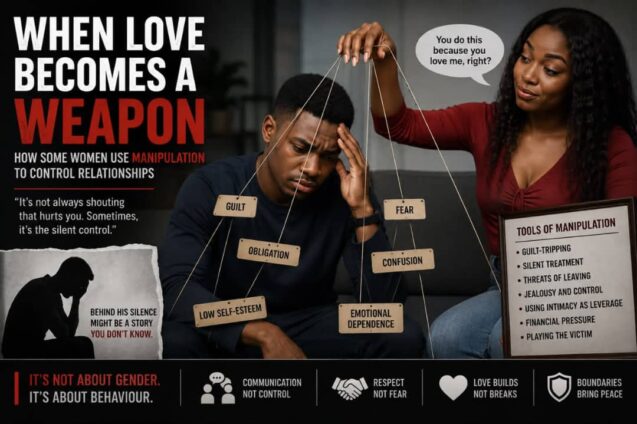
Instead, there may be repeated guilt-tripping, threats of abandonment, excessive jealousy, silent treatment, financial pressure or attempts to control who a partner speaks to and where they go.
These behaviours can gradually turn a relationship into a place where one person feels they must constantly seek permission to live their own life.
And that should concern all of us.
The problem with calling control “love”
One of the most dangerous things about relationship manipulation is that it can be disguised as affection.
“If you really loved me, you would do it.”
“Why are you talking to her?”
“Give me your phone if you have nothing to hide.”
“If you leave me, you will regret it.”
Statements like these may sometimes be treated as ordinary relationship drama. But when they become a pattern, they can create an unhealthy power imbalance.
A person should not have to surrender their privacy to prove their love.
A person should not have to abandon friendships to reassure a jealous partner.
And nobody should be made to feel guilty every time they exercise their right to say no.
There is a fundamental difference between love and control.
Love respects boundaries. Control attempts to erase them.
Men must be allowed to speak about abuse
This is where the conversation becomes uncomfortable.
Domestic and relationship abuse has historically—and rightly—received significant attention because women experience serious and sometimes life-threatening violence.
But acknowledging women as major victims of domestic violence should never mean pretending that men cannot be victims.
Some men experience emotional manipulation, psychological abuse and controlling behaviour in relationships.
The problem is that many may not feel comfortable admitting it.
A man who says he is being emotionally controlled by his partner may be laughed at. His friends may tell him to be stronger. Others may assume that because he is a man, he should simply leave.
But telling someone to “man up” is not a solution.
It can actually deepen the silence surrounding the problem.
A man can be physically stronger than his partner and still be emotionally manipulated. He can love his partner and still be mistreated by her. He can remain in a relationship and still be a victim.
Recognising this does not weaken the fight against violence against women. It strengthens the broader fight against abuse.
Social media is making the line even more difficult to see
Perhaps the most troubling part is how easily unhealthy behaviour is turned into entertainment online.
We have seen jealousy presented as proof that someone is deeply in love.
Partners checking each other's phones are sometimes portrayed as funny. Excessive demands for gifts and money can be celebrated as evidence that someone “knows their worth”.
But not everything that receives laughter online is healthy.
Young people are learning about relationships from TikTok videos, Instagram posts, movies, music and online conversations. If controlling behaviour is repeatedly presented as romantic, some may eventually mistake possessiveness for commitment.
That is dangerous.
A relationship should not become a competition over who controls whom.
We need to change the conversation
The answer is not to start blaming women or portraying them as naturally manipulative. That would be another form of stereotyping.
Manipulation is not a female behaviour.
Men can manipulate women. Women can manipulate men. People of any gender can use emotional pressure to control someone they claim to love.
The real issue is the behaviour.
We should therefore become more willing to ask difficult questions.
Why are we comfortable laughing at a man who admits that his girlfriend controls his life?
Why do we sometimes call jealousy romantic?
Why do we treat emotional abuse as less serious simply because it does not leave a visible injury?
And why do some people remain in relationships where they constantly feel afraid of upsetting their partner?
These questions matter because unhealthy relationships do not always begin with obvious abuse. Sometimes they begin with small acts of control that gradually become normal.
A partner checks your phone.
Then demands your passwords.
Then questions your friends.
Then decides where you can go.
Eventually, what began as “concern” becomes control.
Love should never require the loss of freedom
A healthy relationship is not one in which two people become completely dependent on each other.
It is one in which two people can love each other while still being individuals.
They should be able to communicate without intimidation, disagree without threats, maintain friendships without suspicion and set boundaries without punishment.
Most importantly, they should be able to say no without being made to feel guilty for it.
Society needs to stop romanticising behaviours that undermine these principles.
The media also has a responsibility. Journalists, filmmakers and content creators should be careful about presenting jealousy, possessiveness and emotional manipulation as harmless relationship entertainment.
Young people deserve better examples of what love looks like.
Love is not surveillance.
Love is not emotional blackmail.
Love is not fear.
And love certainly should not be used as a weapon.
When affection becomes a tool for control, it is time to stop asking how much the victim loves the relationship and start asking what the relationship is doing to the victim.
Because real love does not demand freedom as its price.
It protects it. :::
Latest Stories
-
Trump says he is considering firing US ambassador to Greece
3 hours -
Man City bananas ‘brought fun back’, says Varadi
4 hours -
Meta releases Muse Wonder AI models to challenge Anthropic and OpenAI
4 hours -
Daily Insight for CEOs: The CEO as Chief Decision Maker
4 hours -
Burnham had formal meeting with Man City chair while mayor
4 hours -
Is Ghana producing too many lawyers? What is the best lawyer-to-citizen ratio?
4 hours -
NDC sinking Ghana’s democracy with Emelia Agbenyo’s appointment – Miracles Aboagye
4 hours -
Seedorf back in football as Corinthians head coach
4 hours -
Hincapié and Zubimendi injured in post-match training session
4 hours -
Fridges in French supermarkets hit by cyberattack
5 hours -
Qantas flight grounded after bedbug outbreak
5 hours -
Reality Zone with Vicky Wireko: International Day of the Girl, shaping today’s girl for tomorrow’s future – ZONTA Clubs lead the way
5 hours -
Global health must be led by countries, not designed for them – Mintah Akandoh
6 hours -
Mahama honoured at 2026 World Health Summit in Berlin for global health leadership
6 hours -
Breast cancer is not a death sentence – Besease Kontire Obaapanin, Magmina Foundation lead awareness campaign
6 hours