

Audio By Carbonatix
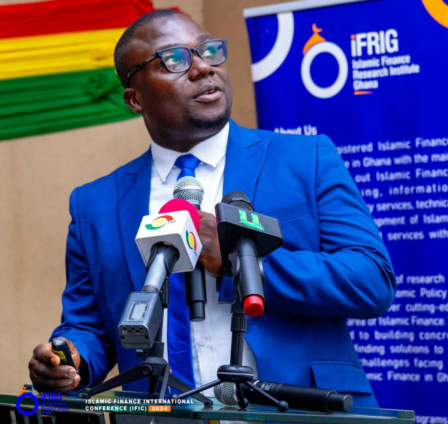
Ghana should explore non-interest bonds, commonly known as Sukuk, as an alternative source of long-term financing for critical infrastructure such as hospitals, roads and schools, Director General of the Islamic Finance Research Institute of Ghana (IFRIG Ghana), Dr Shaibu Ali, has said.
He believes Sukuk could help the country mobilise capital from domestic and international investors at a time when the government faces growing financing needs and limited room for conventional borrowing.
Speaking to JoyNews’ Anass Sabit, Dr Ali said the introduction of non-interest banking should be viewed as an opportunity to develop a broader non-interest financial ecosystem, rather than focusing solely on banking.
According to him, Sukuk are capital-market instruments that could be structured to finance productive national assets and attract long-term investment.
“Non-interest bonds (Sukuk) should not be seen simply as an Islamic financial product. It is a capital-market instrument that can help mobilise long-term capital for productive national assets,” he said.
His comments come as Ghana continues to grapple with significant financing requirements for roads, hospitals, schools, housing and other strategic infrastructure, while seeking to reduce its dependence on traditional borrowing.
Globally, the non-interest financial services industry has expanded significantly, reaching approximately US$4.4 trillion in assets in 2025, according to the latest report by the Islamic Financial Services Board (IFSB).
Dr Ali believes Ghana can tap into this growing market if it establishes the appropriate regulatory framework, professional expertise and investment environment.
Financing hospitals and roads
Dr Ali said major infrastructure projects, including Agenda 111 hospitals and teaching hospitals, could potentially be structured to attract Sukuk financing.
“Take the hospitals we need across the country. We can explore how properly structured non-interest bonds (Sukuk) can be used to finance the construction or development of hospitals and teaching hospitals. These are national assets with long-term economic and social value,” he explained.
He said the same approach could be applied to major road projects, citing the proposed Accra–Kumasi Expressway as an example of the type of transformational infrastructure that could benefit from alternative financing models.
“The Accra–Kumasi Expressway is the kind of transformational project that should make us think differently about infrastructure financing. Ghana should ask whether part of such projects can be financed through non-interest bonds (Sukuk) and other long-term capital-market instruments,” he said.
Education infrastructure, he added, should also be considered as part of a broader investment programme.
With government continuing to construct schools across the country, Dr Ali said such projects could be structured to attract institutional investors seeking long-term investments.
“If government is constructing hundreds of schools, why can’t we begin to look at education infrastructure as an investment programme and develop financing structures that allow institutional investors to participate?” he asked.
Not only for Muslims
Dr Ali stressed that Sukuk should not be viewed as an investment product exclusively for Muslims.
He said investors from different religious and social backgrounds could participate based on factors such as the quality of the underlying asset, risk, potential returns and the credibility of the transaction.
“A Christian, a Muslim or anybody else can invest in Sukuk. What matters to the investor is the quality of the asset, the risk, the return and the credibility of the structure,” he explained.
He believes Ghana could connect its infrastructure needs with the long-term funds held by pension funds, insurance companies, banks, investment managers and international investors.
“We have projects that need money, and we have pools of capital looking for credible long-term investment opportunities. The challenge is how to build the bridge between the two. Non-interest bonds (Sukuk) can be part of that bridge,” he said.
Not a quick fix
Dr Ali cautioned, however, that Sukuk should not be presented as free money or a quick solution to Ghana’s fiscal challenges.
He said investors would still demand credible projects, sound financial structures, transparency, effective risk management and competitive returns.
“Sukuk is not free money. Investors will demand proper structures, transparency, risk management and returns. Ghana must therefore build the regulatory and professional capacity to ensure that every transaction is credible and investable,” he noted.
He said strong regulation, professional expertise and investor confidence would therefore be critical to the success of Ghana’s emerging non-interest finance industry.
Beyond banking
Dr Ali urged policymakers to look beyond the introduction of non-interest banking and develop a broader financial ecosystem covering Sukuk, investment funds, non-interest insurance, known as Takaful, and other capital-market products.
“The opportunity is bigger than banking. If we get the framework right, Ghana can position itself not only to serve the domestic market but also to become a credible centre for non-interest finance in West Africa,” he said.
He said the potential of non-interest finance extended beyond creating another category of financial products, arguing that it could provide an additional channel for connecting long-term capital with national development priorities.
“If Ghana can structure credible projects, create investor confidence and develop the right regulatory and professional environment, non-interest finance could become an additional channel for mobilising long-term domestic and international capital,” Dr Ali said.
Ultimately, he said, the success of non-interest finance should not be measured only by the number of banks or financial institutions that enter the market, but by its contribution to the country's development.
“If we can use capital-market instruments to help build hospitals that save lives, schools that educate our children, roads that connect businesses and communities, and other infrastructure that creates economic value, then non-interest finance becomes part of Ghana’s development story,” he said.
Latest Stories
-
NPP shall prevail in 2028 – Afenyo-Markin rallies delegates
4 minutes -
Baffour Awuah’s detention is about showing him where power lies after resisting EOCO’s ‘unlawful arrest’ – Oppong Nkrumah
5 minutes -
NPP NEC elections – Bawumia sets the tone for post-election peace and unity for victory in 2028
11 minutes -
NPP needs leaders with vision, track record to support Bawumia – Mike Oquaye
13 minutes -
Kufuor urges NPP unity, says Ghana needs party back in power
14 minutes -
Let’s select NPP leaders based on careful examination, not great talk – Kufuor urges delegates
18 minutes -
Investigations, arrests aimed at silencing opposition MPs – Ahmed Shaib
29 minutes -
NPP Conference: Akufo-Addo urges new officers to unite party for 2028
48 minutes -
NPP delegates approve constitutional amendment making flagbearer leader of party
49 minutes -
Mahama Ayariga gives MMDCEs 30-day deadline to secure land for waste transfer stations
1 hour -
NPP approves 14 constitutional amendments despite earlier call to defer exercise
1 hour -
NDC walks out as NPP Delegates Conference suffers hours of delay
1 hour -
PNC cautions NPP against making flagbearer automatic party leader
1 hour -
Treat healthcare as an investment, not a budget cost – Mahama
2 hours -
Mahama outlines Ghana’s strategy to expand healthcare and produce medicines locally
2 hours