

Audio By Carbonatix
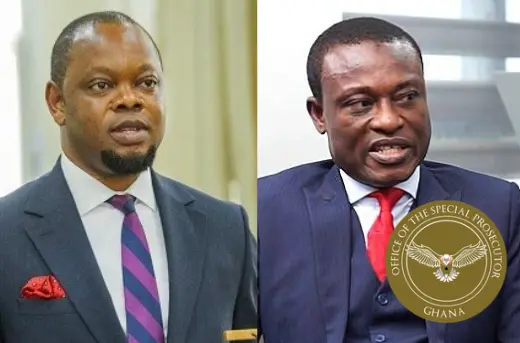
Deputy Attorney General Dr Justice Srem-Sai has explained why the Economic and Organised Crime Office (EOCO), rather than the Office of the Special Prosecutor (OSP), is leading Ghana’s local investigations into the AKSA bribery scandal.
Speaking exclusively to JoyNews’ Evans Mensah, Dr Srem-Sai said the decision was based on the legal mandates of the respective institutions and the range of offences that may arise from the case.
He stressed that the matter goes beyond allegations of bribery and corruption to potentially include money laundering, which falls within EOCO’s mandate.
“It’s also not true that it is just about bribery and corruption. It’s also about money laundering,” he said.
“You know, so there are other offences involved in it that do not necessarily fall within the mandate of OSP but which fall within the mandate of EOCO.”
Dr Srem-Sai dismissed suggestions that the decision to put EOCO in charge was intended to avoid scrutiny from the OSP.
He said the various investigative bodies have different mandates and could collaborate where necessary.
“It is not a question of ‘I want to do it, I want to do it.’ Yes, you want to do it, but who has the mandate to do what ought to be done?” he asked.
He said other agencies could also become involved depending on the circumstances.
“It could be that they can collaborate. It could also be that BNI will take over the whole thing. It could also be that the police would have done their work,” he said.
Dr Srem-Sai insisted that the objective should be to ensure that the appropriate agency investigates the relevant offences rather than creating competition among state institutions.
“It is not a question of a turf war. Because the essence of all these agencies is to fight corruption and to make sure that crime does not survive in glory,” he said.
When asked whether EOCO was considered more efficient than the OSP for the investigation, Dr Srem-Sai pointed to EOCO’s experience.
“I think the record will show – EOCO’s work over the years,” he said.
He argued that the agency’s longer institutional history gave it considerable experience in dealing with economic and organised crime.
“It’s an institution which — the older the institution, the more efficient and more likely it is to be,” he added.
His comments come amid criticism of the OSP’s handling of the AKSA matter, with private legal practitioner Martin Kpebu questioning the office’s ability to conduct an impartial investigation.
Mr Kpebu has also alleged that the case was suppressed under former Special Prosecutor Kissi Agyebeng’s leadership.
Dr Srem-Sai also pushed back against calls for the investigation to be handed to an independent institution to strengthen public confidence.
He said institutional independence alone does not determine whether an investigation will be effective or free from interference.
“I understand these concerns,” he said.
“But you see the work we do here — there’s only one person on top of you as far as this ministry is concerned. Even that person, my boss, cannot just sit down and ignore everything that is happening and just take a decision.”
He explained that decisions within the Attorney General’s Department are subject to established legal processes and that senior officials cannot simply disregard the advice of subordinate lawyers without documenting the reasons.
“So before I take a decision that I disagree with this state attorney’s view, I must put on paper my basis for that disagreement,” he said.
According to him, such a decision must be supported by legal reasoning and relevant authorities rather than political considerations.
“You cannot simply just say the President said I should drop it, so I’m dropping it. The reason would have to be stated on file,” he said.
Dr Srem-Sai further argued that proper documentation within the justice system would make it difficult for an individual to permanently suppress a case.
He said officials know that decisions taken today can be reviewed by their successors.
“When we leave, you cannot save anybody because a new sheriff will come and review the files,” he said.
He therefore maintained that the focus should be on the capacity and effectiveness of investigative institutions rather than simply whether an agency is described as independent.
“Merely calling an institution independent doesn’t make it as independent as you think,” he said.
The local investigation follows the conviction in the United States of Kwaku Asante Berko, a former Goldman Sachs banker and former Managing Director of the Tema Oil Refinery, over a bribery scheme linked to a power plant project in Ghana.
Latest Stories
-
Aksa saga: Don’t turn EOCO-OSP roles into turf war – Deputy AG
8 minutes -
Abandoned Dome-Berekuso-Kitase road project should not become a waste of taxpayers’ money — chief warns
20 minutes -
University of Gold Coast graduates urged to prove themselves beyond certificates
29 minutes -
GoldBod sets new X-Ray Fluorescence standard for gold purity testing from September 1
31 minutes -
Why EOCO, not OSP, is leading AKSA bribery probe – Deputy AG explains
36 minutes -
Republic Bank-JoyNews Habitat Fair to kick off with Mini-fair at Achimota Mall on August 21
43 minutes -
From promises to poisoned rivers: The dangerous silence fueling Ghana’s escalating galamsey and environmental collapse
44 minutes -
Hasty cancellation of AKSA contract could trigger judgment debt – Deputy AG warns
45 minutes -
Mahama won’t protect anyone linked to AKSA bribery scandal – Deputy AG
54 minutes -
Keeny Ice celebrates landmark Wembley performance, thanks Stonebwoy after BHIM Festival UK
1 hour -
GoldBod hasn’t made any losses; Afenyo-Markin’s claim is ‘hallucinatory’ — Sammy Gyamfi
1 hour -
Black Star International Film Festival unveils 2026 key art
2 hours -
Trump threatens Oman over Iran talks as efforts to reopen Strait of Hormuz continue
2 hours -
DBG to develop tailored financing tools to drive Ghana’s oil palm industry
2 hours -
Majority Leader James Agalga visits NYA CEO Osman Ayariga to discuss issues of youth development
2 hours