

Audio By Carbonatix
There is a growing crisis unfolding on our roads, and we must confront it with honesty, urgency, and a collective determination to act.
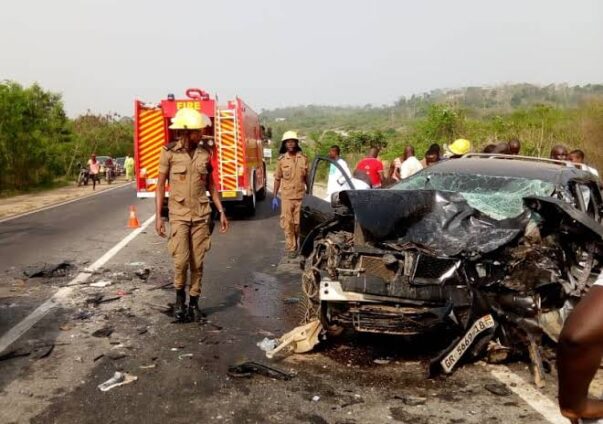
In 2025, Ghana recorded 14,743 road traffic crashes, resulting in 2,949 deaths and 16,714 injuries. The worrying trend continued into 2026. Between January and April alone, 4,899 road crashes claimed 1,009 lives and left 5,982 people injured.
These are not simply statistics. Behind every number is a family in mourning, a child growing up without a parent, and a community grieving the loss of a productive citizen.
As Chairman of the Governing Board of the Driver and Vehicle Licensing Authority, I find these statistics deeply disturbing. At the same time, I believe this moment presents us with an opportunity to have an honest national conversation about road safety.
We must acknowledge that there is no single cause of road accidents in Ghana.
Our road infrastructure remains a significant concern. Many roads are poorly maintained, inadequately lit, and lack essential safety features. Missing road signs, faded lane markings, inadequate pedestrian facilities, and deteriorating road surfaces all contribute to accidents.
We must also acknowledge that corruption within some segments of our enforcement institutions continues to undermine road safety efforts. Traffic regulations lose their effectiveness when violations can be negotiated away.
These are legitimate concerns, and they deserve serious attention.
However, while we improve infrastructure and strengthen enforcement, we must not lose sight of what I believe is the most important factor: human behaviour.
Changing attitudes among road users, particularly drivers, remains the single most important intervention available to us.
The Ghanaian driver often accelerates at an amber traffic light instead of slowing down. Many motorists increase their speed when approaching a junction rather than exercising caution. Drivers disregard lane discipline, ignore right-of-way rules, and frequently abandon the simple principle of first in, first out.
This culture of indiscipline is costing lives.
The DVLA, the National Road Safety Authority, the Motor Traffic and Transport Department of the Ghana Police Service, and the National Insurance Commission are strengthening collaboration to develop a coordinated and data-driven approach to road safety.
At the DVLA, several transformative initiatives are either being implemented or are under active consideration.
Beginning next year, the rollout of RFID-enabled vehicle number plates will strengthen vehicle identification, improve traceability, and support enforcement.
The implementation of a driver demerit point system will ensure that drivers who repeatedly violate traffic regulations are held accountable.
We are also enhancing the roadworthiness certification regime through the integration of technology and live vehicle capture into the inspection process.
In addition, the Authority seeks to implement a new driver's licence acquisition regime designed to eliminate fraud, eradicate fake licences, strengthen driver testing, and ensure that only qualified and competent drivers receive licences.
I also believe that the National Insurance Commission should consider implementing a risk-based insurance model that directly links insurance premiums to driver behaviour. Drivers who repeatedly cause accidents should pay higher insurance premiums, while safe driving should be rewarded.
We should also explore additional interventions, including automated speed enforcement systems, periodic retraining for commercial drivers, expanded road safety education in schools, and the development of a fully integrated national road safety database.
However, technology alone will not save lives. Legislation alone will not save lives. Enforcement alone will not save lives.
The missing ingredient is a change in attitude. Indiscipline is a cost we can no longer afford to pay.
At the DVLA, our success as a Governing Board will not be measured solely by the digital transformation we are implementing. It will not be measured only by increased revenue.
Our success will be measured by our ability to reverse these disturbing statistics, make Ghana's roads safer, ensure that only qualified and responsible drivers operate vehicles on our roads, and ultimately save lives.
Road safety is a shared national responsibility.
The most important safety device ever created is still the human attitude.
The time for change is now, and that change must begin with every one of us the moment we get behind the steering wheel.
About the Author
George Spencer Quaye is the Chairman of the Governing Board of the Driver and Vehicle Licensing Authority (DVLA).
Latest Stories
-
Education Minister engages university administrators over ongoing strike
5 minutes -
Technological convergence, disruptive innovation and the future of youth education in Ghana
31 minutes -
When the sirens become a national anthem: confronting Ghana’s road accident crisis
59 minutes -
Aksa bribery scandal exposes deeper failures in Ghana’s procurement system – Manhyia South MP
1 hour -
Luv FM High School Debate: KNUST, St. Louis strike gold as quarter-finals dreams come alive
2 hours -
Banks’ pre-tax profit jumps 40% to GH¢23bn
2 hours -
Luv FM High School Debate: Anticipation builds as schools battle for supremacy in Round of 16
2 hours -
Banking sector deposits jump 25% to GH¢334.3bn in 2025 — PwC
2 hours -
Hostel Owners Association bares teeth over legality of rent control campaign against exorbitant fees
2 hours -
GCB overtakes Ecobank as Ghana’s largest deposit-taking bank
2 hours -
Young Cocoa Farmers petition Mahama over funding, producer price and start date for new cocoa season
3 hours -
Ruha Benjamin challenges Africa to shape its own AI future
3 hours -
Trump threatens to bomb US ally Oman if it ‘gets in the way’ over Iran deal
3 hours -
FIFA sacks senior executive who criticised Infantino, Sky News understands
3 hours -
Aksa saga: Don’t turn EOCO-OSP roles into turf war – Deputy AG
3 hours