

Audio By Carbonatix
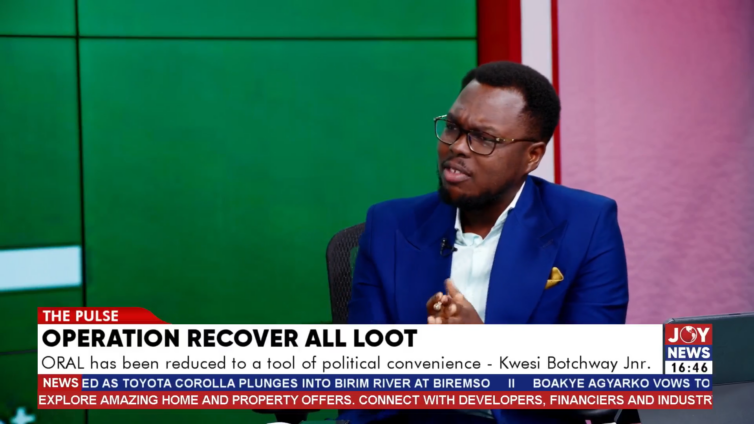
Private legal practitioner Kwesi Botchway Jnr has accused the government of reducing the Office of the President's initiative for accountability and probity, known as Operation Recover All Loot (ORAL), to a tool for political convenience.
According to him, the credibility of ORAL has been undermined by the Attorney General's control over the decision to initiate or discontinue criminal prosecutions.
Speaking on JoyNews' The Pulse, Mr Botchway argued that although accountability in public office was necessary, the manner in which prosecution powers were being exercised had created the impression of selective justice.
“I think that ORAL has been reduced into a tool for political convenience,” he said.
Mr Botchway said the effectiveness of ORAL could not be considered separately from the constitutional powers of the Attorney General, who exercises prosecutorial authority on behalf of the state.
He noted that the same office with the power to commence criminal proceedings also has the authority to discontinue them.
“The authority to initiate prosecution is at the behest of the Attorney General of the Republic, and the authority to also withdraw prosecution is also at the behest of the Attorney General of the Republic,” he said.
He argued that this concentration of prosecutorial discretion had contributed to concerns about whether ORAL was being applied consistently.
For Mr Botchway, the issue was not whether public officials should be investigated or held accountable, but whether the process was being applied equally to individuals across the political divide.
The lawyer alleged that the Attorney General had pursued criminal cases involving members of the previous administration while withdrawing cases involving individuals affiliated with the governing political party.
“We have witnessed that the Attorney General has initiated prosecutions against the previous administration and has withdrawn all criminal prosecutions against members of the erstwhile administration,” he said.
He argued that the pattern had fuelled the perception that ORAL was being used selectively, rather than serving as an impartial mechanism for recovering public funds and addressing alleged wrongdoing.
Mr Botchway rejected suggestions that members of the New Patriotic Party (NPP) opposed to transparency or scrutiny of public officials.
“Nobody in the NPP is against accountability or transparency,” he said.
He maintained that holding public office should come with an acceptance of scrutiny and responsibility for decisions taken while in office.
“I am of the considered opinion and position that once you subject yourself and once you hold any public office, you should be willing and ready to put yourself up for accountability,” he said.
He therefore sought to distinguish opposition to what he considers selective prosecution from opposition to accountability itself.
Mr Botchway said the handling of criminal cases had created a perception, whether based on fact or public interpretation, that individuals associated with the governing party were being treated differently from opposition figures.
“The perception out there, or the reality, paints a different perception that you have an Attorney General who has withdrawn every single criminal prosecution case against members who are affiliated to his political party, and has on the other side instituted criminal charges against members of the opposition party,” he said.
He suggested that such a situation could undermine public confidence in ORAL and other accountability measures.
Latest Stories
-
This is the result of GoldBod activities – Akim Oda MP demand answers over $1.7bn loss
5 minutes -
Photos: Sammy Gyamfi at Government Accountability Series
19 minutes -
Ghana School of Law SRC President-elect petitions authorities for relief for referred students
27 minutes -
Promasidor Ghana unveils Onga Mix Tomato Paste, names Diana Hamilton brand ambassador
39 minutes -
‘You admitted the loss, now account for the GH¢22bn’ – Minority hits back at GoldBod CEO
41 minutes -
Gender Department raises alarm over rising teenage pregnancy in Ashanti Region
58 minutes -
GJA@77: Ethical journalism foundation for strong, resilient democracies – UK Deputy High Commissioner
1 hour -
Police pickup carrying suspects crashes into trotro on KNUST campus, several injured
1 hour -
AMA Mayor apologises to alleged extortion victim, orders refund
1 hour -
Akwatia MP defends GoldBod, says IMF report didn’t blame it for losses
1 hour -
Building community after a merger: What UniMAC’s concord initiative can teach higher education
1 hour -
UN security official meets GoldBod CEO Sammy Gyamfi
1 hour -
Two detained after French influencer’s scorched body found in vineyard
1 hour -
ORAL has been reduced to a tool for political convenience – Kwesi Botchway Jnr
1 hour -
6 in 10 businesses fail to properly account for VAT – GRA
1 hour