

Audio By Carbonatix
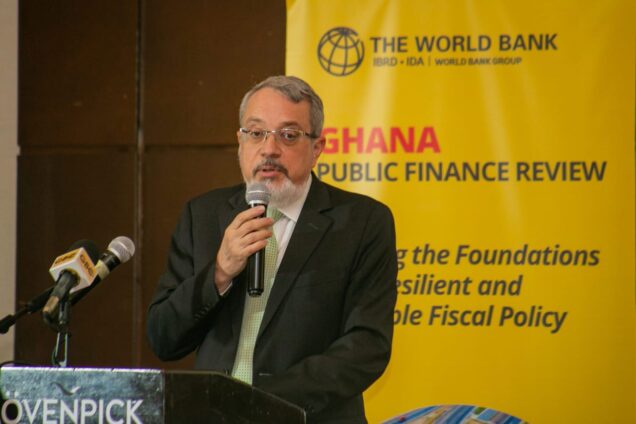
Ghana’s economic recovery has been strong but remains structurally incomplete, with persistent poverty, weak job creation and infrastructure gaps threatening the sustainability of recent gains, the World Bank Division Director for Ghana, Liberia and Sierra Leone, Robert R. Taliercio, has said.
Speaking at the launch of the World Bank’s *Tenth Ghana Economic Update* in Accra on Wednesday, August 26, 2026, Mr Taliercio said the economy grew by 6% in 2025, the fastest pace since 2019, before accelerating further to 6.4% in the first quarter of 2026.
According to him, the country had also made significant progress in macroeconomic stability, with headline inflation falling from 23.2% in February 2025 to 3.2% in March 2026, although it had since increased to 4.6%*.
He stated that Ghana’s successful completion of its International Monetary Fund Extended Credit Facility programme was a major milestone that demonstrated restored economic credibility.
He added that the country recorded a primary fiscal surplus of 2.5% of GDP in 2025, exceeding the 1.5% target, while public debt declined from 70.3% of Gross Domestic Product (GDP) in 2024 to 49% at the end of 2025.
“Government deserves full credit for the difficult decisions that made these results possible,” Mr Taliercio said.
However, he cautioned that the gains should not obscure the structural weaknesses still confronting the economy.
“The recovery remains structurally incomplete,” he said, noting that the fiscal surplus had been achieved largely through expenditure compression”.
He said capital spending was *38% below budget*, warning that such an approach was not sustainable for long-term growth and development.
Mr Taliercio said Ghana must strengthen domestic revenue mobilisation to support sustained fiscal consolidation, while also addressing poverty and inequality.
He noted that *56.4% of Ghanaians remain in poverty*, with spatial disparities widening, creating a disconnect between headline economic growth and improvements in living standards.
He also raised concerns about the ability of the economy to create enough jobs for Ghana’s growing youthful population, saying growth was being led by sectors with limited employment absorption.
Risks to the recovery
Mr Taliercio projected economic growth at *4.8% in 2026*, converging to around 5% over the medium term, provided fiscal discipline is maintained and external debt restructuring is completed.
He, however, warned that the outlook remains vulnerable to both domestic and external risks.
He said a prolonged conflict in the Middle East could disrupt global trade, increase energy and production costs and create renewed inflationary pressures.
Ghana’s heavy dependence on gold and cocoa exports also leaves the economy exposed to adverse movements in commodity prices, which could put pressure on the exchange rate, inflation and public finances.
Domestically, he identified financial pressures in the energy and agricultural sectors as major concerns.
“Delays in energy sector recovery programmes cost the country approximately $1 billion annually,” he said.
He also called for reforms to the operations of the Ghana Cocoa Board (COCOBOD), arguing that its financial and operational inefficiencies were putting pressure on farmers and public finances.
Mr Taliercio said the World Bank welcomed continued discussion on reforms to the COCOBOD Act and advocated far-reaching changes to promote market-based principles and minimise quasi-fiscal risks.
Transport sector remains major constraint
The World Bank official said Ghana’s transport infrastructure was another major obstacle to economic transformation, making it the special focus of this year’s Ghana Economic Update.
“This is not just an infrastructure story. It’s a growth story, competitiveness story and a job story,” he said.
According to him, only 27% of Ghana’s 94,200-kilometre road network is paved**, while more than half of the network is in fair-to-poor condition, with feeder roads particularly affected.
He said Ghana’s rail network had also suffered a significant decline, falling from 947 kilometres of operational rail in 1960 to just 160 kilometres in 2020.
The World Bank estimates that road safety incidents alone cost Ghana about *2.1% of GDP annually, equivalent to approximately *$4.55 billion**.
Mr Taliercio said the situation was compounded by fragmented institutional responsibility within the transport sector, which undermines effective coordination, planning and execution.
He outlined six priority areas for transforming the sector: operationalising the *Road Maintenance Trust Fund*, developing a unified national transport strategy, revitalising freight-led rail services along the western and eastern corridors, treating road safety as a fiscal and public health emergency, adopting climate-resilient design standards and extending Ghana’s Digital Single Window to Takoradi and inland terminals.
$500m Investment in Feeder Roads
Mr Taliercio said the World Bank was supporting the government’s efforts through the Ghana Market Access and Connectivity Project, which was ratified by Parliament in July.
Under the project, the World Bank is investing $500 million to rehabilitate approximately *1,050 kilometres of feeder roads under performance-based maintenance contracts.
He said the investment would target areas where poor connectivity was constraining agricultural productivity and rural livelihoods, while also supporting the operationalisation of the Road Maintenance Trust Fund.
Mr Taliercio stressed that capital investment alone would not resolve Ghana’s infrastructure challenges.
“Building roads without maintaining them simply accelerates the cycle of degradation that we are all trying to break,” he said.
He said the World Bank remained committed to supporting Ghana’s macroeconomic stabilisation and structural reforms to make the recovery more inclusive, job-intensive and resilient.
Latest Stories
-
MTTD, AMA city guards to manage traffic during Kaneshie drainage works
1 minute -
GARID announces Kaneshie traffic diversions as major drainage works begin on September 7
5 minutes -
TrafficTech cameras to target motorists speeding above 50km/h in school zones — Police
6 minutes -
“We may be down, but we are not out” — Boakye Agyarko vows to revive NPP as he files for National Chairman
9 minutes -
TrafficTech to reduce roadside encounters between police and motorists — Police
13 minutes -
Study links unofficial Ghana border crossings to documentation gaps, financial hardship
13 minutes -
TrafficTech to issue court notices to speeding motorists based on camera evidence — Police
14 minutes -
Tricycle, motorcycle operators face arrest after August deadline for reflective stickers
24 minutes -
Ambassador Quartey highlights Ghana’s sustainable cocoa sector at Cocoa Connect Seminar in Rimini
43 minutes -
World Bank calls for far-reaching reforms to COCOBOD Act
1 hour -
56.4% of Ghanaians remain in poverty despite economic recovery – World Bank
1 hour -
ReZultz Advertising wins gold for best integrated campaign at 18th Gong Gong Awards, takes home 7 additional honours
1 hour -
Delays in energy sector recovery cost Ghana $1bn annually – World Bank
1 hour -
World Bank warns Ghana’s recovery remains structurally incomplete
1 hour -
Ayitey Powers remanded for one week over alleged threat against NSA boss
1 hour