

Audio By Carbonatix
Associate Professor of Accounting, Governance, and Sustainability at the University of Ghana Business School, Professor Samuel Simpson, has urged credit unions to adopt smart technologies to improve services and deepen member value.
He said technology could make credit unions more attractive, particularly to young people, while improving accessibility, efficiency, and financial inclusion.
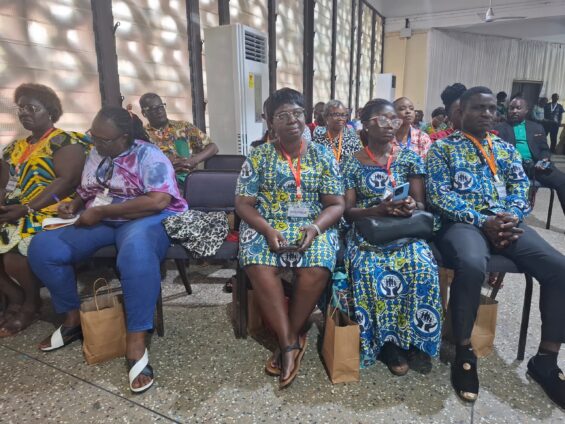
Prof. Simpson made the call in Accra on Friday when he delivered the keynote address at the 24th Annual General Meeting of the Controller and Accountant General’s Employees Cooperative Credit Union (CAGECCU).
The meeting was held on the theme "Smart Systems: Harnessing Technology to Drive Member Value and Promote Financial Inclusion.”
He said credit unions must leverage mobile applications and other digital platforms to enable members to access their accounts, check balances, make transfers and payments, and obtain information without physically visiting their offices.
“I am excited to hear that you are voting electronically and not joining a long queue,” he said, urging the Union to extend such digital solutions to other aspects of its operations.
Prof. Simpson said effective use of technology could also strengthen transparency by providing members with transaction records and audit trails but cautioned members to be vigilant about cybersecurity risks and protect their passwords and mobile devices.
He also urged members to reduce unnecessary withdrawals from their savings, saying such withdrawals could undermine the financial benefits they derived from belonging to a credit union.
He explained that members could instead take loans against their savings, where available, while allowing their savings to continue earning interest.
“If you have borrowed within your savings, you are using your smart system,” he said, explaining that maintaining savings while borrowing could enable members to continue earning interest on their deposits.
The Board of Directors’ report presented at the meeting indicated significant growth in CAGECCU’s operations during the 2024 and 2025 financial years.
Membership increased from 5,440 in 2024 to 5,916 in 2025, representing an 8.75 per cent growth, while total assets rose by 17.75 per cent from GH¢42.60 million to GH¢50.16 million.
Members’ savings increased by 19.90 percent to GH¢45.51 million, while loan disbursements rose by 45.60 percent to GH¢18.72 million.
Investments also increased by 58.60 per cent to GH¢13.77 million.
However, impairment losses on locked-up investments resulted in net deficits of GH¢1.01 million in 2024 and GH¢877,643.58 in 2025, preventing the board from recommending dividends for the two financial years.
Isaac Dupey, Chairman of the Planning Committee, who presented the report, said significant funds remained locked up with Gold Coast/Black Shield Fund Management Ltd, Legacy Fund Management Ltd, and Investa Capital Fund Management Ltd.
The Union also faced liquidity pressures arising from delays of up to three months in monthly remittances from the Controller and Accountant-General’s Department.
The meeting elected a new five-member board to steer the affairs of CAGECCU.
The new board comprises Kofi A. Agyen, Chairman; Beatrice Nantwi, Vice-Chairman; Edith N. Laryea, Secretary; Emmanuel Kevin Vanderpuye, Treasurer; and Divina D. Nkwatabisa, Member.
Christian Osei Yaw, immediate past chairman, reaffirmed CAGECCU’s commitment to self-help, mutual democratic participation, and accountability.
He expressed confidence that innovation and responsible leadership would position the Union among Ghana’s best-performing credit unions.
Latest Stories
-
Ghana @70: Litina outlines support services for diaspora visitors seeking to reconnect with Ghanaian roots
5 minutes -
Boat carrying nearly 270 people capsizes off northern Cyprus
52 minutes -
Survivalist dropped into Arctic Circle alone with just 10 tools for TV show
54 minutes -
Kasoa, Odupong Ofaakor chiefs call for removal of MCE over alleged incompetence, disrespect
2 hours -
Credit unions urged to embrace technology to deepen member value
2 hours -
The silent decay: Silent road signs
2 hours -
SIGA reports strong recovery in state enterprises
2 hours -
British woman killed in stabbing at German railway station
2 hours -
Niger says it regains control of airbase after soldiers mutiny
3 hours -
Africa’s Road to LA28 begins as Ghana’s Paralympic committee steps up preparations
3 hours -
Foods you must eat if you have irregular periods
4 hours -
Fire engulfs storeroom at Apaaso, Kintampo
4 hours -
Gas tanker accident triggers leak at Fiaso
4 hours -
BCI urges women to prioritise breast health to reduce cancer cases , deaths in Ghana
4 hours -
Christians must emulate St Augustine’s virtues — Bishop Kobina Louis
4 hours