

Audio By Carbonatix
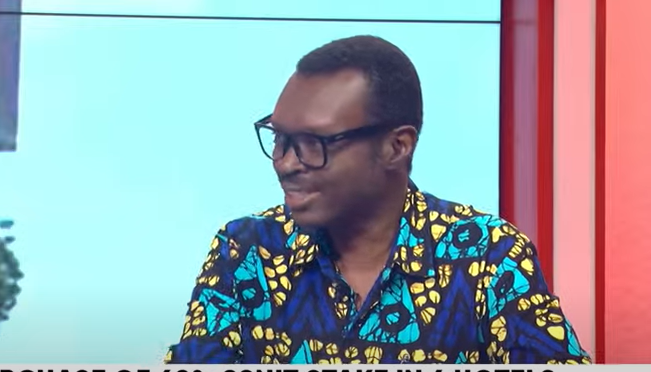
Anti-corruption campaigner and Vice Chair of the African Union Advisory Board Against Corruption, Edem Senanu, has called for clear laws and stronger sanctions to ensure public officials found culpable of wrongdoing are prosecuted and held accountable.
His call comes as a Corruption Watch investigation raises questions about the use of public funds in the construction of astroturf and other sports facilities under the administration of former President Nana Akufo-Addo.
The One Constituency, One Astroturf programme became a major feature of the Akufo-Addo administration as one of its flagship sports infrastructure initiatives.
However, an investigation by Corruption Watch has uncovered concerns over the procurement processes and ownership of some of the facilities constructed under the programme.
The investigation found that two senior officials who served under the former administration, former Energy Minister John Peter Amewu and former Ghana Gas Communications Director Ernest Owusu Bempah, are at the centre of ownership disputes involving sports facilities in Hohoe and Agogo, respectively.
The two facilities, according to the investigation, were constructed largely with public funds valued at more than GH¢17 million.
The exposé is the first in a nationwide investigative series launched by Corruption Watch in February 2025. The series examines 169 astroturf and sports infrastructure projects across Ghana, representing public investments estimated to exceed GH¢1 billion.
The current investigation focuses on three key anti-corruption concerns: procurement irregularities, abuse of office and conflict of interest.
The Hohoe Sports Stadium in the Volta Region and the Agogo Sports and Cultural Complex in the Ashanti Region were funded by state agencies through their respective corporate social responsibility programmes.
The agencies identified as providing funding include the Ghana National Petroleum Corporation (GNPC), GNPC Foundation, Ghana National Gas Company Limited (Ghana Gas), Volta River Authority (VRA), GO Energy Company Limited and the Hohoe Municipal Assembly.
According to the investigation, the execution of the two projects was characterised by procurement irregularities.
Speaking on the Joy FM Super Morning Show, Mr Senanu said Ghana's Constitution clearly addresses conflict of interest involving public officers, but argued that there is a gap in the law when it comes to prescribing specific sanctions for breaches.
“Till date we've not had appropriate laws,” he said.
Mr Senanu explained that the Constitution already provides clear guidance on the conduct expected of public officials.
“The Constitution is absolutely clear about public officers not putting themselves in a position of potential conflict of interest,” he said.
He said that Parliament had been reviewing legislation on the conduct of public officers and expressed hope that progress would be made to strengthen the legal framework.
However, he said the crucial issue was the need for legislation that clearly sets out the penalties for breaches.
“The reason why we need that finalised is that there's a gap. You need a law that then begins to prescribe the sanctions,” he said.
According to Mr Senanu, the absence of clearly defined sanctions creates difficulties when officials are accused of placing themselves in situations of conflict of interest despite being aware of their obligations.
He cited situations where an official may have been required to disclose information to the PPA or another relevant institution but failed to do so.
“So what happens if, irrespective of the fact that you've been cautioned not to put yourself in the position of conflict of interest, you do so with impunity, and the evidence suggests that in spite of the given law that you are aware of and should have disclosed to PPA or whoever, you did not do that,” he said.
Mr Senanu said the law must make clear what penalties apply when such breaches occur.
“What sanctions do we apply? Is that a two-year sentence? Is it a five-year sentence?” he asked.
He said clearly defined sanctions would make it easier for prosecutors to take cases to court and secure accountability where wrongdoing has been established.
“So we need a clearly defined law that provides the sanctions so that if you have to pick an individual and go to court, there's something sanctioned,” he said.
Mr Senanu argued that the current uncertainty creates a perception among some public officials that they can breach rules without facing meaningful consequences.
“At the moment, that gap, that grey area is what is creating the feeling that 'I can do whatever I like and get away with it',” he said.
He also pointed to the difficulties prosecutors face when the law does not clearly establish the applicable punishment.
“Because in court, the prosecution is difficult. What sanctions to apply is difficult,” he said.
Latest Stories
-
Why healthcare innovation needs more than startup enthusiasm
52 seconds -
GTP pays homage to Asantehemaa Nana Yaa Akyaa II
4 minutes -
Kanayo Dambu declares bid for Northern Region NDC Youth Organiser
8 minutes -
Sammi Awuku welcomes Kojo Brace into NPP, says he will make a ‘fine politician’
10 minutes -
Ghana, we need to talk: Who will feed us tomorrow?
16 minutes -
Fameye marks birthday with orphans at Village of Hope
31 minutes -
Language barrier limiting opportunities for Ghanaian youth in Russia – Opare Addo
32 minutes -
Mr Isaac Baah Ashun
32 minutes -
Critical thinking essential to counter misinformation in AI era – Putin aide
40 minutes -
Princess Ocansey named among Top 100 Iconic Female World Leaders, set to be honoured at UNGA81 Powerlist reception
40 minutes -
William Plange recounts healing from depression in forest
41 minutes -
Trump seeks to rebuild support among 2024 voters in North Carolina
59 minutes -
The Merqury Quaye Effect: How one man put DJs on Africa’s entertainment map
1 hour -
Photos: IGP engages Okada riders on road safety, registration and crime prevention
1 hour -
NPA reviewing calls to cushion consumers amid petrol price hikes – Edudzi Tameklo
1 hour