

Audio By Carbonatix
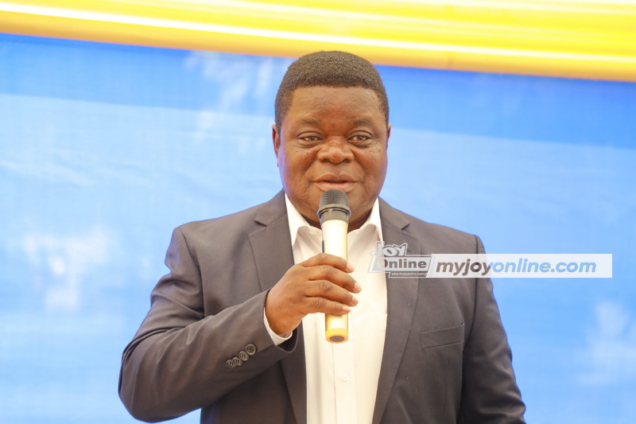
Economist Professor Peter Quartey has warned that Ghana remains highly vulnerable to external economic shocks because the country has limited buffers to absorb global disruptions.
He said the vulnerability is particularly worrying because Ghana continues to depend heavily on imported processed fuel despite being an oil producer.
Speaking on Joy News’ PM Express Business Edition on Thursday, Prof Quartey said businesses could expect some temporary relief from borrowing costs following the Bank of Ghana’s decision to maintain the policy rate at 14%.
He, however, cautioned that the relief depends on how global developments unfold.
“Oh yes, certainly businesses should be comforted, but temporarily,” he said.
“I mean, we should just touch wood, touch wood if nothing happens, if the prices come down, if what is happening in Iran between Iran and the U.S. doesn’t escalate and things get better, then why not?”
“At the moment, it’s a temporary relief for businesses. We’re not expecting to see higher costs of credit, at least in the next month or two.”
Prof Quartey said Ghana’s vulnerability becomes clearer when compared with countries facing the current geopolitical tensions.
He said that such countries have reserves that can provide some protection during global disruptions.
“For these countries that are even fighting, Iran, the U.S., and the rest, they have a buffer. They have oil reserves that they can fall on,” he said.
“Basically, they have very little buffer to fall on, and therefore, anything that happens is that when they sneeze, we catch a cold.”
He identified Ghana’s limited domestic fuel processing capacity as one of the major weaknesses.
“And I think we are not processing enough of the oil. We are an oil producer, but we are not processing quite a good chunk of the oil,” he said.
“We still continue to import processed fuel, and that is a big problem for us.”
Prof Quartey also raised concerns about Ghana’s continued reliance on fossil fuels while other countries accelerate their transition to alternative energy sources.
“Secondly, we’re relying too much on fuel, petrol and, you know, crude, for instance, whereas in other countries, other forms of fuel, green energy, green transition is happening rapidly,” he said.
“That is not happening so much with us, and I think that makes us very vulnerable to external shocks.”
He also pointed to Ghana’s dependence on gold for export earnings as another source of vulnerability.
“And if you even look at our exports, for instance, at the moment, gold accounts for almost 60% or 61% of our export earnings,” he said.
“That puts you in a very vulnerable situation.”
“Should gold prices tumble, or should anything happen to the international market, we are likely to suffer the consequences.”
Latest Stories
-
Mr John Blankson Adu Otu
6 minutes -
Prof. D. K. Yeboah-Amankwah
10 minutes -
AFCON 2027Q: Queiroz ‘proud’ of Black Stars performance despite defeat to Cote d’Ivoire
25 minutes -
Your next home could be here: 3rd JoyNews Republic Bank Habitat Clinic opens at Junction Mall today
28 minutes -
GCAA assures safety won’t be sacrificed to attract more airlines
32 minutes -
AFCON 2027Q: Queiroz furious with ‘joke’ penalty awarded Cote d’Ivoire in Black Stars defeat
37 minutes -
GCAA backs more domestic airlines to drive down airfares
50 minutes -
SHC launches nationwide audit, gives occupants 21 days to regularise property interests
1 hour -
Manhyia South MP describes EOCO arrest attempt as ‘provocation’
1 hour -
Appiagyei appeals to Lordina Mahama, Jane Naana over detention of Ghana Jollof accused
1 hour -
New regional hospitals will bring specialist care closer to Oti, Savannah and Western North – Health Ministry
1 hour -
Gender Minister delivers Mahama’s address at launch of State of Africa’s Children Report
1 hour -
Lambussie NCCE engages stakeholders on rule of law, anti-corruption fight
1 hour -
Lands Minister cuts sod for Phase Three of Appiatse Redevelopment Project
2 hours -
GNFS swift response saves three bedrooms from fire at Amasaman
2 hours