

Audio By Carbonatix
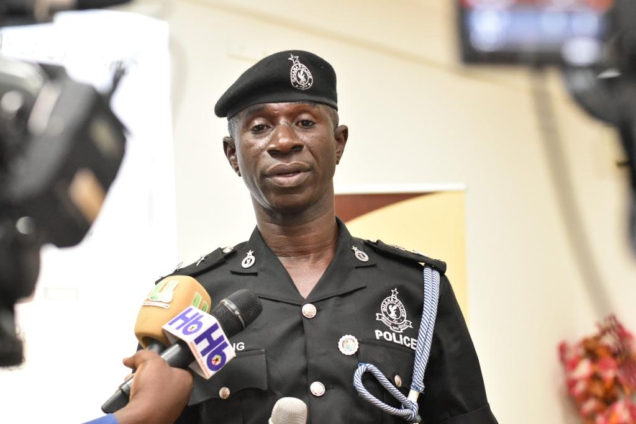
Director of Education, Research and Training at the Motor Traffic and Transport Department (MTTD) of the Ghana Police Service, ACP Alexander Obeng, has rejected the notion that all government vehicles are automatically exempt from regulations governing tinted windows.
He said vehicles belonging to ministries, departments, agencies and metropolitan, municipal and district assemblies must comply with the law unless they fall within the limited categories expressly exempted.
Speaking on Joy FM’s Super Morning Show on Monday, September 28, ACP Alexander said the exemptions apply primarily to vehicles used for specific security, emergency and essential public services.
“When you say government, you also have to be very careful,” he said.
He explained that the exempted categories include vehicles used by the President for official duties, designated security agencies, emergency medical service providers and institutions responsible for transporting money and bullion.
“Vehicles used by a President for his official purpose, government-organised security agencies, and those that deliver medical services to us, either ambulances or hearses, and those that support the movement of our coins, notes and bullion,” he stated.
ACP Alexander stressed that the exemption could not be extended indiscriminately to every vehicle owned by a public institution.
“It can’t be ministry, department or agency vehicles. It cannot be metropolitan or municipal assembly vehicles. No,” he emphasised.
According to him, the specified vehicles are treated differently because they sometimes perform critical functions that require urgent movement and additional security.
“Why are these vehicles exempted? Because there are certain instances when they deliver essential services,” he explained.
He added that some of these vehicles may also be permitted to exceed prescribed speed limits when responding to emergencies or carrying out legally recognised essential duties.
Tinted-window regulations
Turning to the broader regulations on tinted windows, ACP Alexander said vehicle windows must generally allow at least 70 per cent light transmission.
“When you are in the vehicle, even the windows that have glass should allow 70 per cent light transmission into the vehicle,” he said.
“Even if you want to put tint, it should allow anybody by the roadside, 60 metres away, to see you.”
He noted that the requirement applies to the side and rear windows, while the front windscreen must remain completely free of tinting or any other obstruction.
“As for the front-looking glass, there shouldn’t be any tint on it. It is against the law,” he stated.
“The front-looking glass—the windscreen—shouldn’t have any obstruction on it, including any tint. It should be left clear.”
ACP Alexander said the restrictions were designed to ensure that drivers maintained adequate visibility and control while allowing other road users and security officers to see what was happening inside vehicles.
“The law says clearly that anytime you are driving, you should have full visibility of traffic and full control of the vehicle,” he said.
“It is also about ensuring that there is transparency and accountability, and also enhancing public security on our roads.”
He consequently advised motorists, including drivers of public-sector vehicles, to remove unauthorised tints, particularly those covering front windscreens.
“Those who have put these tint materials on their vehicles, you better advise yourselves, particularly those who have also tinted their front-looking windscreen,” he cautioned.
Latest Stories
-
LA 2028: Black Queens to face Mauritius in Round Two of African qualifiers
7 minutes -
Three dead, including child, in Channel crossing attempt
10 minutes -
Woman charged with stealing from patients and staff at hospitals across Ontario
11 minutes -
Foreign tourists stay longer as domestic guests dominate Ghana’s accommodation market – GSS
12 minutes -
Ghana’s tourism accommodation market shows sharp regional disparities – GSS
17 minutes -
Ayalolo BRT to get contra-flow lanes on three major Accra corridors
21 minutes -
GH¢111bn DDEP maturity wall in 2027/2028 – Insights from Charles Adu Boahen
23 minutes -
Danlad Ibrahim on crutches after suffering injury against Aduana FC
24 minutes -
Aayalolo to operate contra-flow on three major Accra corridors
29 minutes -
Northern Region pupils left unsupervised as teacher unions begin strike
30 minutes -
Limited time forced me to contest 2024 election as independent candidate — Alan Kyerematen
32 minutes -
GES clarifies NCPTA, Prospectus Ghana Limited partnership
33 minutes -
Daily Insight for CEOs: The CEO’s role in strategic reflection
35 minutes -
John Jinapor reiterates government’s commitment to Salaga transmission project
37 minutes -
I’m not surprised Tinkler resigned because I predicted this – Kojo Addae Mensah
54 minutes