

Audio By Carbonatix
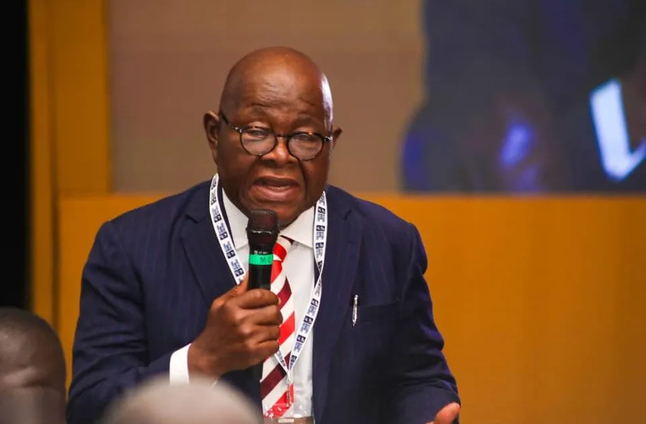
Former Speaker of Parliament, Professor Mike Oquaye, has explained the New Patriotic Party’s (NPP) decision to make its presidential flagbearer the leader of the party, saying the move reflects the political reality the party faces when it is in opposition.
Speaking in an interview on the Joy FM Super Morning Show on Monday, October 5, Professor Oquaye was asked why the NPP had arrived at the decision after previously considering constitutional amendments that would have made the national chairman the leader of the party.
The question was whether the party had not already understood this political reality in 2025 when it considered a wide range of amendments to its constitution.
Professor Oquaye explained that the position of party leader depends largely on whether the NPP is in government or opposition.
“Do you realise that the chairman is still the leader of the party? Particularly when we are in opposition,” he said.
He explained that when the NPP is in government, the President naturally assumes a leadership role within the party because of the constitutional and political position of the office.
“When there is a president, regardless of whether you accept it practically or not, reality makes us all see that the president is actually the leader because he's the leader of the nation,” Professor Oquaye said.
“He's the first gentleman or lady of the nation.”
Read also: NPP delegates approve constitutional amendment making flagbearer leader of party
According to him, the latest decision is an attempt to formally recognise what happens in practice rather than maintain a structure that does not reflect the party’s political circumstances.
“This we have thought of. Now we have put what is practical and the reality on the ground into motion,” he said.
Professor Oquaye said that the party’s structures would continue to evolve in response to changing circumstances.
“We are always developing,” he said.
When asked whether the flagbearer also becomes the leader of the party once the NPP has selected its candidate for a presidential election, Professor Oquaye agreed.
“Yes, because we are moving in harmony towards winning our election,” he said.
He explained that once the party enters an election, it needs a single person to carry its political message and lead its campaign.
“And in fact, the flagbearer when he is elected in the party leader now. We are going into a contest. Somebody must hold the party's flag. That's why we talk about flag bearer,” he said.
Professor Oquaye said the NPP had therefore decided to recognise the practical reality rather than create a structure that could lead to confusion.
“And it doesn't matter whether anybody else wants to see somebody else as the leader or not. So, we have watched the situation, and we have come to the full realization that this is the reality. Therefore, let us accept that and move along,” he said.
The discussion also turned to accountability within the party.
The host reminded Professor Oquaye that, particularly in the early years of the Fourth Republic, the NPP had at times relied on the separation between the chairman and the flagbearer to provide checks and balances.
The question was whether making the flagbearer the leader of the party could weaken that system of accountability.
Professor Ocquaye acknowledged the importance of the issue but said the NPP had other structures capable of providing oversight.
“Oh, definitely. Definitely. Who watches the watchman is always a very important issue,” he said.
He, however, said that the party had to balance the need for checks and balances with what he described as the practical reality of political leadership.
“But we also accept that if we don't get the reality well, it rather brings difficulties,” he said.
Professor Oquaye said the NPP had considered the broader circumstances before taking the decision.
“So, let us accept those things as they are. And in fact, I've given you examples. I know what incident you are referring to, an isolated incident,” he said.
“We have looked at the totality of all realities, and we are saying in the circumstances, since in reality it is true that it is there.”
He said that once a presidential candidate is chosen to lead the party into an election, the party should give that person the necessary support to prosecute the campaign.
“Presidential candidate who is the flag bearer and, for that matter, he leads the battle, then let us not pretend. Let us give him the full support,” Professor Oquaye said.
“Therefore, he's the leader of the party,” he said.
When pressed further on who would check the flagbearer if that person becomes the leader of the party, Professor Oquaye pointed to the NPP’s existing leadership structures.
He said the party has a National Council, a Council of Elders and a National Executive Committee, which includes the national chairman.
“We have a whole National Council. We have a whole Council of Elders, and we have a National Executive which includes the chairman of the party,” he said.
Professor Oquaye insisted that becoming flagbearer and party leader would not place an individual beyond the party’s disciplinary and accountability structures.
“Even though a person is a flagbearer, I tell you, when it is necessary, appropriate people in the party can take even appropriate disciplinary action against him,” he said.
He cited the NPP’s previous disciplinary actions against senior party officials as evidence that its internal structures could still hold leaders accountable.
“When we were one time taking and accepting action against a chairman, some people thought it was not possible. It is possible with us,” he said.
“So, if a president does something illegal, which I know a presidential candidate does anything illegal as an NPP presidential candidate, I can assure you he won't get away with it. The NPP is a strong party,” he said.
Latest Stories
-
Ray Michael Djan Jr puts Ghanaian creativity on global stage with Chelsea anthem
2 minutes -
Matilda Dibloni Kokar elected USAG president after two-year dormancy
4 minutes -
NPP delegates wanted youthful energy with Kojo Bamba’s election – Political scientist
8 minutes -
Zenith Bank supports Childhood Cancer Unit at Greater Accra Regional Hospital
8 minutes -
KMA empowers 64 persons with disabilities; Mayor unveils plan for sustainable skills centre
10 minutes -
DJs Union urges musicians to prioritise respect, communication amid industry tensions
17 minutes -
“Ghanaian DJs deserve their flowers” – Lasmid
18 minutes -
Zenith Bank supports childhood cancer unit at Greater Accra Regional Hospital
19 minutes -
‘Who’s in charge doesn’t really matter; we’re all servants’ – John Boadu on leader of NPP
23 minutes -
Christa Pike’s prognosis still unclear after failed execution, lawyer says
39 minutes -
SLTF to advance fees for first-year students facing admission payment deadlines
41 minutes -
Ghana Institute of Architects calls for action to make adequate housing a human right
41 minutes -
BoG, Police arrest seven over alleged misuse of Ghana Cedi as bouquets
42 minutes -
NCPTAs appeal to striking teachers to return to classroom
42 minutes -
Government plans engineered landfills and waste transfer stations nationwide – Ayariga
44 minutes