


Audio By Carbonatix
Restrictions on US broadband providers' ability to prioritise one service's data over another are to be reduced after a vote by a regulator.
The Federal Communications Commission voted three to two to change the way "net neutrality" is governed.
Internet service providers (ISPs) will now be allowed to speed up or slow down different companies' data, and charge consumers according to the services they access.
But they must disclose such practices.
Ahead of the vote, protesters rallied outside the FCC's building to oppose the change.
Many argue the reversal of rules introduced under President Barack Obama will make the internet less open and accessible.
The decision is already facing legal challenges, with New York's attorney general, Eric Schneiderman, announcing he will lead a lawsuit challenging the FCC's decision.
Mr Schneiderman accused the watchdog of failing to investigate possible abuse of the public commenting process. He said as many as two million identities, some of dead New Yorkers, were used to post comments to the FCC website.
During the hearing, FCC commissioner Mr Michael O'Rielly hit back at those claims, saying staff had been able to determine and discard comments that were illegitimate.
Thursday's proceedings in Washington were halted for about 15 minutes after a security alert forced an evacuation of the FCC's chamber, the final twist in a bitter and at times vitriolic debate.
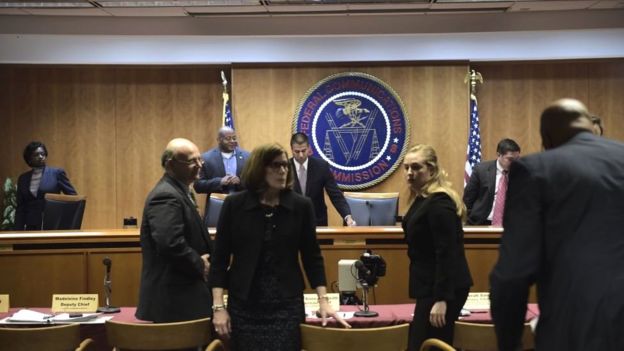
The FCC's chairman, Ajit Pai, argues the changes will foster innovation and encourage ISPs to invest in faster connections for people living in rural areas.
He refers to the change as "restoring internet freedom".
Technically, the vote was to reclassify broadband internet as an information service rather than telecommunications.
The consequence of this is that the FCC will no longer directly regulate ISPs.
Instead, jurisdiction will pass to another regulator, the Federal Trade Commission (FTC). Its key responsibility will be to check that the companies disclose if they block data, throttle it or offer to prioritise traffic, rather than stopping such behaviour.
One criticism of this is that US consumers often have few if any ISPs to choose between. Moreover, opponents of the change claim it could take years to address any misbehaviour.
"I dissent to this legally-lightweight, consumer-harming, corporate-enabling, destroying-internet freedom order," said Democrat commissioner Mignon Clyburn ahead of the vote.
But fellow commissioner Mr O'Rielly, a Republican, said fears over the end of net neutrality were a "scary bedtime story for the children of telecom geeks".
Latest Stories
-
Germany’s far-right AfD set for big win in eastern state, just short of majority
12 minutes -
Catholic Bishops urge Chief Justice to avoid remarks that could raise doubts about impartiality
23 minutes -
Mrs Doris Emma Doryumu (Nee Dove)
32 minutes -
Illegal mining concessions easier to obtain than lawful ones in Ghana – Prof Frimpong-Boateng
49 minutes -
At least 5 dead after Amazon cargo plane barreled off runway at Miami airport
53 minutes -
Frimpong-Boateng proposes Environmental Restoration Fund funded by mineral royalties
57 minutes -
Corrupt individuals are worse than pathogens; their actions cause premature deaths – Prof Frimpong-Boateng
1 hour -
No illegal mining operation will find refuge on Akyem Essase lands — Chief declares
1 hour -
Flight price rises due to ‘foolish leaders’ starting wars, Virgin’s Branson says
1 hour -
Consult traditional authorities before granting mining concessions on stool lands — Baffour Sikabede to gov’t
1 hour -
Why are European countries moving their gold out of North America?
1 hour -
Galamsey: Chiefs must not trade rivers for mining royalties – Baffour Sikabede
2 hours -
Jamaica to bring slavery reparations petition to King Charles
2 hours -
UEW holds Fourth Annual Colloquium on politics and Ghana’s environmental future
2 hours -
2026 U-20 WWC: Black Princesses fall to Ecuador in opening game
4 hours