

Audio By Carbonatix
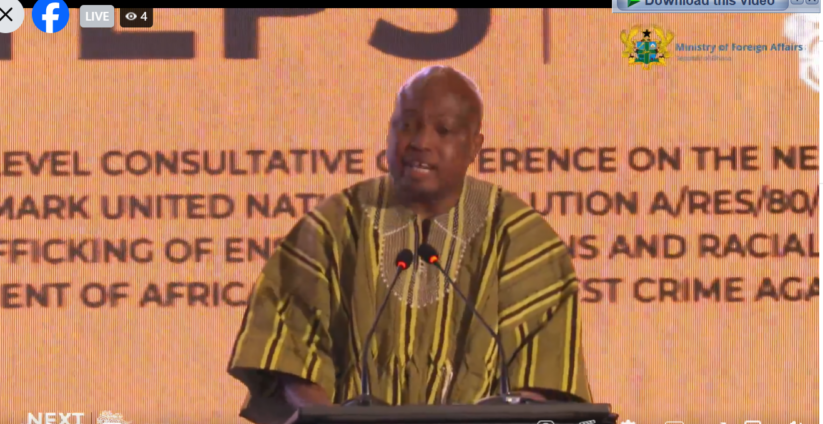
Foreign Affairs Minister Samuel Okudzeto Ablakwa says people who once dismissed Ghana’s United Nations resolution on the trans-Atlantic slave trade as merely an academic exercise is now being proven wrong, as reparatory justice gains global traction through apologies, acknowledgements and policy shifts.
Addressing heads of state, foreign ministers, scholars and members of the African diaspora, Mr Ablakwa said the issue of reparatory justice has moved beyond academic debate into firm global policy engagement.
He said that those who once dismissed the UN resolution must now be “revising their notes.”
He noted that the UN resolution, which declared the trans-Atlantic slave trade and enslavement of Africans as the gravest crime against humanity, has helped elevate the issue onto the international agenda.
According to him, developments since the adoption of the resolution show that skeptics who dismissed it as an “academic exercise” are now having to reconsider their position.
“The reports for these conversations demonstrate that reparatory justice is no longer a peripheral issue.
It is now firmly established as a legitimate global concern that demands serious engagement and thoughtful solutions,” he said.
Mr. Ablakwa pointed to a series of recent apologies and acknowledgements from global institutions as evidence of growing momentum.
“We have all heard the apology from Pope Leo XIV, the head of the Catholic fraternity, apologising for the role of the Catholic Church and the papal bulls that offered theological doctrinal justification for slavery,” he stated.
He added that Ghana, together with its global coalition led by President John Dramani Mahama, has accepted these apologies as part of wider reconciliation efforts.
“We have warmly accepted the apology,” he said.
Mr Ablakwa also referenced a similar apology from the leadership of the Church of Scotland over its historical role in slavery.
He further highlighted remarks by French President Emmanuel Macron, who has called for France to confront its colonial past and is expected to address the Accra conference.
“He has also led France to take steps to confront its colonial past, including moves to repeal the Code Noir—that deeply dehumanising set of laws which treated Africans as commodities,” he noted.
He also said Code Noir does not exist anymore.
Mr Ablakwa concluded that these developments confirm that reparatory justice can no longer be treated as an academic exercise, but as a serious global agenda shaping international discourse and policy.
Latest Stories
-
Amin Adam calls for review of fuel taxes as diesel prices remain above GH¢18
9 minutes -
World Vision Ghana, Ahafo districts sign MoU for universal WASH coverage
38 minutes -
When the gold engine stutters: What Ghana’s Cedi and reserves are telling us about the new economic architecture
56 minutes -
Two reportedly die after being trapped in mining pit at Juaboso
1 hour -
Petrosol cleans up Wa Municipal Hospital, to donate medical equipment
1 hour -
KiDi brings the hits to London in sold-out UK headline concert
2 hours -
The last goodbye of Ghanaian shot dead in the US
2 hours -
MCC opens door to Ghana again as MiDA revives development partnership
2 hours -
CSIR moves to turn scientific research into jobs, national growth
2 hours -
More patrons troop in as 3rd Republic Bank-JoyNews Habitat Fair clinic enters final day stretch
2 hours -
‘If NPP was ‘insensitive’ over fuel prices, NDC must accept same description now’ — Amin Adam
2 hours -
German, Russian foreign ministers hold rare talks amid rising tensions
2 hours -
Gov’t to develop policy for Ghanaian Sign Language in education
3 hours -
Accra Academy defend ODADEƐ ’90 5-a-side title
3 hours -
Ghana risks EU gas market access over methane emissions – Expert warns
3 hours