


Audio By Carbonatix
Sarfoa, a mother in Abiriw, a town in the Eastern Region of Ghana, always wakes before first light to begin her daily routine. The first order of the day is to send her son to the community borehole to fetch water for their household. Most days, she says, he leaves home at 4:30 am to run this errand before leaving for school in Akropong, about an hour's walk away. Long queues at the borehole were common, and as a result, her son often arrived late for school, and her business often opened late. In communities like Abiriw, the search for water has always taken its fair share of the day.
It is a quiet arithmetic that governs communities without a reliable water supply. Every errand, every emergency and every plan is made with the knowledge that a water queue can rearrange an already strained schedule. For these communities, this is simply how life runs.
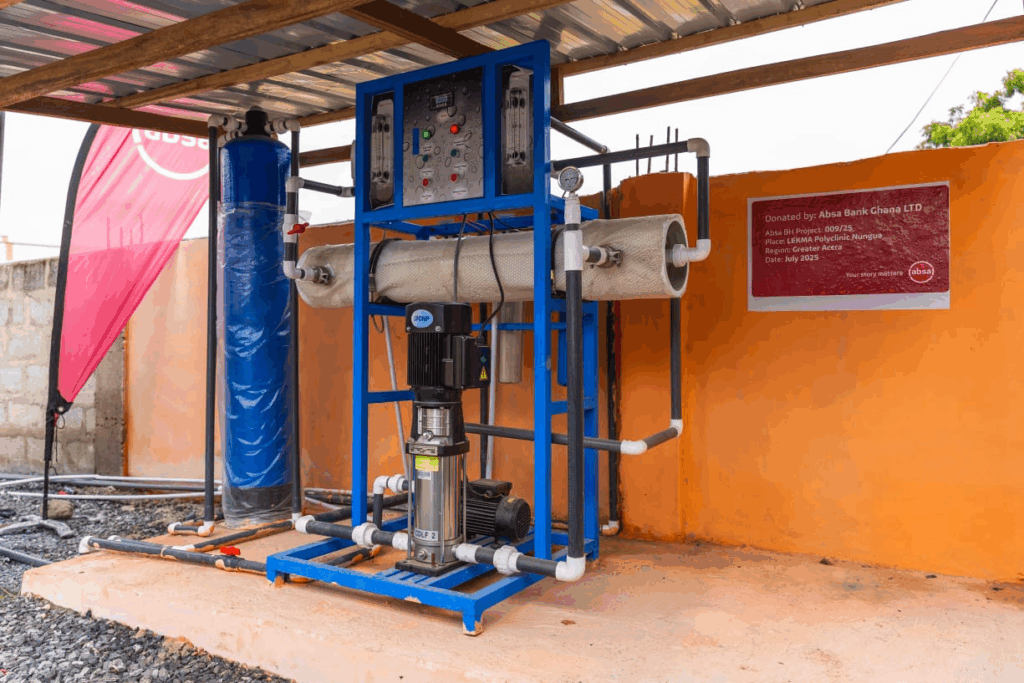
This year, the routine has changed for Abiriw and many such communities, thanks to Absa Bank Ghana LTD’s Water for Life project, which has delivered 21 boreholes as of August 2025. The project has impacted an estimated 37,000 people in 11 regions. Its impact, however, is not only in the numbers: long errands are now quick stops; businesses open earlier; and children get to school on time more often.
The Water for Life initiative is Absa Bank Ghana LTD’s practical response to communities that lack potable water. The project sits under the Social Impact Response Pillar of the bank’s Force for Good agenda and aims to provide clean, reliable water where it is needed most. Each site is chosen based on need, which is why a clinic in coastal Accra and a settlement outside Sunyani can both sit on the same work plan.
Ghana has extended water infrastructure over the years and continues to do so. The scale of need, however, means partnership matters. Progress is faster when public authorities, private organisations and communities pull in the same direction. That is the spirit in which the Water for Life initiative operates: institutions doing what they can together, so that families do not have to keep paying for a basic necessity with their time and their health.
In Abiriw, the change is already visible. Kwadjo Darko, known by his neighbours as Dokono Wura Ba (the kenkey seller’s son), recalls times when he needed to pay people to fetch the water he needed to run his business. The municipal pipes did not flow, and the whole community relied on a single water source. Children often had to dash across the main road to reach the only working water point, which exposed them to moving vehicles. Many households woke at 3:30 am to get ahead, or bought water at about GHS 3.00 per gallon, sometimes as much as ten gallons a day. With the new borehole nearby, he says, his business costs have fallen, and he has regained the time he used to waste.
At the LEKMA Polyclinic in Nungua, the problem was not distance but chemistry. Due to the area’s coastal location, groundwater in Nungua tends to be saline, making conventional boreholes unsuitable for drinking and clinical use. The project, in addition to drilling a borehole, installed a reverse osmosis system to remove salts and other impurities, ensuring a steady flow of clean, safe water for the polyclinic and the surrounding community.
“This intervention ensures a consistent water supply, supports sterile medical environments, and saves the clinic the cost of purchasing water. It is a blessing to our patients and staff,” noted Dr William Frimpong, Medical Superintendent, LEKMA Polyclinic.
Leaders in the area welcomed the decision to site the plant at a health facility. “Water is life, and by choosing to enter Krowor with the gift of water, Absa has entered the heart of our community, where life is created and preserved. This partnership means a lot to us, and today you have shown that our story matters,” said Dr Agnes Naa Momo Lartey, the Member of Parliament for Krowor.
The most obvious gain in both places is time. When a safe source sits within reach, the day begins earlier and with fewer trade-offs. In many communities, the impact is seen in regularised school attendance, activities done with less stress, and in small enterprises that open on time. Health outcomes shift, too. At a facility like LEKMA, water reliability underpins sterile practice, infection control and predictable work schedules. When the basics are settled, clinical staff can plan with confidence.
There is also an economic thread running through these stories. Money once set aside for water or transport can be directed elsewhere, shops and kiosks keep regular hours, and parents arrive at work on time. None of these changes is dramatic on its own, but taken together, they make households and communities more stable and productive.
“Water for Life is built on partnership. Our role is to help close those gaps with practical solutions, selected based on need, and sustained with local ownership,” explained Priscilla Yeboah, Head of Citizenship at Absa Bank Ghana LTD.
In Abiriw, residents like Sarfoa and Kwadjo Darko still start their day early. The difference is a choice that did not exist before. It is a reminder that progress is not always dramatic; often it is felt in everyday life, working as it should.
Latest Stories
-
T-bills auction: Government exceeds target marginally; yield on 91-day bill remains unchanged
3 hours -
GPL 2026/27: 10-man Aduana hand Kotoko defeat in Kumasi
3 hours -
GPL 2026/27: Medeama ease past Basake Holy Stars
4 hours -
Appiah Adomako writes: Why DVLA must stop treating every expired licence holder as delinquent
4 hours -
Localization must transfer decision-making power, not just project responsibilities
4 hours -
Modernising Ghana’s traditional markets through the 24-Hour Economy markets initiative
4 hours -
New economy will boost local production and create jobs – Finance Minister
4 hours -
Real-Time VAT on cross-border digital services – not a new tax and does not violate double taxation principle
5 hours -
Digitalisation, AI key to Ghana’s tourism transformation – GHATOF
5 hours -
Stronger GTA-private sector partnership needed to grow tourism – GHATOF
5 hours -
Amazon eyes Ghana for broadband expansion after talks with Mahama
6 hours -
National Investment Quiz 2026: Six schools qualify for quarter-finals
6 hours -
‘Do not let Russia pay for its madness with lives of your people’ – Zelensky to Ghana, 46 other countries
6 hours -
6,079 promotion cases fully processed and paid – CAGD says amid nationwide teachers’ strike
7 hours -
Teacher unions to meet government Monday over nationwide strike
7 hours