


Audio By Carbonatix
Member of Parliament for Abuakwa South, Dr. Kingsley Agyemang, has called on African lawmakers to take bold legislative steps to close the continent’s widening healthcare gap and make access to quality health services a fundamental right for every citizen.
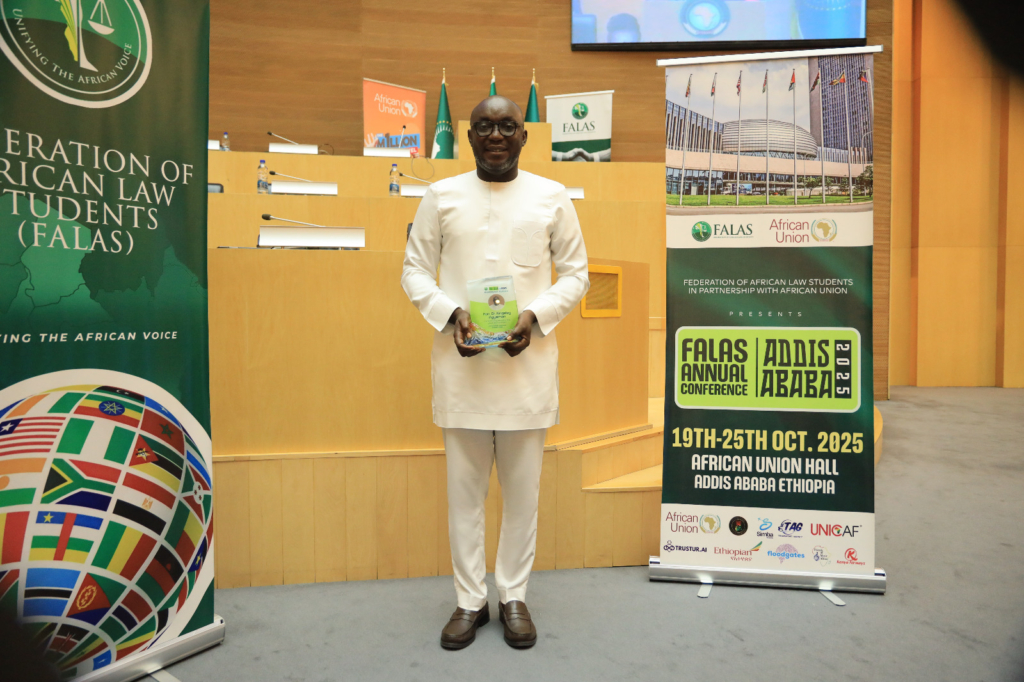
Delivering the keynote address at the 5th Annual Federation of African Law Students (FALAS) Continental Conference at the African Union Headquarters in Addis Ababa, Ethiopia, Dr. Agyemang challenged African governments and parliaments to move “from policy declarations to binding legislation” that guarantees Universal Health Coverage (UHC) and upholds human dignity.
Held under the theme “Legislating for Health Justice: Advancing Universal Health Coverage in the Pan-African Context,” the conference drew legal scholars, law students, policymakers, and AU officials from across the continent.
Reflecting on his journey to Ethiopia, Dr. Agyemang shared how the view from above reminded him of Africa’s shared destiny — and its deep inequalities.
“As our Ethiopian Airlines flight soared from Accra, we crossed the skies above Togo, Benin, Nigeria, the Central African Republic, and South Sudan before descending over the rugged highlands of Ethiopia. Looking down, I saw one Africa — the same rivers, forests, and farmlands, the same vibrant communities and faces. We are one people, yet our realities are profoundly different.”
He compared Africa’s pursuit of health justice to “a continental flight,” explaining that while all countries may be on the same journey toward UHC, “our destinations and speeds often differ,” shaped by history, governance, and resource disparities.
According to Dr. Agyemang, true health justice must start with strong legislative intent, constitutional guarantees, and robust oversight.
“Health justice is the heartbeat of development. It calls for a legal order where access to quality health care is not a privilege for the few but a right guaranteed to every citizen,” he said. “To legislate for health justice is to legislate for human dignity.”
Citing Ghana’s National Health Insurance Scheme (NHIS) as an example, he described it as a landmark in expanding access to healthcare, but warned that reform must be continuous and data-driven.
“Ghana’s National Health Insurance Act was a pioneering step toward equity in access. But legislative action is not a single event. It must be a living process — informed by evidence, revised financing, and stakeholder participation.”
He emphasized the importance of parliamentary oversight and coherence across fragmented health laws, saying:
“Oversight is the conscience of democracy. It ensures that ministries deliver, budgets are properly applied, and citizens’ voices are heard. When exercised with diligence, such oversight becomes an instrument of justice for the voiceless.”
To humanize his call, Dr. Agyemang shared a personal story from his constituency.
“A few years ago, I met a young mother who had walked more than six kilometres to reach a health centre, only to find that the nurse on duty had no delivery kit. She wrapped her newborn in her own scarf and whispered that she was grateful her child had survived. That single encounter taught me that legislation must not only allocate funds; it must protect dignity.”
He said similar experiences are common across Africa — from health workers in Malawi wading through floodwaters to deliver vaccines, to mobile clinics in Kenya powered by solar energy, and midwives in South Sudan turning their pain into advocacy.
“These are not acts of charity; they are acts of justice in motion. They remind us that the pursuit of Universal Health Coverage is ultimately a pursuit of equity and empathy.”
Calling for Pan-African cooperation, Dr. Agyemang urged AU member states to build resilient, interconnected health systems.
“Disease, like poverty, knows no borders. A child’s cough in Lagos, a cholera outbreak in Harare, or a malaria surge in Kisangani can ripple through the continent if we do not stand together,” he warned. “If we can integrate our skies through the African Continental Free Trade Area, surely we can integrate our health systems.”
He highlighted the African Medicines Agency and Africa Centres for Disease Control and Prevention (Africa CDC) as examples of how collaboration can enhance safety and trust across borders.
“The safety of a medicine approved in Nairobi should be trusted in Accra or Addis Ababa.”
Dr. Agyemang also praised Ethiopia for its leadership in health diplomacy, describing it as “a model of how shared responsibility can become a national ethos.”
Addressing the young law students, he urged them to view the law as a tool for justice and inclusion.
“Every argument you present in court, every brief you write, and every policy recommendation you make can bring health closer to the people who need it most,” he said. “Health justice must not be an abstract principle debated in parliaments; it must be a lived experience that touches the heart of every African home.”
He ended with a stirring call to unity and action. “The future of health justice in Africa will not be written by chance. It will be written by those who stand for equity, compassion, and action. Let us legislate, innovate, and collaborate to create a continent where every citizen enjoys the right to health, the freedom to thrive, and the promise of justice.”
Participants at the conference hailed Dr. Agyemang’s keynote as one of the most powerful contributions to the ongoing debate on health law and governance in Africa — describing it as a “wake-up call” for lawmakers to move from policy rhetoric to practical reform and treat health as both a moral and legal imperative.
Latest Stories
-
Power restoration fault suspected in Kumasi Central Market fire
2 hours -
The 7-foot giant of Ngleshie Amanfro: Seven-foot Ghanaian Ephraim Saawa dreams of joining the national basketball team
3 hours -
Government promises support for Kumasi Central Market fire victims
3 hours -
Vibes The Movie: Big Ghun’s Ghanaian film earns five nominations at 2026 REFFA
3 hours -
MamaCare CEO warns unresolved conflicts among health workers could undermine maternal and neonatal care
4 hours -
Health professionals urged to translate medical knowledge into practice to save mothers
4 hours -
Conflicts among care providers linked to maternal, neonatal deaths – Expert
5 hours -
GIS marks 10th TIME conference, champions improved teaching practices
5 hours -
BRICS Or Balance? What Ghana’s bid really means
6 hours -
GPRTU wants full TRAFFITECH-GH implementation to start in 2027
6 hours -
Mahama announces plans to import electric wheelchairs for PWDs
6 hours -
KGL U17 Colts 2026: Western beat Prempeh Elite Academy to set up final final with Greater Accra Region
7 hours -
Late Solanke strike salvages 10-man Spurs draw at Man United
7 hours -
Gender Ministry to monitor welfare of Nana Akua Addo’s children amid domestic violence case
7 hours -
Benedict Okyere Yeboah: Ghana’s football problem goes beyond sacking a coach
7 hours