

Audio By Carbonatix
An apple reflected on a lamp. A clock where time seemed to have frozen. Nurses dressed more like astronauts on Mars.
Irene Pressner keeps “flashes” of her experience after contracting the coronavirus. The conceptual artist and photographer from Venezuela was close to death in New York City.
After suffering severe pain and fainting a few times, she was finally admitted to a hospital. A few days after her hospitalization, her husband was also admitted. Only she survived.
Now in recovery and mourning, the artist continues experimenting to see how the virus changes her art. But in her case she knows it won’t be dark: “My works have light, but now will also have the burden of what I lived.”
Affected by the pandemic, many visual artists are taking refuge in their work in search of sense and solace. Some have suffered the horror, the sickness and the loss firsthand. Others, are channeling their anguish and their fear, their feelings of loneliness.
Pressner has tried to make some sense of the whole thing. Art, like many other times in her life, is helping her to heal. First she took on photography.
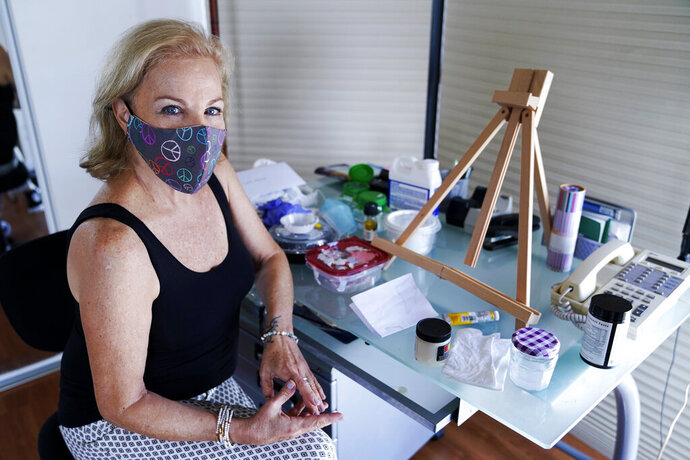
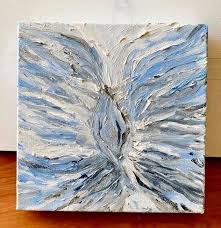
Then came painting, with subjects including an apple reflected on a lamp of her apartment — the first thing she saw when she opened her eyes once after fainting. More recently she created a series of angels in tribute to those “angels of flesh and bone” who came to support her.
Pressner said the art she is making now may not be representative of her career, but it's what is coming out in this period of self-discovery.
She notes a series of photographs she did shortly before she got sick, “We Are Not Islands,” gained new meaning during her isolation.
“The other works are transitional, like I have not found myself yet,” said the artist, who has been recognized in her home country and the U.S., including at the Museum of Latin American Art in Long Beach, California, where her award-winning “Felix” is part of the permanent collection.
In Brooklyn, photographer Lara Alcántara dealt with the anxiety of having her husband on the front lines as an anesthesiologist — while taking care of her house and her two daughters, 12 and 7 — creating a fantasy world in images she publishes almost daily on her Instagram account.
They are carefully staged self-portraits. Some reflect her fatigue humorously: She appears stuck in a washing machine, ironing her head or buried in a pile of toys.
Others show her passion for fashion — in one image she hangs from a hanger between the clothes in her closet — or art and literature, with nods to the “Girl with a Pearl Earring,” “The Last Supper” and “The Little Prince.”
“Photography has usually been the way that I express any distress, anything that is going on in my life, and I think that now it was extra important for me to go out to this creative world that I invented,” said Alcántara, a Venezuelan in New York who also works in public relations and as an actor.
“The escape of photography was completely necessary,” she emphasized, noting that the news, and the stories that her husband would bring home overwhelmed her.
Lately she has taken her art outdoors. In an composition created at the beginning of August at a beach in Florida, four different images of her surround some sort of grave made out of seaweed. The title is “The Rebirth of the Artist Within.”
“I feel that many people realized that time is very valuable, but that we don't always use it to achieve our happiness. I feel that I found myself in this process and I hope to have inspired others do the same,” she said.
Not far from her house in Brooklyn, Brazilian painter Flávia Berindoague was having a productive period as well, albeit more lonely. The artist, who teaches in public schools, suffered from anxiety the first week in quarantine and soon realized she had to rethink her relationship with her space. “Suddenly this place became my working space and I needed to refigure it and find a new way to enjoy it,” said Berindoague.
Her first works were drawings with repetitive strokes in which she imagined herself writing letters to her loved ones. They were “very anxious drawings, automatic drawings” that she called “Taciturn Writings.”
With more time on her hands, she also resumed painting, creating abstract pieces in acrylic over canvas that resembled maps, using only dots and lines.
Among other pieces she created is a series titled “Geographical Distancing,” representing the impossibility of being close to her family at the moment in Belo Horizonte, Brazil, where she was born. She also made a “Blood Map,” inspired in the death of George Floyd.
The concept of the work is similar to what she had been doing before. "But the way I was applying it was more based on personal experience,” she explained.
“Previously I was more interested in the collective memory of events happening in the world and mostly in Brazil. After Covid, I was more focused on myself, in how I was dealing with the experience.”
Peruvian artist Fernando Otero not only has seen his production pick up but also his sales, something he attributes to the new relationship with space.
“There has been a reappreciation of the domestic space,” he said from Lima, Peru. Art lovers want “this lock-up to stop being a lock-up and be a pleasant cohabitation or domestic experience” with “an object to accompany them, to talk to them a little.”
While before the pandemic Otero, a multidisciplinary artist, was going through a period dedicated to abstract symbols or geometric painting, the works that flourished during his confinement have been much more specific: A coffee pot. A balloon. Objects that surround us.
“Curiously, the objects that I am painting now are containers. After us being so contained and for so long, they are all black containers,” said Otero.
Latest Stories
-
Badminton: Ghana wins bronze, two silver medals at All Africa U-19 Champs
16 seconds -
Black Star Experience announces national choral music contest to discover new Ghanaian talent
11 minutes -
Melcom serves 1,000 meals to children in selected orphanage homes
12 minutes -
Miracles Aboagye questions Mustapha Gbande’s authority to direct EOCO arrest of Manhyia South MP
13 minutes -
My music is a true reflection of who I am – Nigerian singer Ladé
13 minutes -
Activa International Insurance Ghana reinforces culture of compliance and customer protection
20 minutes -
Mining must prove its impact, not just publicise it — Chamber of Mines
29 minutes -
NDC disqualifies Dzifa Gunu from La Dadekotopon contest
36 minutes -
Togbe Afede XIV opposes proposed 5-year presidential term
39 minutes -
World Vision targets 90 percent universal WASH access in Asunafo North, Asutifi North
57 minutes -
I told EOCO to arrest Manhyia South MP – Mustapha Gbande
1 hour -
2028 election will be a combination of strategy and ‘buga’ – Miracles Aboagye
1 hour -
Bombs preventing rescue of kidnapped youths, Nigerian police say
1 hour -
Flydubai co-pilot planned to crash plane into Tel Aviv airport or building, reports say
1 hour -
National security must be built beyond Accra – Muntaka
1 hour