


Audio By Carbonatix
Nutrition Lead at AGRA Bertha Mkandawire says Africa needs scalable solutions to deal with malnutrition on the continent.
Scalable solutions in agriculture are innovations or technologies that can be effectively and easily expanded and adapted to increase productivity, efficiency, and sustainability across varying farm sizes and conditions.
She says about 52% of the population on the continent cannot afford a healthy diet and only 6 African countries are likely to meet targets set by governments to improve nutrition by 2025.
She is urging the global community to support ongoing works on the continent to improve nutrition.
“Let’s advance more scalable solutions. What Africa needs now are solutions that are scalable to address the stunting rates that are still quite very high among many African countries,” Mkandawire said.
Speaking at a side event at the ongoing 29th United Nations Climate Change Conference (COP29) in Baku, Azerbaijan, she said due to the importance of nutrition, it has become a big part of AGRA’s work and they are open to working with partners to roll out a nutrition strategy across the continent.
“We realized that on the African continent, many people depend on primary staples; maize, wheat, and rice, as their primary source of calories.
"These crops are facing low productivity because of climate change, and that becomes a very big challenge,” she said.
“We at AGRA are emphasising soil health because improved soil leads to improved nutrients in the crops we are growing,” she added.
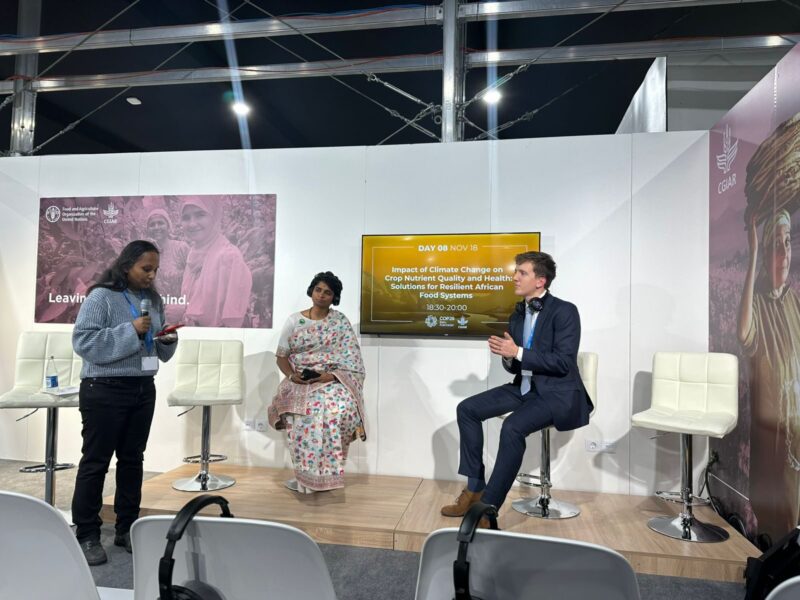
The side event was on the topic; “Impact of Climate Change on Crop Nutrient Quality and Health: Solutions for Resilient African Food Systems.”
It explored the impact of climate change, particularly rising atmospheric carbon dioxide and extreme weather events, on food supply and the nutrient quality of key staple crops.
It highlighted how these challenges heighten malnutrition risks, especially in vulnerable populations, and discussed innovative technologies and resilient food production systems to safeguard food security and improve nutritional outcomes.
Vice President of Global Programs at Farm Journal Foundation Rose Barbuto observed over 3 billion people cannot afford a healthy diet across the world.
She said poor diet is responsible for one-fifth of the mortality rate in the world but higher in low-income countries.
Between 76 to 85% of the population in the developing world cannot afford healthy balanced diets, a situation she said climate change was partly responsible for.
“Beyond traditional yield measures, increased carbon in the atmosphere contributes to the reduction of protein and minerals in plants while increasing the production of sugars and starches due to changing balances in nitrogen and phosphorous levels.
"Elevated carbon dioxide has been shown to decrease protein concentrations in wheat, barley, rice, and potato by 10 to 15%,” she disclosed.
Oliver Camp, Environment and Food Systems Advocacy Advisor of the Global Alliance for Improved Nutrition (GAIN) observed climate change is making micronutrients, in particular, less available to the populace.
“We know that when there is a higher concentration of carbon dioxide in the atmosphere, you see a reduction in really critical micronutrients in crops. You see a reduction in iron and zinc in wheat.
"So, if you're getting 70% of your calories from wheat and then that is having its nutrient content reduced, then you can see how that will affect nutrient outcomes,” he said.
Praveena Sridhar, Chief Science and Technology Officer of the Save Soil movement called for practices that will help replenish soil nutrition.
She urged farmers to practice no-till, intercropping, and sustainable soil management practices or regenerative agriculture.
Latest Stories
-
BRICS Or Balance? What Ghana’s bid really means
12 minutes -
GPRTU wants full TRAFFITECH-GH implementation to start in 2027
31 minutes -
Mahama announces plans to import electric wheelchairs for PWDs
35 minutes -
KGL U17 Colts 2026: Western beat Prempeh Elite Academy to set up final final with Greater Accra Region
54 minutes -
Late Solanke strike salvages 10-man Spurs draw at Man United
1 hour -
Gender Ministry to monitor welfare of Nana Akua Addo’s children amid domestic violence case
1 hour -
Benedict Okyere Yeboah: Ghana’s football problem goes beyond sacking a coach
1 hour -
GPL 2026/27: Darkwah Wiafe’s winner sees All Blacks beat Kotoko
1 hour -
ITF World Tour : Patel Wins Boys’ Singles Final at J100 Accra
2 hours -
Ghana must pursue BRICS partnership if it brings economic benefits – Kpebu
2 hours -
Success and Wright Claims J100 Accra Girls’ Doubles Championship
2 hours -
ITF J100: America’s Wright wins J100 Accra Girls’ Singles Title
2 hours -
Expedition hopes to find aviator Amelia Earhart’s plane on remote island
2 hours -
US seeks changes to rejected $109m health compact with Ghana – Mahama
2 hours -
Nine dead in mass shooting at Pennsylvania home
3 hours