

Audio By Carbonatix
Fresh data from the Bank of Ghana, tracked by JoyNews Research, show a sharp deterioration in Ghana’s oil export earnings in 2025.
By the end of October, oil exports stood at $2.2 billion, compared with $3.3 billion over the same period in 2024. That represents a decline of $1.12 billion.
The decline reflects a combination of weaker international oil prices and falling domestic production.
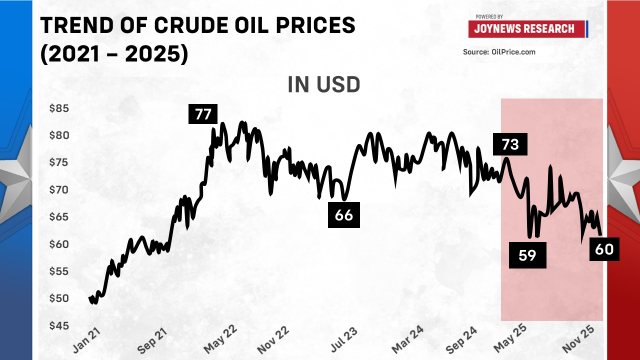
Oil entered 2025 trading slightly above $70 per barrel but prices have steadily declined since then, touching lows of about $59 and currently hovering around $60 per barrel.
This is well below the $70 to $80 range that prevailed through much of 2023 and 2024. The data suggest that average oil prices in 2025 are the lowest since the latter part of 2021, a trend that has weighed heavily on oil producing countries such as Ghana.
For Ghana, however, price weakness tells only part of the story. The revenue shortfall has been compounded by falling production volumes.
While some oil producers are able to cushion lower prices with higher output, Ghana’s production has been moving in the opposite direction.
After peaking in 2019 at 71.4 million barrels, output has declined every year since.
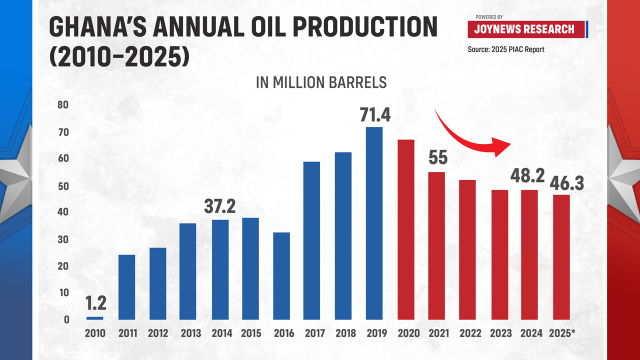
In 2024, Ghana produced about 48 million barrels. The Public Interest and Accountability Committee estimates production of 46.3 million barrels for 2025, although that projection already appears optimistic.
In 2019, the Ministry of Finance had set a target of 500,000 barrels per day by 2024. In 2025, actual production stands at about 126,994 barrels per day, far below that ambition.
The slowdown is evident in recent production data. In the first half of 2025, Ghana produced 18.4 million barrels, compared with 24.8 million barrels over the same period in 2024. That represents a decline of 25.8%.
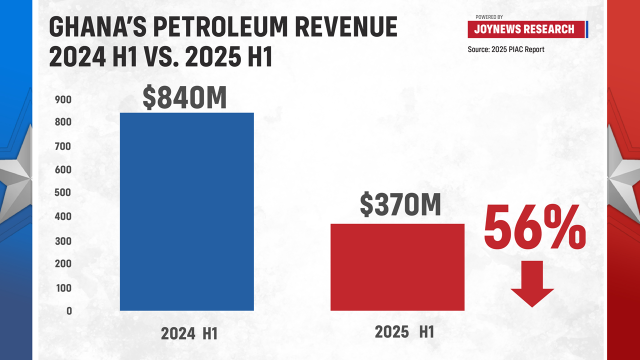
Government revenues have fallen even faster. Oil receipts dropped by 56%, from $840 million in the first half of 2024 to $370 million in the first half of 2025.
While export earnings have weakened, Ghana’s oil import bill has risen. Imports of refined petroleum products increased by about $500 million over the first ten months of 2025 compared with the same period in 2024.
This translates into monthly petroleum imports of roughly $430 million, up from about $390 million per month last year. The combination of falling export revenues and rising import costs has widened pressure on the balance of payments and increased demand for foreign exchange.
Behind these trends lie structural weaknesses in Ghana’s petroleum sector.
Policy missteps in the upstream industry and the lack of new petroleum agreements have made the sector less attractive to investors.
With no new wells coming on stream, production continues to decline, eroding government revenue and increasing reliance on imported petroleum products.
The growing domestic demand for refined petroleum strengthens the case for scaling up local refining capacity to meet domestic consumption and reduce the import bill.
Cutting petroleum imports, which now average about $400 million a month, would significantly ease pressure on the cedi and lower Ghana’s exposure to external shocks.
The Ghana Petroleum Hub Corporation aims to address this gap by positioning the country as a regional supplier of refined petroleum products, but progress will depend on sustained policy clarity and investment.
Without decisive action, Ghana risks remaining caught between declining oil production, weaker export earnings and rising import costs.
Restoring momentum will require renewed confidence in the upstream sector alongside faster progress in domestic refining.
Until then, oil will remain a growing vulnerability rather than a stabilising force for the economy.
Latest Stories
-
UG Vice-Chancellor urges swift operationalisation of National Research Fund
11 minutes -
Pope Leo to have surgery after lump found in lung
18 minutes -
Joseph Cudjoe writes: Ghana must break free from the dangerous mindset that natural resources are the foundation for wealth
41 minutes -
Children among 109 dead after boat capsizes off Djibouti, UN says
45 minutes -
OmniBSIC Bank’s 11th health walk promotes fitness and business growth
55 minutes -
2026 World Maritime Day: Danish Embassy organises “The Gulf of Guinea Speaks”
1 hour -
New Economy will tackle unemployment and restore hope – Ato Forson
1 hour -
IMMILAC president recounts personal losses as security women lead breast cancer awareness campaign in Wa
1 hour -
University of Ghana postpones October 12 reopening as GAUA strike persists
2 hours -
Bahass Foundation launches vocational skills training to support mental health recovery in Wa
2 hours -
NPP orders parliamentary aspirants and their supporters to suspend campaign activities
3 hours -
Techiman unites against child marriage: Joy Impact Makers Awardee leads charge on International Day of the Girl Child
3 hours -
Ghana Psychological Association calls for greater involvement of people with lived experience in mental health care
4 hours -
Ablakwa says Ghana could evacuate more citizens from South Africa if the situation worsens
5 hours -
Violence against girls must be tackled through individual responsibility – Gender advocate
5 hours