

Audio By Carbonatix
The mind of the poet often orbits around the earth, gathering particles of words into the subconscious mind and when it has finally rested, unpack them; a mixture of good and bad words, and like a farmer separating the harvested wheat from the chaff, combs through the mind and once convinced about the appropriate words, put them forward as art.
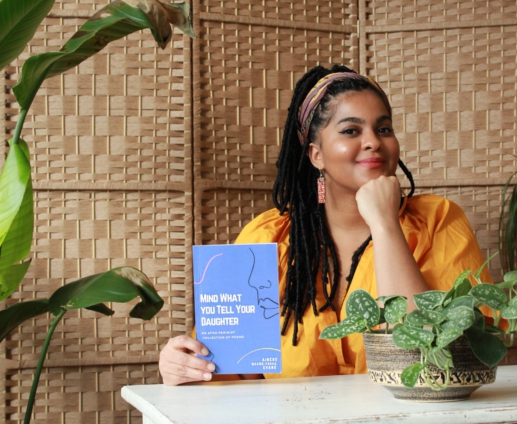
That is how the book “Mind What You Tell Your Daughter... An afro feminist collection of poems” was birthed.
At the height of the pandemic when the government put restrictions on human movements in order to contain the spread of the virus, Aincre Maame-Fosua Evans, confined within her house, allowed her mind to rummage through fields, gathering childhood memories and that of present-day humanity struggles, and moulded them into words in the hope that the unpleasant experiences many women go through from the hands of society, may spark a conversation that will result in systems that protect their dignity and respect.
“Writing this first collection of poetry has been a deeply disruptive, mindful and restorative process,” she writes. The book, she again writes, “is a collection that puts on trial the difficult and contentious claim, that what we teach and tell our daughters is for their own protection.”
“We not only accommodate violence through these lessons, but we soak children and burn them in it,” she adds.
The 52-page book is slashed into three parts, and each part recounts existing experiences embedded in a system skewed to the disadvantage of women. It is important to say that, the book has not been set to attack the patriarch, but more of an invitation for parents (adults) to reflect on the impact their words may have on their daughters (children).
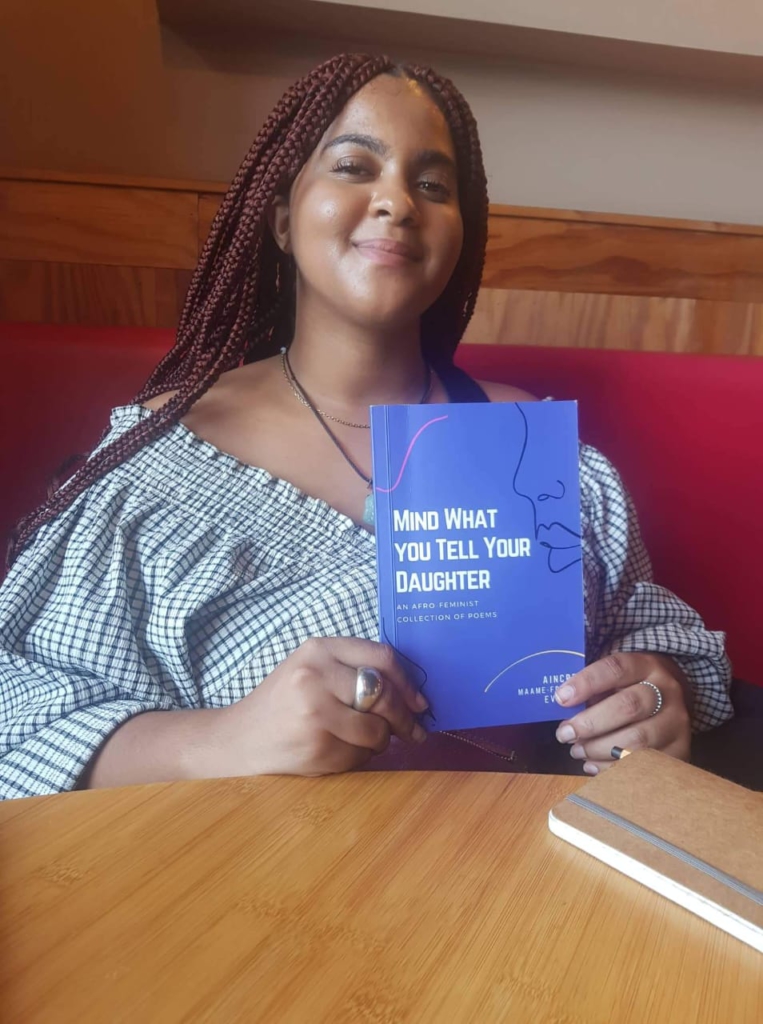
Aincre Maame-Fosua Evans was born in London to a Ghanaian mother and Welsh father. She is a writer, academic and currently a Senior Research Assistant to the Kwame Nkrumah Chair at the Institue of African Studies, University of Ghana, Legon.
Our conversation took place inside a rather noisy coffee café. The place is usually quiet with customers speaking with a bit of sensitivity to the presence of others. However, on this afternoon, a customer, perhaps unaware of the level her voice could reach, boomed into an iPhone 13. She was mostly using earpieces so I had to conclude the person on the other end was struggling to hear whatever was being communicated to him or her.
Therefore, we had to raise our voices to an appreciate decibel to properly hear each other. Aincre comes across as a very reserved person, but she is very articulate, concise and matured in articulating her ideas. She does not speak in bits and parts; she speaks with clarity and with a good dose of humility. Adjusting her long braids which had spread onto her shoulders, she gently used both hands to push them back, placed her right hand on the coffee cup and recounted her childhood memories growing up in Ghana under the watchful eyes of her grandmother, whose age began to succumb to ill health.
In the poem “Spinach and Cassava,” Aincre recounts her time with the grandmother, snaking through the garden, picking fruits and vegetables. She talks about her grandmother’s strength now eaten away by dementia, forcing a space of silence between them, but filled with eye gestures and the squeezing of hands.
Imaa and I have walked twice around this garden
Passed the plantain leaves and pawpaw fruit;
Spinach leaves and cassava she had once knelt down to plant
Coconut trees she had tended to,
beaten me sore for climbing.
I cannot bring myself to speak to her,
she cannot reply.
But she clasps her fingers in my own
and grips me through the dementia.
Shakily we walk around,
and each time we pass the coconuts,
she smiles.
In “To Daughters Who Were asked for more,” Aincre confronts an entrenched system in certain societies where women's voices are silent, when it comes to decision making, even whatever decision may be about them. She questioned the relevance of such practice, because women have long been relegated to the fringes, and are only good for sex and childbearing.
It is understood that in the company of men
we set but do not sit at the table
We are there to retrieve
And we pray that what they ask for is water.
Aincre who was educated in Holland, Vietnam, Hong Kong and the United Kingdom, is already happy with the feedback the book has generated. She is confident readers will look at the book not necessarily as an instrument for the confrontation of disrupting the existing system, but that men and women can work together for a just society.
****
Anny Osabutey (PrampramFisherman) is an avid country traveller, broadcast journalist, writer, documentarian, amateur filmmaker/photographer and Co-founder of the Prampram Tourism Centre. He tweets with the handle @annyosabutey
Latest Stories
-
Happy 76th Birthday to the Daily Graphic!
16 minutes -
Amin Adam celebrates Prof. Alhassan Musah on appointment as KAAF University Vice-Chancellor
23 minutes -
Mahama reaffirms commitment to Volta development at Asogli Te Za
34 minutes -
Bawumia urges NPP aspirants to accept results, reunite party after elections
40 minutes -
Double fibre cut disrupts Telecel services, 72,754 subscribers affected
55 minutes -
Bawumia demands probe into financiers behind Ghana-linked cocaine shipments
59 minutes -
Spain beat Czech Republic to maintain winning run
1 hour -
Ronaldo ‘greatest symbol’ of Portugal – Fernandes
1 hour -
NPP election: We thank NDC for making the attempt; we never expected them to show up – Karbo says after boycott
2 hours -
Tennessee prison chief to resign after Christa Pike’s failed execution
2 hours -
Free SHS suffering under NDC gov’t- Dr Bawumia
2 hours -
NSA cannot manage all Ghana’s sports facilities alone – Ampofo Ankrah
2 hours -
MoH announces mop-up recruitment for health professionals
2 hours -
Turn Saltpond history into economic opportunity – Stakeholders
2 hours -
Ampofo Ankrah opens up on ‘constant and unrelenting’ pressure at NSA
3 hours